
Reward design, incentive strategy, payouts, and commission structures.

By Kirsty Sharman

Short answer: match the shape of the reward to the shape of the revenue. When your money arrives over months rather than at a checkout, there are 4 structures real firms use: one payment when the client signs, a split payment across two moments, a percentage of the fee, or a percentage of revenue released only once the client has paid you. Most firms should start with a single payment at signature, and move to a split if the gap between the introduction and the signature runs past about two months.
Deciding when to pay a referral reward is easy when there is a checkout. Someone clicks a referral link, buys, and the reward fires. Plenty of businesses do not work that way. A consultancy wins a client over six weeks of conversations. An accounting firm takes on a client in March and invoices them for the next nine years. A software company runs a trial, then a procurement process, then a contract.
In all of those, the introduction and the money are months apart, and a reward built for a checkout does not fit. This post is about the shape of the reward itself: one payment or several, a flat amount or a percentage, and whether it releases at signature or after the client has paid. Which milestone counts as a conversion in the first place, and how you verify it in your CRM, is a different question, and we answered it in how to track referrals when there's no checkout.
Why the usual advice does not survive a long sales cycle
Most referral advice assumes the sale is one event. It tells you to reward the purchase, and that is the end of it. Most referral rewards advice is written for that shape of sale.
When the sale is a process, three things break.
The first is verification. You cannot pay on something you cannot confirm, and for a long sale the thing you can confirm early, an enquiry or a first call, is not worth paying for on its own.
The second is the referrer's patience. The person who made the introduction did their part in a single conversation. If nothing happens for four months, the program feels broken to them even though it is working exactly as designed.
The third is the gap between a sale and the cash. Revenue can arrive over several invoices or over months of work. A percentage reward paid at signature is a percentage of money you have not been paid yet.
How to pay a referral reward: the 4 structures firms actually use
We host consulting referral programs for accounting practices, tax firms, consultancies and other professional services businesses, and when we looked across them there was no single answer. There were four, running side by side right now.
| Structure | What the referrer gets | Best when |
|---|---|---|
| On signing | The referred person becomes a client | The sale is long but reliable once it closes |
| Split across 2 events | A small reward when the lead qualifies, a larger one when they sign | The sale takes months and referrers go quiet |
| A percentage of the fee | The client signs, and the reward is a share of the agreed fee | Deal sizes vary a lot |
| A percentage of revenue, after the money lands | The work is delivered and the client has paid | Work can be cancelled, or payment is not certain |
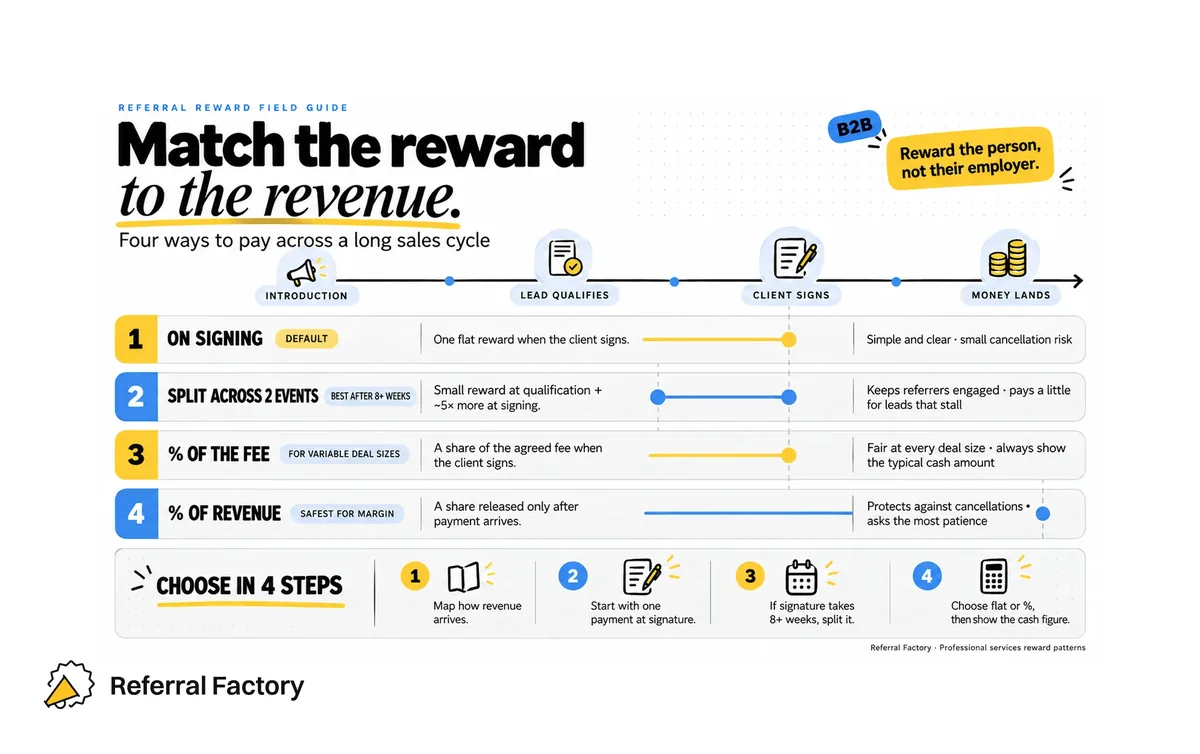
On signing is the most common by far, and it is the right default. It is also what most customer referral programs in professional services already do. One reward, released when the referred person signs a contract. It is simple to explain, simple to verify, and nobody argues about whether it has happened.
Splitting the reward across two moments is the one more firms should steal. One accounting software company we host pays a small amount when the referred lead qualifies, then roughly five times more when that lead becomes a customer. The ratio matters as much as the amounts. The first payment acknowledges the thing the referrer actually controls, which is making the introduction. The second pays for the outcome they do not control. If you reward the referred person too, the same logic applies on their side, which is the thinking behind a double sided referral program. In a business where the signature is months away, that first small payment is what keeps the referrer in the program.
A percentage of the fee suits firms whose work varies in size. A UK estate planning practice we host pays 5% commission, and tells its referrers that it works out at around £77 per client. That second half of the sentence is the part most firms leave out, and it is the difference between an offer people act on and an offer they have to do arithmetic on. We walk through the maths in calculating the value of a referral reward.
A percentage of revenue, released only once the money has landed, is the most cautious option and the rarest. A US business consulting firm we host pays 10% of its own revenue on the deal, but only after the file closes and the client's money has actually come in. It asks more patience of the referrer, and in exchange the firm never pays out on revenue it did not receive.
The mistake we see most: writing the offer before deciding the event
One firm we host describes its own reward trigger two different ways on two pages of the same campaign, "if they sign up" and "if they become a client of ours". Those are different events, sometimes months apart, inside one program. Nobody did anything careless. The copy was written before the decision was made, and the decision never quite got made.
The reward amount feels like the big decision, so it gets all the attention, and the trigger gets described in whatever words fit the sentence. Then a referrer introduces someone in May, sees them sign in September, and asks why they were not paid in May.
Write down what you are paying for, in one sentence, before you write a word of the offer. Then use that same sentence everywhere the program is described.
What each structure actually costs you
There is no benchmark here, and I would be careful of anyone who gives you one. No published research establishes a normal referral fee for professional services. What exists is what real firms do, and they disagree with each other. The same held in two other sectors we looked at closely, education referral rewards and financial services referral rewards.
Paying on signing costs you the risk that the work gets cancelled in week three. For most firms that risk is small enough to ignore, and the simplicity is worth more than the protection.
Splitting the reward costs you a small amount on leads that never convert. That is the price of keeping referrers engaged through a long sale, and the firms doing it treat it as a marketing cost rather than a leak.
A percentage costs you predictability. It scales with the value of the client, which is fair, but your referrer cannot picture it unless you tell them what it usually comes to.
Waiting for the money to land costs you enthusiasm. It is the safest option for your margin and the hardest one to sell to a busy partner who introduced someone six months ago. For a sense of what a well-run program can do at the other end of the scale, a regulated fintech we work with converts referrals 8x better than paid ads.
One more thing that applies whichever structure you pick. If the person referring you works at a client company rather than owning it, reward the person, not their employer. Credit against the company's invoice rewards a business that did nothing, and it never reaches the human who put their own name on the recommendation.
How to decide, in four steps
- Work out how your revenue actually arrives. One invoice at signature, several invoices over a year, or a payment that depends on an outcome. The reward should follow the same shape.
- Start with a single payment at signature. It is the simplest thing to explain and the easiest to budget for, and for most firms it is the right answer.
- Count the weeks between introduction and signature. If it is more than about eight, split the reward so the referrer gets something smaller when the lead qualifies and the rest when the client signs.
- Decide flat or percentage, then say what it comes to. If you go with a percentage, put the typical cash figure next to it in the same sentence.
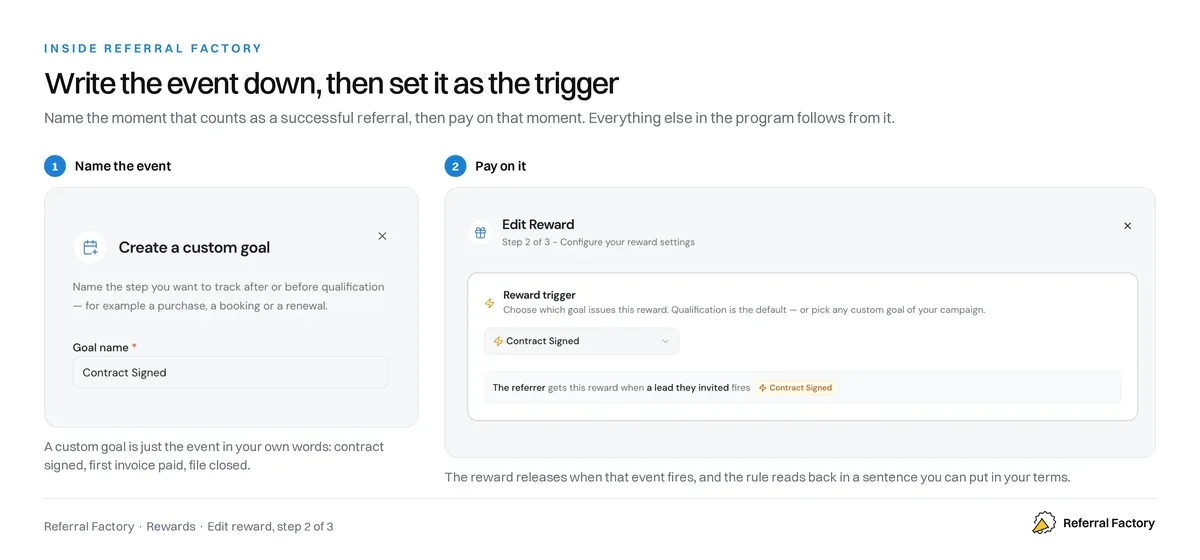
Once the structure is decided, the tracking part is mechanical. Referral tracking software records which client came from which referrer and releases the reward on the event you chose, so nobody is reconciling spreadsheets nine months later. If you want to see how firms handle the attribution side of this when there is no checkout to hang it on, we covered it in how to track referrals when there's no checkout. If you are still deciding whether to build this yourself, start with what is referral software.
FAQ
Should you split a referral reward when the sale takes months?
Split it once the gap between the introduction and the signature runs past about two months. One accounting software company we host pays a small amount when the lead qualifies and roughly five times more when that lead becomes a customer, which keeps the referrer engaged through the months in between. Below that, a single payment at signature is simpler and works fine.
Should a referral reward be a fixed amount or a percentage?
Both work. Fixed amounts are easier for referrers to picture and easier to budget. Percentages scale with the client's value, which suits firms whose deal sizes vary. One practice we host pays 5% and tells referrers it averages around £77 per client, which is the detail that makes a percentage usable.
What is a normal referral fee in professional services?
There isn't one. No published research sets a norm, and the programs we host range from a flat amount per client to 10% of revenue. Anyone quoting you a tidy range is repeating an opinion rather than data.
Can you pay a referral reward before the client pays you?
Yes, and most firms do, because paying at signature is simpler and keeps referrers engaged. Waiting until the money lands protects your margin and suits work that can be cancelled or that depends on an outcome, but it asks a lot more patience of the person who made the introduction.
Who should get the reward when the referrer works for a client company?
The individual who made the introduction, not their employer. A credit against the company's account rewards the business rather than the person who used their own reputation, and it tends to kill repeat referrals.
Referral link generator (free)
We take your website, send it to Referral Factory, and provision a real referral program for your brand. The link you get is a live referral URL your customers can share, backed by tracking and rewards in the app - not a static "generator" preview. This is the fastest way to see what a real referral program would look like for your brand! Try it below...