
Reward design, incentive strategy, payouts, and commission structures.

Most people setting up an education referral program agonise over what to give away and barely think about when to hand it over. That is backwards. Across the education programs we run at Referral Factory, the reward amount matters far less than the moment you pay it.
Get the timing right and you lift participation, protect your margin, and stop paying out on referrals that never really convert. Get it wrong and you either kill participation by making students wait too long for their reward, or pay out on referrals who never actually enrol. This post covers both halves: what to offer, and when it should pay out.
It is the rewards chapter of our complete guide to referral marketing for education providers, and the companion to the segment posts on schools, parents and training providers.
The reward amount is not where programs are won or lost
Looking across the education referral programs we run, the rewards range from around £5 to €500. That is a huge spread, and it tells you something useful: there is no single right amount. The right reward is whatever is meaningful to your students and affordable against what a new enrolment is worth to you.
What varies far more, and matters far more, is the payout trigger. Two programs offering the exact same reward can perform completely differently depending on whether they pay on signup or on course completion. That single decision is the most overlooked lever in education referral marketing.
When should the reward pay out?
There is a spectrum of payout triggers, from the earliest and most generous to the latest and most protective. Where you sit on it should be driven by two things: how much a wrong payout costs you, and how much friction your students will tolerate.
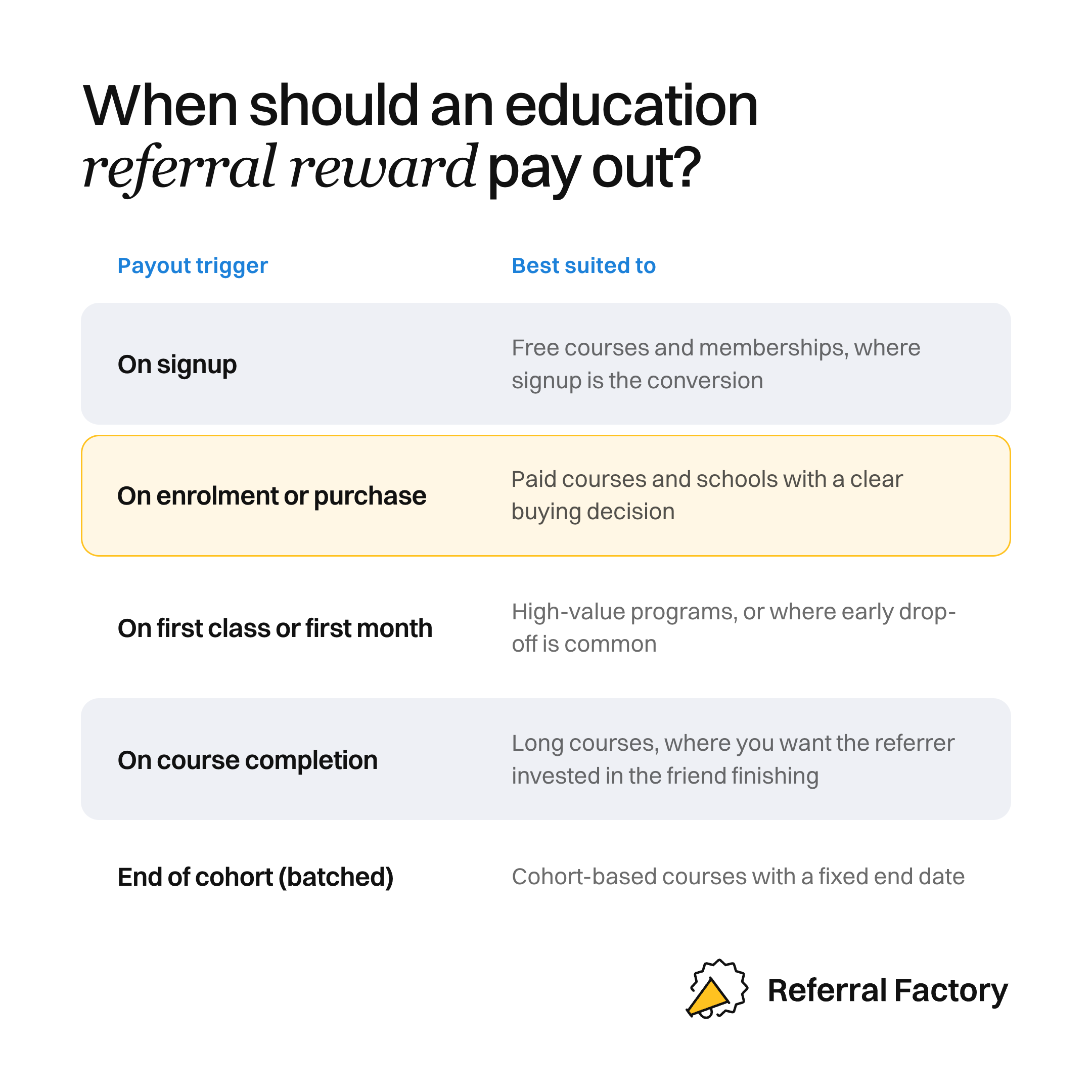
| Payout trigger | Best suited to |
|---|---|
| On signup | Free courses and memberships, where signup is the conversion |
| On enrolment or purchase | Paid courses and schools with a clear buying decision |
| On first class or first month | High-value programs, or where early drop-off is common |
| On course completion | Long courses, where you want the referrer invested in the friend finishing |
| End of cohort, batched | Cohort-based courses with a fixed end date |
On signup. Best for free courses and free memberships, where signing up is the conversion. Anything stricter here kills participation, because there is no purchase to wait for.
On enrolment or purchase. The default for paid courses with a straightforward buying decision. The referred friend has committed money, so the referral is real, and you are not making your referrer wait months to be thanked.
On first class or first month completed. For high-value courses, or any program where people enrol and then drift away before they start. Paying after the first session or first month almost eliminates the risk of rewarding a referral who never truly began.
On course completion. For longer courses where you want the referrer invested in their friend actually finishing. It is the most protective trigger, but also the slowest, so it suppresses participation unless the reward is worth the wait.
Batched at the end of a cohort. For cohort-based courses with a defined end date, where paying everyone at once is simpler and fits the rhythm of how you run.
The trade-off runs in one direction the whole way along. The earlier you pay, the more people take part, and the more you risk paying for weak referrals. The later you pay, the safer each payout, and the fewer people bother. Your job is to sit at the point on that line where a wrong payout would actually hurt, and no later.
In Referral Factory each of these triggers is a setting, so whichever point you choose, the reward releases automatically at that moment and only when your condition is met.
How much to offer, and in what form
Once the timing is set, the amount and form follow from your segment.
A school should usually keep rewards modest and non-cash, so the program reads as a thank-you rather than a commission. Credit toward trips or clubs, priority booking or a contribution to the school fund all fit, as covered in the posts on running a school program and parent referrals.
A bootcamp or training provider selling a high-ticket course can afford a large reward, and cash works well because the buyer is an adult investing in a career return. An online course creator can lean on the product itself, giving account credit or a free module that costs a fraction of its face value.
Two rules hold across all of them. Make it double-sided so the referrer is offering their friend something rather than asking a favour. And match the form to whether the referrer is still studying with you, in which case credit keeps them close, or has finished, in which case cash or a voucher is the honest reward.
The one rule that matters most
Whatever you choose, make it unambiguous. The single biggest mistake I see is a payout rule so vague that students cannot tell when, or whether, they will be paid. Your students should be able to say in one sentence exactly when the reward lands. If they cannot, participation quietly dies, no matter how generous the number looks.
This is also the danger with gamifying your program. Students respond well to the leaderboards, tiers and points of a student ambassador program, but game mechanics only work on top of a payout rule they already understand. Add points and badges to a reward students cannot actually pin down and you get activity without trust, which converts nobody. Get the rule clear first, then make it fun.
What good looks like
CBD College, a training provider running a program with us, pays a clean, clear reward when a referred friend enrols, and converts 56% of referred people into enrolments against roughly 11% from Google Ads. A separate online tutoring business generated 1,715 referred leads in ten months on a simple double-sided reward, converting over half of them. Neither program wins because of the size of its reward. They win because the reward is clear, double-sided, and paid at a moment that makes sense for what they sell.
Getting started
Pick your payout trigger first, using the spectrum above, then set an amount you can afford against the value of one new enrolment, then decide the form based on your segment and whether your referrers are current or past students.
Enter your website and Referral Factory builds a branded campaign for you automatically, then handles the tracking and payouts with no code, so the rule you set is applied automatically, every time. For reward ranges and setup by sector, the education referral programs page lays it out.
Frequently asked questions
When should I pay out a referral reward in education?
It depends on what you sell and what a wrong payout costs you. Free courses should reward on signup, paid courses on enrolment, high-value or drop-off-prone programs after the first class or first month, and long courses on completion. The earlier you pay the more people take part, and the more you risk rewarding weak referrals.
How much should an education referral reward be?
Across the education programs we run, rewards range from around £5 to €500, so there is no single right number. Choose an amount that is meaningful to your students and affordable against what a new enrolment is worth to you. The timing of the payout matters more than the size.
Should education referral rewards be cash or something else?
It depends on the segment. Schools usually do better with non-cash, community-oriented rewards, training providers can use cash because the buyer is investing in a career return, and course creators can reward with their own product. Whatever you choose, make it double-sided.
What is the most common mistake with referral rewards?
Leaving the payout rule vague. If students cannot say in one sentence when they get paid, participation drops regardless of how generous the reward is. Clarity beats size.
Should both the referrer and the referred friend get a reward?
Yes. Double-sided rewards let the referrer offer their friend something rather than ask a favour, which lifts participation more than any increase in the reward amount alone.
How do I make sure I only pay for referrals that convert?
Set the payout trigger later in the journey, such as after enrolment or the first month of study, and use referral software to release the reward automatically only when that condition is met.
Referral link generator (free)
We take your website, send it to Referral Factory, and provision a real referral program for your brand. The link you get is a live referral URL your customers can share, backed by tracking and rewards in the app - not a static "generator" preview. This is the fastest way to see what a real referral program would look like for your brand! Try it below...