
Examples, templates, checklists, and practical inspiration you can adapt quickly.
By Kirsty Sharman

Short answer: most professional services firms already get referrals. What they do not have is a program, which means nobody knows who referred whom, the thank you depends on somebody remembering, and the introduction lands in an inbox rather than a process. Turning that into a program is five decisions: who you ask, what you pay them, when it pays, what you disclose, and what happens to the referred person after the introduction.
Adam from Referral Factory on why referrals work so well for professional services firms.
Consulting, accounting, law, advisory and agency work all sell the same thing underneath the deliverable, which is confidence that you will not make the client look bad. That is why a recommendation from a peer does more work in this sector than a campaign ever will, and why so much of the new business arrives through a sentence somebody said in a meeting you were not in.
Why referral marketing for consulting firms works harder than it does elsewhere
The evidence is strongest where somebody has bothered to measure it. TaxDome's 2025 report on how businesses choose accounting firms, based on more than 350 US business decision makers, found that 58% had found their current firm through a peer recommendation and that 92% said referrals were critical to the choice. The figures are in TaxDome's announcement of the report. In legal services, the Legal Services Consumer Panel's 2025 tracker survey, run across 3,750 legal services users between February and April 2025, found a family or friend recommendation was the single most common reason for choosing a provider, at 18%.
Those two numbers look far apart and both are useful, because the gap is the point. A recommendation matters more when the buyer cannot judge the work themselves, is spending somebody else's money, or has to defend the choice internally. Consulting buyers do all three.
What the same research shows is that the recommendation is a start, not a close. The same Legal Services Consumer Panel survey found that 57% of people who received a recommendation still went looking for more information before making contact. The introduction opens the door. What the referred person finds next decides whether they walk through it.
The five decisions
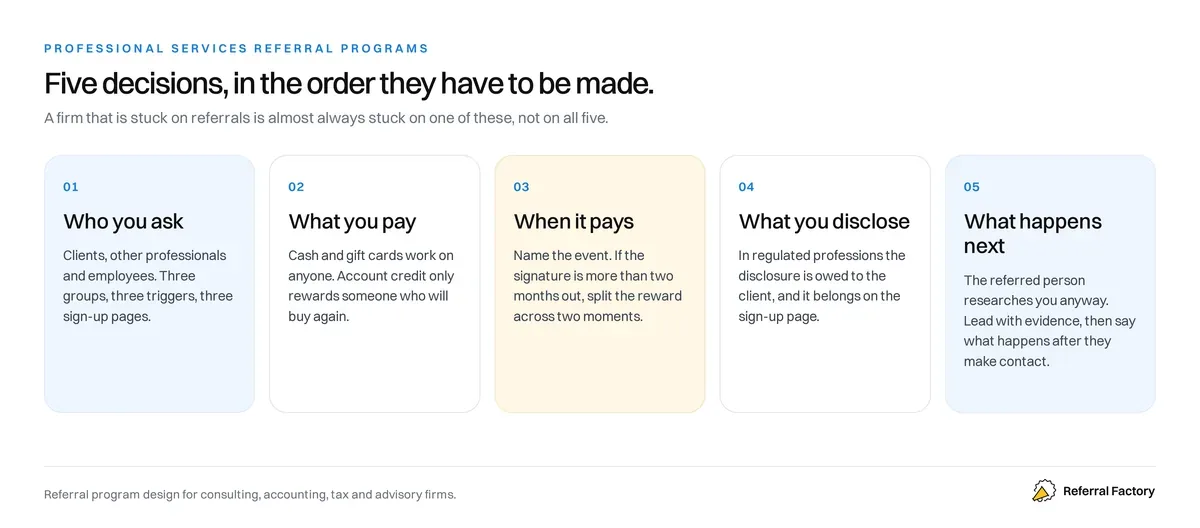
Every professional services referral program comes down to the same five decisions. Firms that get stuck are almost always stuck on one of them, not on all five.
1. Who you ask
Clients are the obvious referrers and usually not the best ones. Three groups refer professional services firms: clients, other professionals, and employees. Each has a different trigger, a different reward and a different conversation, which is why one sign-up page for all three tends to underperform three separate ones.
| Referrer | What sets them off | What usually works as a reward |
|---|---|---|
| Clients | A piece of your work landing well | Cash, or account credit if they will buy from you again |
| Other professionals | Their own client needing something you do | Cash or commission, with the tax position stated before they join |
| Employees | Someone in their network needing the service | Cash, handled through payroll |
The most sophisticated professional services program we host runs a client campaign and a second, separate campaign for other professionals. One accounting software company we host runs the same mechanic twice, once for clients and once for employees: same rewards, same structure, different sign-up form.
2. What the reward is
Cash and gift cards work on anyone. Account credit only rewards somebody who will buy from you again, which rules out most partners and every employee, so the choice between cash and credit is really a question about who your referrers are.
Size is harder, because there is no published benchmark and the firms we host are a long way apart. One UK estate planning practice pays 5% commission and tells referrers that works out at around £77 per client. A US business consulting firm pays 10% of its own revenue on the deal. Anyone quoting you a tidy industry range is repeating an opinion.
3. When it pays
This is the decision professional services firms get wrong most often, because the signature can be months from the introduction. Pay at signature and the referrer waits a long time for anything at all. Pay at the introduction and you are paying for leads.
Splitting the reward across two moments is what more firms should steal. One accounting software company we host pays a small amount when the referred lead qualifies, then roughly five times more when that lead becomes a customer. The first payment acknowledges the thing the referrer controls, which is making the introduction. The second pays for the outcome they do not.
Whatever you choose, write it down once. One firm we host describes its own reward trigger two different ways on two pages of the same campaign, "if they sign up" and "if they become a client of ours". Those are different events, sometimes months apart, inside one program.
4. What you disclose
Paying for referrals is legal in most places for most professional services firms. The condition attached to it is disclosure, and in regulated professions the disclosure is owed to the client rather than to the regulator. Ohio's rules for accountants, for example, require that a firm accepting or paying a referral fee discloses that to the client.
The firms that clear compliance fastest put the position in front of referrers before they join rather than at the point the first reward is paid. What accountants and other regulated professionals have to disclose is usually one sentence on the sign-up page and one in the terms.
5. What happens after the introduction
A referred person arrives warm and researches you anyway. The firms that convert them treat the referral page as a credibility document rather than an order form. The best one we host leads with 400 completed applications, 40 years of combined experience and a client testimonial video, and only then asks for an email address.
The second half is telling them what happens next: who they will speak to, what you will ask for, and when they will hear back. Publishing that removes the only real risk the referrer is carrying, which is not knowing what they are sending their contact into. Converting a referred lead is mostly this, done deliberately.
Keeping it running when the work is seasonal
Tax practices have the sharpest version of this problem, but anyone with a seasonal delivery peak has it. The client ask works best just after you have visibly done something, so a program built around the busy season goes quiet with it.
The fix is not to push harder in the quiet months. It is to run a second, always-on program aimed at people whose trigger moments ignore your calendar: the lawyer handling a sale, the banker on a funding round, the bookkeeper whose client has outgrown them. Keeping referrals coming after the season ends is a question of who you are asking, not how often.
Where to start
- Pick one audience, usually clients, and launch for that group alone.
- Name the event that releases the reward, in one sentence, and use that sentence everywhere.
- Give every referrer a trackable referral link so attribution is recorded at the introduction rather than reconstructed later.
- Build the referred person a page that answers "why should I trust you" before it asks for anything.
- Add the second audience once the first one is running.
If you want to see how this looks in a live program with published numbers, the iKhokha referral program case study walks through one end to end, and our consulting referral program page covers the setup specifics.
FAQ
Does referral marketing work for consulting firms?
Yes, and it tends to outperform other channels because consulting buyers cannot assess the work before they commit. TaxDome's 2025 survey found 58% of accounting clients chose their firm on a peer recommendation. The gap between firms is not whether referrals happen, it is whether anything captures them.
How much should a consulting firm pay for a referral?
There is no published benchmark. Across the professional services programs we host, rewards run from a flat amount per signed client to 5% of the fee or 10% of revenue on the deal. Size it against what a client is worth to you over the relationship rather than against a rate someone quoted you.
When should the reward be paid?
At a named event, and if the gap between the introduction and that event runs past about two months, split it. A small payment when the referred lead qualifies and a larger one when they sign keeps the referrer in the program through the months in between.
Can professional services firms pay for referrals legally?
In most jurisdictions yes, with disclosure. Regulated professions usually require the arrangement to be disclosed to the client, and some have specific rules about fee sharing. Check your own regulator rather than assuming, and put the position in your terms.
Who should a professional services firm ask to refer?
Clients, other professionals and employees, as three separate programs rather than one. Partners are often the highest value referrers, because their trigger moments are not tied to your delivery calendar.
Why do referred leads not always convert?
Because a recommendation is an introduction, not a decision. The Legal Services Consumer Panel found 57% of people who received a recommendation still looked for more information before making contact, so what they find when they look is doing as much work as the referral itself.
Referral link generator (free)
We take your website, send it to Referral Factory, and provision a real referral program for your brand. The link you get is a live referral URL your customers can share, backed by tracking and rewards in the app - not a static "generator" preview. This is the fastest way to see what a real referral program would look like for your brand! Try it below...