
Reward design, incentive strategy, payouts, and commission structures.

Offer a double-sided reward, sized to the value of the product, and release it only when the referred person hits a real milestone. In practice that means somewhere between $25 for a checking account and $1,000 for a mortgage or wealth client, split between the customer who referred and the friend who joined. That is the pattern across the finance programs we host, and it is what good financial services referral rewards look like: sized to the product, split fairly between both sides, and paid only on results. This post covers how to pick your number, what form the reward should take, and the finance-specific twists: the insurance exception, reward caps, and what to do when your best referrers are other businesses.
The legal side of rewards, who you may reward and what must be disclosed, has its own guide: are referral programs legal in financial services. This post is about the other half of the question: what will actually motivate people to share, at the scale of an institution with a large existing customer base, not a single flagship campaign.
Adam from Referral Factory on what rewards you can legally offer in financial services.
Start with the structure: double-sided, with a finance twist
A double-sided reward pays both parties: the referrer gets a thank you, the friend gets a reason to act. It is the default structure across our finance clients for a simple reason: it reframes the referral from selling to helping. Your customer isn't pitching a bank, they're passing £50 to a friend.
The finance twist is what the friend's side should be. In most industries the friend gets a discount. In advice-led finance, the strongest friend-side reward is usually access, not money. “Use my link and get a free consultation with my adviser” lands better than “get $200 off,” because the gift is help with a decision the friend is already worried about. One pension advisory firm we host gives the referred friend a full financial review, normally priced at £800, plus £25; the referrer gets £200 and entry into a holiday prize draw. Nearly half of their referred leads become clients.
Keep the two sides roughly equal in perceived value where you can. Programs that reward only one side tend to fizzle: if only the referrer earns, sharing starts to feel like profiting off your friends, and if only the friend earns, nobody has a reason to share in the first place.
How much? Reward ranges by product
Reward size should track the lifetime value of the product. This is the guidance we publish, and it matches what live programs on our platform actually pay:
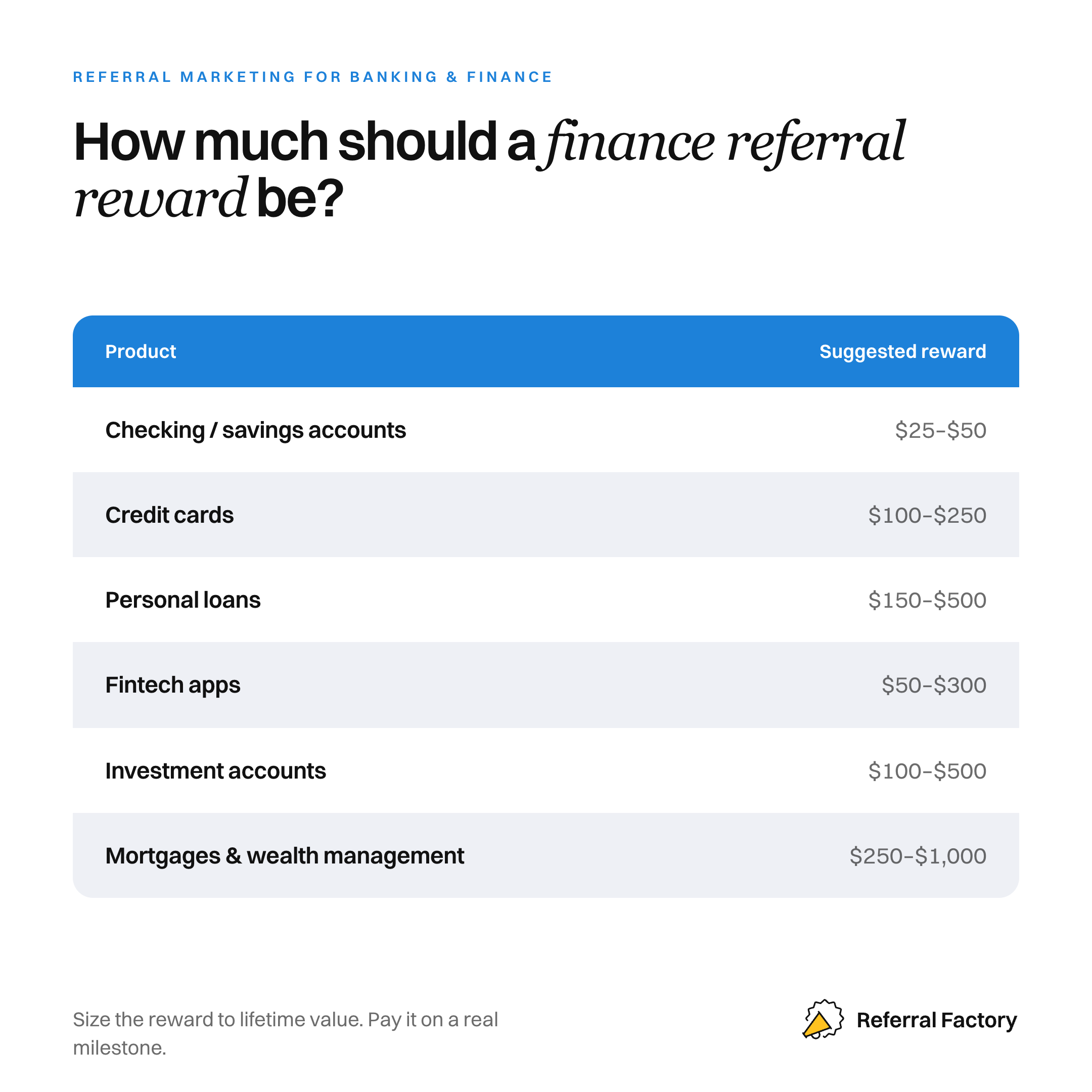
| Product | Suggested reward |
|---|---|
| Checking / savings accounts | $25–$50 |
| Credit cards | $100–$250 |
| Personal loans | $150–$500 |
| Fintech apps | $50–$300 |
| Investment accounts | $100–$500 |
| Mortgages and wealth management | $250–$1,000 |
Two things worth copying from live programs. First, vary the reward within a product line when ticket sizes vary: one lender we spoke with pays $20 for a small loan referral and $40 for a larger one, set as two reward rules rather than one. Second, cap earnings per advocate so the total budget stays predictable at scale: one European digital bank pays €50 per referral up to 10 friends, a €500 ceiling per customer, which is what makes a program with tens of thousands of participants budgetable in the first place, and still leaves plenty of headroom for enthusiastic advocates. The same cap-and-milestone pattern shows up in credit union referral programs and in fintech and neobank programs, both worth a look if you're in either segment.
If a number in this range makes your CFO flinch, compare it with what a lead costs you today: the average lead in financial services costs around $653 (Statista) before it converts at all, and paid leads run above that average. The full comparison lives in paid vs referral in financial services, and the wider strategy sits in our guide to referral marketing for financial services businesses.
What form should the reward take? The four options
Cash. Universal and clear, but it touches your payment rails and, in some verticals, your compliance perimeter. Several finance teams we've spoken with chose against cash specifically so the program never interacts with billing systems.
Gift cards. The workhorse of finance programs, and the reason is operational: a digital gift card, redeemable at a wide choice of retailers, feels like cash to the recipient without being a payment your regulated entity makes to a customer. The pension firm above pays its £200 through a flexible card redeemable at over 100 retailers.
Credit in your own product. The clever option where it fits: waived fees, a rate bonus, account credit. It does two jobs at once, rewarding the referrer and pulling them deeper into your product. A fintech app crediting the user's account keeps the value inside the ecosystem.
Access and recognition. For business and wealth clients, a bigger gift card is often less motivating than status: priority service, an invitation, a personal thank you from the adviser. In advice relationships, a handwritten note plus a modest gift frequently outperforms a larger cash payment, because what those clients value most is the relationship itself.
Pay on the milestone, not the signup
Whatever the reward, release it when the referred person becomes a real customer: account funded, loan approved after underwriting, review completed and authority signed, policy quote plus booked meeting. iKhokha does exactly this: it pays its R500 referral reward only once the referred business is verified and has traded R1,000, alongside a 10% discount for the new customer. Every strong finance program we host works this way. It protects the budget from junk signups, and it is the single design choice compliance teams like most, because each payout maps to a verified, logged event. The mechanics, down to the CRM deal stage that fires the payout, are covered in how to track a referral when there's no checkout.
The insurance exception: when only one side can be rewarded
In many US states, anti-rebating rules, laws that stop an insurer sweetening a policy sale with cash or gifts, prevent insurers from giving the referred friend anything of value for buying a policy. The design answer is single-sided: reward the existing customer, and make the friend's incentive the service itself. One US insurance brokerage we host pays its customers a $75 gift card when the referred friend requests a quote and books a review with an advisor, and converts three in four referred leads. Designed well, a single-sided program performs far better than most marketers expect. The legal detail, including which states allow small gifts, is in the compliance guide.
When your referrers are businesses, not customers
Finance has a second referrer population most industries don't: professionals who meet your future clients daily. Mortgage brokers, car dealers, real estate agents, repair shops for an equipment lender, accountants for a business bank. Two structural rules from programs that do this well:
Run it as a separate campaign. A lender we spoke with runs $50 gift cards for customer referrals and a different, larger structure for professional partners, as two distinct campaigns, so neither group sees the other's terms. The two audiences respond to different rewards and different messaging, so keeping them separate makes both programs easier to run.
Check the legal line first. Paying professionals for referrals is regulated differently from thanking customers, and in US settlement business it is prohibited outright. The compliance guide covers where the line sits; our referral partner program guide covers the mechanics where it is allowed.
Setting it up
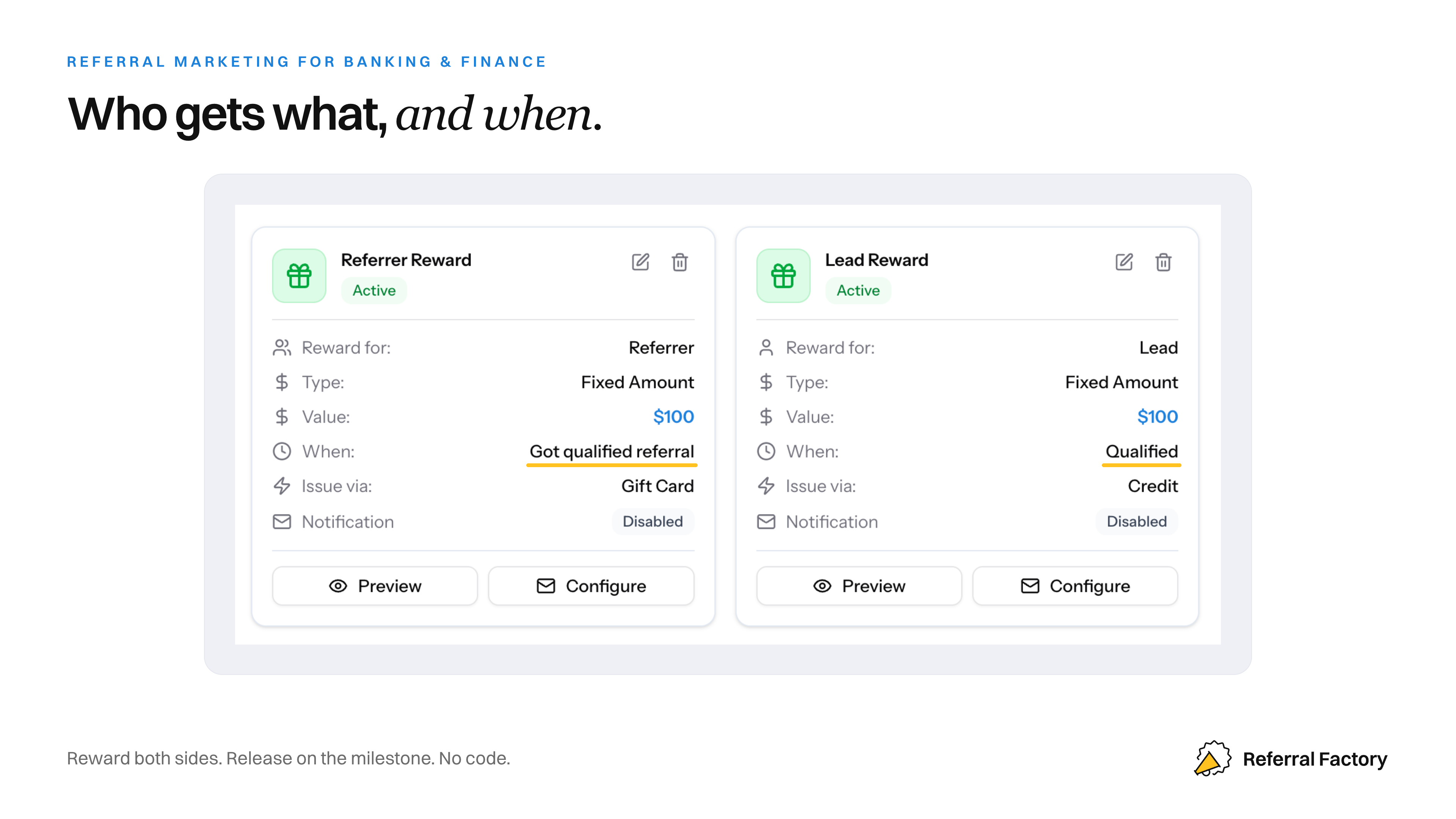
Setting up reward logic is configuration work, not an engineering project. In Referral Factory, you enter your website and it builds a branded campaign automatically, then you set reward rules by trigger: who gets what, in which currency or gift card, released only when your qualifying condition is met in your CRM. Different rewards per campaign, capped totals, and separate customer and partner programs all run from the same dashboard, with every payout logged for audit. For institutions with stricter data requirements, the platform holds SOC 2 and ISO 27001 certification and can be self-hosted, so reward and customer data never leave your servers.
Frequently asked questions
How much should a bank pay for a referral?
For everyday accounts, $25–$50 per successful referral is the published range we see hold up in practice; premium products justify more. The better question is the trigger: pay it when the account is funded and in use, not at signup.
Should the referrer and the friend get the same reward?
Roughly equal perceived value is the guidance we publish. They don't have to be the same thing: £200 to the referrer and a free £800 review to the friend is unequal in cash and well balanced in value.
Are gift cards better than cash for finance referral programs?
Usually, for operational reasons: a gift card rewards the referrer without your regulated entity making a cash payment to a customer, which several finance teams told us was the deciding factor. Recipients treat a flexible multi-retailer card as near-cash anyway.
Can we reward with account credit instead of money?
Yes, and it is often the smartest option for fintechs and banks: credit keeps the referrer engaged with your product. Check the credit doesn't count as a rebate in insurance lines or breach product-specific caps.
What if we can't offer big rewards because of compliance caps?
Design around the cap rather than against it. Firms regulated by FINRA (the Financial Industry Regulatory Authority, which oversees US brokers) work under a $300 per person per year limit, and programs in that world lean on access, recognition, and the friend-side offer (a free review or consultation) to carry the motivation that cash can't.
Referral link generator (free)
We take your website, send it to Referral Factory, and provision a real referral program for your brand. The link you get is a live referral URL your customers can share, backed by tracking and rewards in the app - not a static "generator" preview. This is the fastest way to see what a real referral program would look like for your brand! Try it below...