
Tracking referrals, attribution logic, ROI, qualification, and conversion visibility.
You track it with a referral link, not a discount code. The link records who introduced whom at the moment the introduction happens. The reward is released later, when the referred person reaches a real milestone in your CRM: a loan approved, an account funded, a signed authority, a booked meeting. You track the introduction, then let your existing sales process confirm the conversion. That's how you track a referral when there's no checkout: no checkout required, because the checkout was never the thing you needed to track.
This is the question I hear most from finance teams considering a referral program, and it usually arrives as an objection: “referral programs are for e-commerce, we don't have a buy button.” So let's walk through exactly how programs at banks, lenders, advisory firms, and insurers make attribution work, down to the CRM fields. This matters most at real scale, once you're running the setup below across tens of thousands of customers, link-and-milestone tracking is the only version that holds up; a spreadsheet or a paper form breaks long before then.
Adam from Referral Factory on tracking a referral when there is no checkout.
Why finance conversions break normal referral tracking
In e-commerce, the referral and the purchase happen in the same place, minutes apart. A code at checkout closes the loop.
In finance, the conversion happens later, somewhere else, and often offline. A mortgage completes after underwriting. A pension transfer completes when paperwork is signed. An insurance policy is bound after a call with an advisor. The gap between “my friend told me about you” and “I am now a customer” can be weeks, and no part of it looks like a checkout. One UK pension firm told us their old paper-based refer-a-friend scheme “wasn't really getting past the sofa”: recommendations were happening in living rooms, and nothing captured them.
A discount code can't fix this, because a code needs a till to be typed into. A referral link solves it, because a link separates the two events that matter: it captures the introduction immediately, then waits for the conversion to happen wherever it naturally happens, in your CRM, your loan book, or your branch.
The flow, step by step
Here is the entire mechanism, using the setup our finance clients run:
- Every customer gets their own referral link. They share it by WhatsApp, email, or text, or a QR code in a branch or an advisor's email signature.
- The friend clicks and leaves a first name and an email address. That creates a referred lead, permanently attributed to the customer who shared the link. Note how little data moved: no account numbers, no financials, nothing a compliance team loses sleep over.
- The lead flows into your CRM. With HubSpot, Salesforce, Pipedrive, or Zoho connected, the referred lead lands alongside every other lead, tagged with its source and referrer.
- Your team works the lead exactly as normal. Underwriting, KYC, advice meetings, credit checks. The referral system does nothing during this stage except wait.
- The lead hits your milestone and the reward releases automatically. When the deal stage in your CRM changes to your qualifying stage, say Closed Won in HubSpot or a custom “Account Funded” stage in Salesforce, the referral is marked converted and the payout fires. Nothing is paid until the milestone is confirmed, and every step is logged.
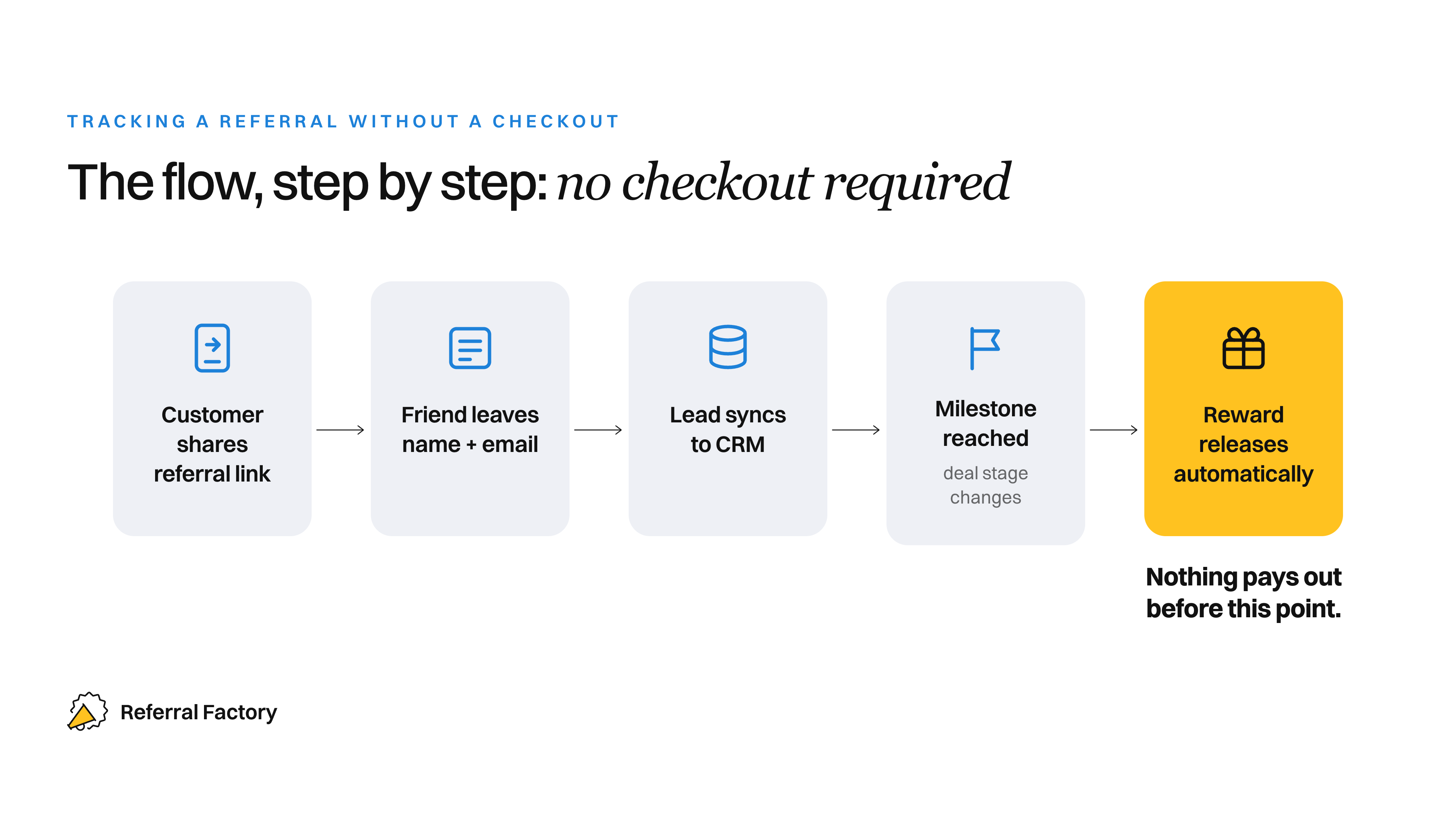
The design principle underneath it: track the relationship, not the transaction.
What counts as “converted”? Real milestones from real programs
The milestone is yours to define, and it should be the moment a referred person becomes a real customer, not the moment they show up. These are milestones running in live finance programs on Referral Factory today:
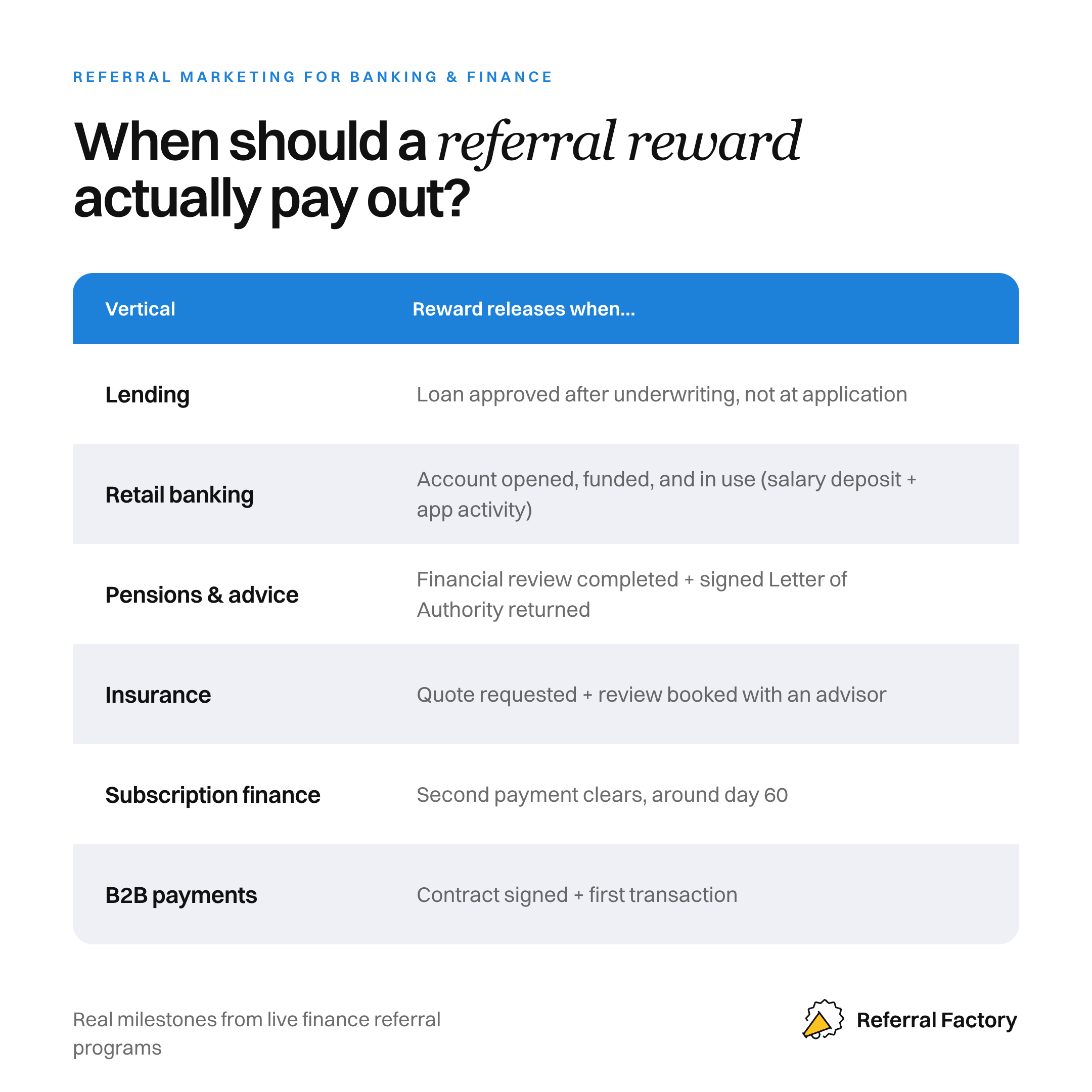
| Vertical | Reward releases when... |
|---|---|
| Lending | The loan is approved after underwriting, not at application |
| Retail banking | The account is opened, funded, and in use (one digital bank requires a salary deposit and app activity before paying out) |
| Pensions / advice | The friend completes a financial review and returns a signed Letter of Authority, the document appointing the adviser |
| Insurance | The friend requests a quote and books a review with an advisor |
| Subscription finance | The second payment clears, around day 60, so cancelled accounts never trigger a payout |
| B2B payments | The referred company signs a contract and transacts for the first time |
Two patterns stand out. Every milestone is verifiable inside a system the business already runs. And none of them can be gamed by a fake signup, which is why milestone-based programs keep their lead quality high: across our finance clients, referred leads convert at rates between 13% for high-volume retail banking and 75% for advice-led insurance, figures that only hold because nobody is being paid for junk. The compliance side of milestone rewards, why regulators prefer them too, is covered in are referral programs legal in financial services. The credit union and fintech versions of this same milestone-gated pattern are covered in credit union referral programs and how to build a fintech or neobank referral program.
The B2B wrinkle: when a salesperson makes the introduction
B2B finance adds one complication: the referral often happens inside a relationship a sales agent owns. A fleet manager mentions to their account manager that a partner company needs fuel cards. There is no link click anywhere in that story.
The programs that handle this well let the agent generate a referral link on the customer's behalf. One multinational payments company we host runs exactly this: the sales agent creates the customer's link, the agent's name is stamped on the referral, and the lead lands in Salesforce attributed to both the referring customer and the agent who facilitated it. The reward still waits for the milestone (in their case, a signed contract plus first transaction). The referral is captured even though the customer never touched a screen.
iKhokha, a South African payments fintech, tracks referrals this way through HubSpot, triggering the reward when the referred business first trades.
If your revenue runs through account managers rather than an app, build this in from day one.
What to measure once it's running
Three numbers tell you whether the program works, and they map to what your dashboard tracks:
- Advocates: customers who joined and created a link. This measures whether your promotion is reaching people.
- Referred leads: friends who clicked and left their details. This measures whether advocates are actually sharing.
- Converted referrals: leads that hit your milestone. Converted divided by referred leads is your conversion rate, and it is the number to compare against your paid channels.
Skip clicks and reach; they make the program look busy without telling you whether it's working. For how referral conversion compares with paid acquisition in finance, see paid vs referral in financial services.
Do you need developers for any of this?
No. This is what referral software exists to do. With Referral Factory, you enter your website and it builds a branded campaign for you automatically, then handles the link generation, lead capture, CRM sync, and milestone-triggered payouts with no code.
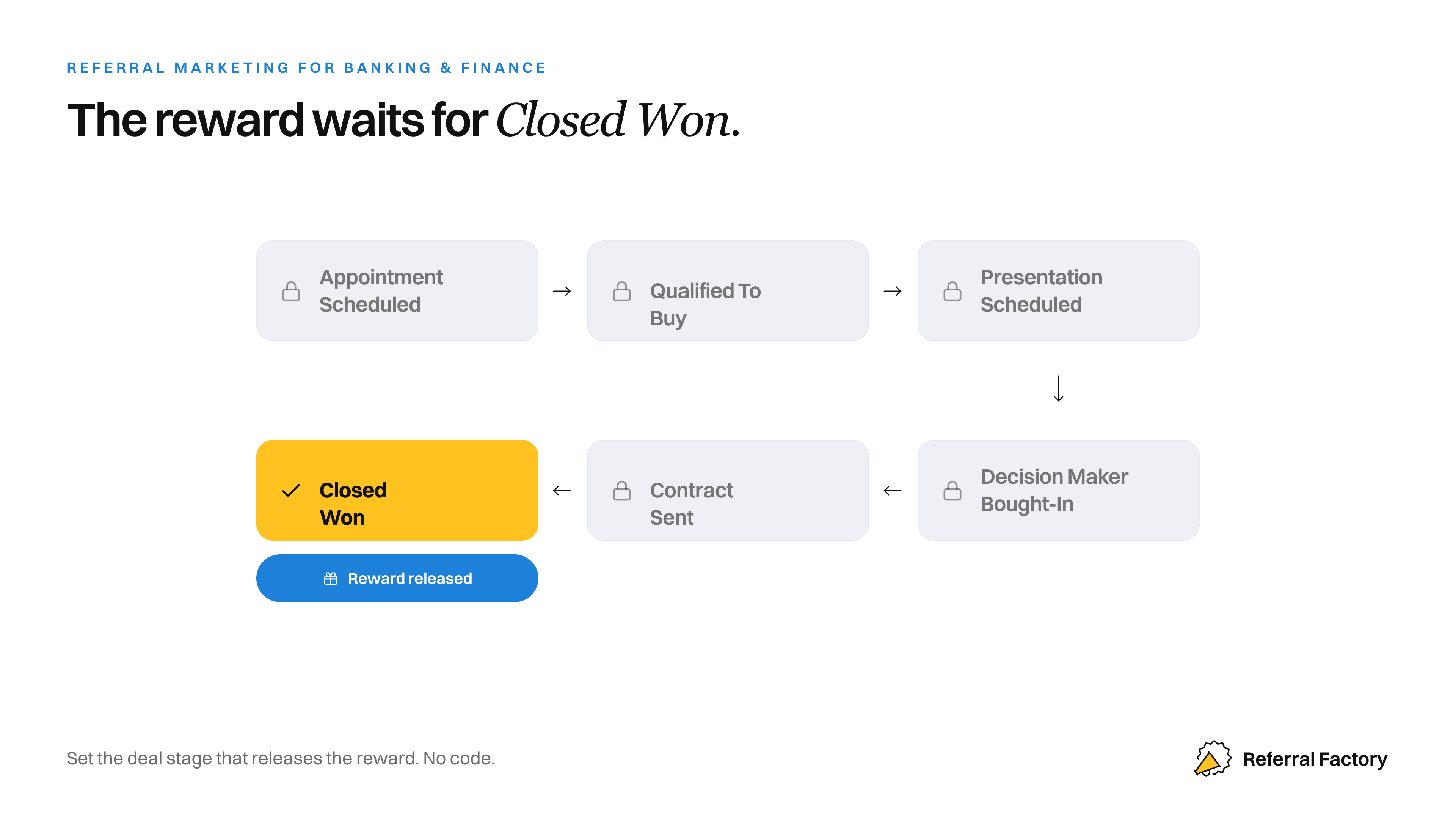
The native HubSpot and Salesforce integrations are the piece doing the heavy lifting in every setup described above: change the deal stage, and the reward logic follows. If your bank has stricter requirements, the platform holds SOC 2 and ISO 27001 certification and can be self-hosted so referral data never leaves your servers.
For a bank-specific overview of program metrics and tracking tools, our earlier guide to how banks track referral customers covers the wider dashboard; this post is the mechanics underneath it. For the wider strategy this mechanic sits inside, see our guide to referral marketing for financial services businesses.
Frequently asked questions
How do you track referrals if the sale happens in a branch or over the phone?
The introduction is still captured online, by the friend clicking the link and leaving their name and email. The offline sale is recorded where it already gets recorded, your CRM, and updating the lead's stage there is what marks the referral converted. It doesn't matter where the sale happens; what matters is that it gets recorded in your CRM like every other sale.
Can I track referrals in HubSpot or Salesforce?
Yes, natively. Referred leads sync in with their referrer attached, and moving the deal to your chosen stage (Closed Won, Funded, Policy Bound) triggers the conversion and the reward automatically.
What if our sales cycle takes months?
Nothing breaks. The link attribution is permanent, so a referral made in January that funds in June still pays the right person. Long cycles are an argument for links over codes, not against referral programs.
Should the reward trigger on signup instead, to keep it simple?
Avoid it in finance. Paying on signup invites junk leads and, worse, pays out on customers who never materialise. Every strong finance program we host pays on a verified milestone, and it is also the structure compliance teams approve fastest. What to offer is its own question, covered in what to offer as a referral reward in financial services.
Do referral codes ever make sense in finance?
Rarely. Codes exist to be typed into a checkout, and finance mostly doesn't have one. Links carry the attribution themselves, work in WhatsApp and QR codes, and need nothing from the friend except a click and two form fields.
Referral link generator (free)
We take your website, send it to Referral Factory, and provision a real referral program for your brand. The link you get is a live referral URL your customers can share, backed by tracking and rewards in the app - not a static "generator" preview. This is the fastest way to see what a real referral program would look like for your brand! Try it below...