
Industry-specific guidance showing how referral marketing works in real operating contexts.
Build a fintech referral program as a double-sided reward, usually $25–$50 a side, and release it only when the friend does more than sign up: funds the account, logs in, and shows real activity. That is the shape of a fintech referral program that works, and most fintechs already have the raw material for one without knowing it. A new user downloads your app because a friend showed them theirs, and that introduction happens in a text message or over coffee, off the record, with no way for you to reward it or even count it. A referral program is not a new idea for a fintech to bolt on, it is the thing your users are already doing, given a link and a reason to use it. This guide covers what a real program pays, how to stop it being abused, where to put the invite, and why the cost math favours referral over paid acquisition in this category more than in almost any other. It's written for fintechs and neobanks with a large existing user base (10,000 or more accounts), where a bonus-abuse pattern or a tracking gap gets expensive fast, not for a pre-launch app testing its first hundred signups.
Adam from Referral Factory on what the best finance referral programs do differently.
Why fintechs need this more than most
Fintechs have a trust problem that branch banks and credit unions don't. You have no branch on the corner, no decades-old name on a building, and a user is being asked to hand you their salary or their savings on the strength of an app store rating. A recommendation from someone they already trust closes that gap faster than any amount of paid advertising or slick UI can. When a friend says “I use this and it's great,” the new user skips the part where they'd otherwise sit and worry about whether a five-year-old company is safe with their money.
The cost math backs this up. Paid customer acquisition in consumer fintech runs around $258 per customer in banking apps, $175 in lending, and $166 in investing, and B2B or enterprise fintech CAC can run into the tens of thousands of dollars per customer (First Page Sage, Fintech CAC Benchmarks 2026). Those figures buy a click, not a funded, active account, so the true cost per active customer is higher still. A referred user starts the relationship already trusting you, which means fewer of them drop off between download and first deposit. The fuller cost comparison, including conversion rates by finance sub-vertical, is in customer acquisition cost in financial services: paid vs referral.
How fintech referral programs are structured
The pattern across digital banks and neobanks running programs today looks like this: both sides get a reward in the $25–$50 range, an advocate can refer a capped number of friends a year, usually around 10, a per-advocate limit that keeps the total budget predictable once a program has tens of thousands of users in it, not a ceiling on the program's own size, and the reward only releases once the friend has done more than open an account. Live programs stack two or three proof points on top of the signup: a minimum deposit or salary payment landing in the account, at least one app login, and sometimes a connected card or payment method. Programs built this way convert referred leads into paying customers at rates of roughly 10–15%, well above what a cold paid lead converts at.
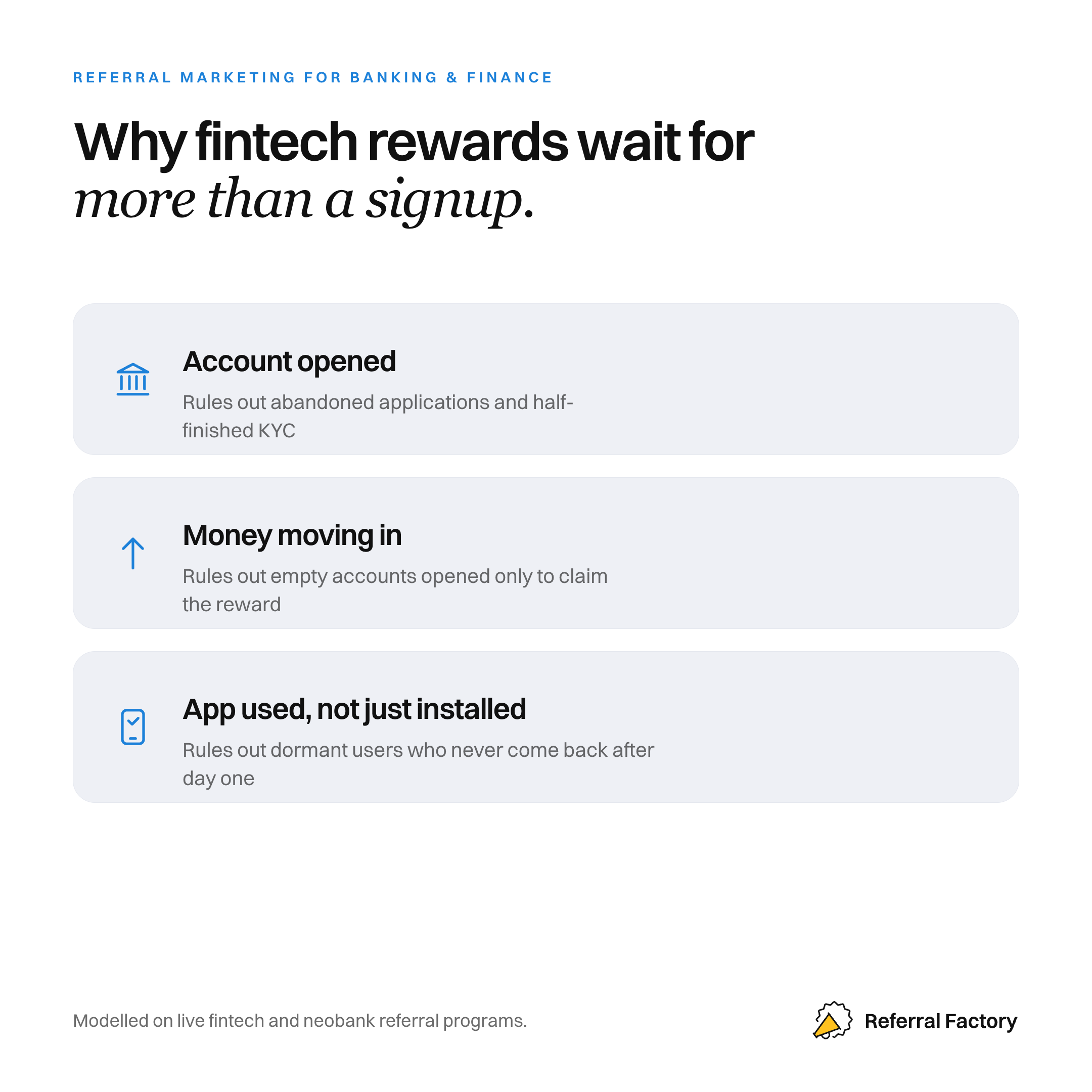
That milestone stack looks strict until you understand what it is protecting against. An account opening is not a customer, in fintech it can be a customer, a bot, or someone farming a signup bonus, so the reward waits for proof of a real, active user: money moving in, a login, and product usage. The reward-by-product ranges that apply across financial services, checking and savings up to card and lending products, are covered in what to offer as a referral reward in financial services.
The bonus-abuse problem, and how to design around it
Fintechs deal with a fraud pattern that most other industries don't: people who open accounts purely to collect the signup or referral bonus, then close them, sometimes referring themselves through a second account or a friend's phone. Neobanks and challenger banks have had very public trouble with this. It is the single biggest reason a fintech referral program looks stricter than a retail one.
Three design choices keep a program safe without making it clunky for real users. First, track every invite through a personal referral link, never a shareable generic code, so each signup is tied to one identifiable advocate and duplicate or self-referrals stand out. Second, gate the reward behind a real financial action, not a login, a funded deposit or a completed KYC check (the identity checks required before an account can move money) is much harder to fake than an email signup. Third, cap what any one advocate can earn in a year, live programs commonly cap around 10 referrals, which keeps a single bad actor's upside small even if something slips through. None of this needs a fraud team to build, it is configuration inside your referral platform: link-based tracking, milestone gating, and a per-advocate cap, applied from day one. The same defences apply outside finance too, and we cover them in general in how to prevent referral fraud.
Where to put the invite
The advantage a fintech has over a traditional bank is that your entire relationship with the user already lives inside an app you control, so you can put the invite exactly where attention already is.
At onboarding, once a new user has funded their account, not before, a simple “invite a friend, you'll both get €50” screen catches people at their most enthusiastic moment, right after they've had a good first experience. Inside the app, a permanent invite tile in the menu or account screen means the option is there whenever a user thinks of someone. After a positive moment, a bill paid off, a savings goal hit, a card delivered, a one-line prompt rides on genuine excitement instead of interrupting it. On the app store review prompt, pair your rating ask with your referral ask, a user who is happy enough to leave five stars is happy enough to send a friend a link. Keep every prompt to one clear line and one link, a fintech user's attention is short and the invite screen is competing with their actual banking task.
Running it without engineering time
A fintech's product team has better things to build than a referral system from scratch, and this is the part where an off-the-shelf platform earns its keep. For a real example, iKhokha, a regulated fintech with its own engineering team, chose to buy its referral program rather than build one in-house and kept its developers on core product. With Referral Factory, every user gets a unique link generated automatically, the reward stays locked until your milestone, a funded account, a completed KYC check, whatever you define, is confirmed through an API call or CRM integration, and the per-advocate cap and full audit trail are configuration, not a sprint. That matters doubly for a regulated fintech, because the same audit trail that stops bonus abuse is what your compliance team will ask to see. The platform also holds SOC 2 and ISO 27001 certification and can be self-hosted, so user data never leaves your infrastructure, a requirement most fintechs with a large user base are already screening every vendor for. Exactly how that milestone-and-CRM mechanic works, down to the API call that releases the reward, is covered in how to track a referral when there's no checkout. If you want a look at how other fintechs have built theirs, the examples in best fintech referral programs are a useful next read, and the wider strategy behind all of this is in our guide to referral marketing for financial services businesses.
Frequently asked questions
How much should a fintech pay for a referral?
€50/€50 or the local equivalent is a common range for everyday consumer accounts, similar to the $25–$50 range published across financial services generally. Larger products or B2B fintech referrals justify more, an annual cap per advocate keeps the budget predictable.
How do you stop people gaming a fintech referral program?
Track every invite through a personal link rather than a shareable code, gate the reward behind a real financial action like a funded deposit or completed KYC check rather than a signup, and cap how much any one advocate can earn in a year. Those three rules cover most abuse patterns without adding friction for genuine users.
What counts as a successful fintech referral?
Not the account opening. Live programs typically also require a deposit or salary payment above a threshold and at least one app login, sometimes a connected card too, a real, active customer, not a name in a database.
Do fintechs actually get customers from referrals?
Yes, and the trust economics favour it more than most industries. Consumer fintech paid acquisition runs $166–$258 per customer depending on category, and a referred user arrives already trusting you, which shows up as fewer people dropping out before their first deposit.
Is a fintech referral program legal?
Rewarding your own users for referring friends is standard marketing in most markets and products. Where fintech touches regulated products like lending or investing, the same rules covered in are referral programs legal in financial services apply, check with your compliance team before launch.
Referral link generator (free)
We take your website, send it to Referral Factory, and provision a real referral program for your brand. The link you get is a live referral URL your customers can share, backed by tracking and rewards in the app - not a static "generator" preview. This is the fastest way to see what a real referral program would look like for your brand! Try it below...