
Industry-specific guidance showing how referral marketing works in real operating contexts.

Credit unions are set up to win at referral marketing better than almost any business in finance, and most of them are getting very little out of it. A strong credit union referral program pays both sides around $25–$50, releases the reward only when the new member's account is funded and in use, puts the invite where members already are (the app, the branch, the statement), and handles the eligibility question up front. This guide covers each piece, with real numbers from programs running today, and it's aimed at credit unions with a large, established membership base (10,000 members or more), where the mechanics below need to hold up at volume, not a single branch just getting started.
Adam from Referral Factory on what the best finance referral programs do differently.
Why credit unions are built for this
Referral marketing runs on trust, and credit unions hold more of it per member than almost any institution. You are member-owned, so recommending you isn't doing a company a favour, it's inviting someone into a co-op you part-own. Banking is already the most trusted subsector of financial services in the 2025 Edelman Trust Barometer, and 88% of consumers trust recommendations from people they know above every other channel (Nielsen). Your members already talk about you, and a member who has just been helped with a car loan or a fee refund is exactly the person who will recommend you, if you give them an easy way to do it.
There's a structural bonus most credit unions overlook: your field of membership. Because eligibility is often based on family, employer, or community, the people your members would naturally refer, relatives, colleagues, neighbours, are disproportionately already eligible to join. Your referral audience and your eligible audience are nearly the same people. Banks can't say that, and neither can most fintechs, which have the opposite problem: no branch and no decades-old name to lean on. How that trust gap plays out for a fintech or neobank is covered in how to build a fintech or neobank referral program.
The problem is that almost none of those conversations get recorded anywhere. A member mentions you at a barbecue, the friend nods, and that's where it ends: no name, no follow-up, no way for you to even know it happened. The fix is the same as everywhere in finance: give every member a referral link, and let the link do the remembering. The mechanics are covered in how to track a referral when there's no checkout.
What a real credit union program looks like
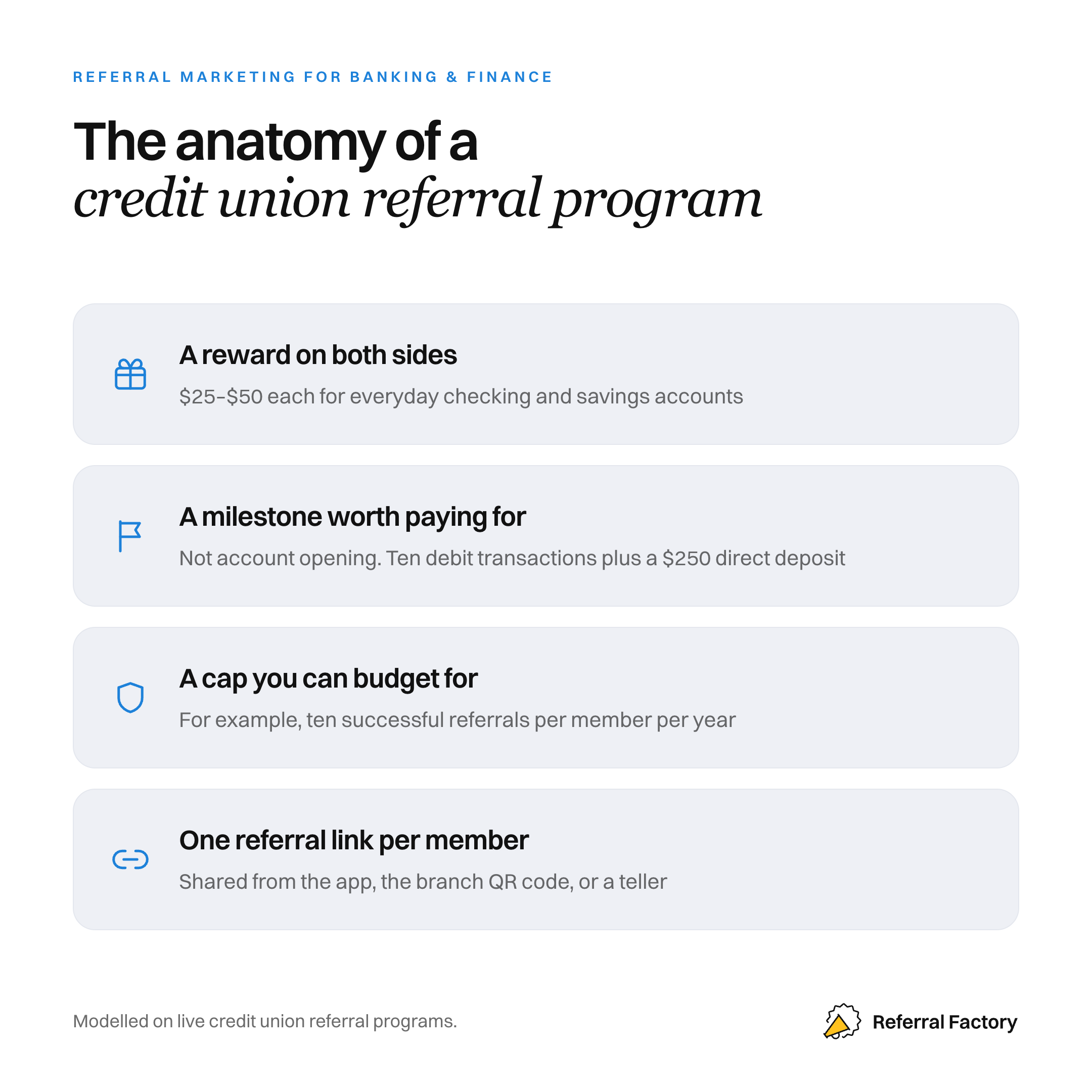
Here is a live example worth copying from, Credit Union West's refer-a-friend program: both sides get $50. The new member must, within 60 days of opening their checking account, complete ten or more debit card transactions and at least one direct deposit totalling $250 or more, and keep the account in good standing. Referrers are capped at 10 successful referrals, $500, per calendar year, and each referral must come through the member's referral link.

Notice how much design is packed in there. The reward is double-sided, so sharing feels like passing $50 to a friend. The milestone is not “opened an account”, it is “actually banks with us”: transactions plus a direct deposit is the credit union version of the funded-and-active trigger we see across retail banking programs. The cap is per member, not per program, so it's what makes the total budget predictable once you're running this across a membership in the tens of thousands, not a ceiling on how big the program itself can get. And the link requirement makes every referral attributable, no teller guesswork, no “who told you about us?” field that nobody fills in honestly.
On reward size, $25–$50 for everyday accounts is the range we publish for checking and savings products, rising with product value; the full breakdown, including gift cards vs account credit and when credit in the member's own account is the smarter option, is in what to offer as a referral reward in financial services.
The eligibility wrinkle, and how to handle it
The one thing that makes credit union referrals different from bank referrals: the friend has to qualify to join. If your field of membership is geographic or employer-based, a referred friend from the wrong county hits a wall, and a wall at the end of a warm introduction is worse than no introduction.
Handle it on the friend's landing page. When a friend clicks a member's referral link, the page they land on should say, before anything else, who can join: “live, work, worship, or study in X”, “employees of Y”, “family of members”. One clear sentence up front spares the friend an awkward rejection later, and means the leads that do come through are people who can actually join. If your charter allows the common workaround, joining an affiliated association, say that too. That landing page is doing the job of an ad, so give it the same care you'd give one. In the UK, the same applies to common-bond credit unions, and the FCA's promotion rules treat that page as a financial promotion, so run it through your usual sign-off.
Where to put the ask
Credit unions have something fintechs spend millions trying to build: physical presence and daily digital contact with the same people. Use both.
In the app and online banking, use a persistent “refer a friend” tile, because that is where your most engaged members already are. In the branch, use a QR code at the teller window that opens the member's own referral link, so a member who has just had a great experience can act on it right there. After positive moments, add a one-line referral prompt to the loan approval email, the fee-waived notification, or the anniversary of membership. From staff, let tellers and loan officers generate a member's link on their behalf, the same agent-assisted pattern B2B finance programs use, so an in-person “my sister needs a car loan” conversation still gets captured and attributed.

One compliance note for the mortgage desk: rewarding members for referring friends is standard marketing, but paying realtors or brokers for mortgage referrals crosses into RESPA territory. Keep the program aimed at your members and you stay comfortably clear of it.
Running it without a developer
Most credit unions don't have spare engineering capacity, and this is the part where that stops mattering. For a sense of the scale this reaches, a fintech running the same playbook signed up thousands of customers to refer, at about 20% conversion. With Referral Factory, you enter your website and it builds a branded member campaign automatically: every member gets their own link, the friend page carries your eligibility wording, QR codes come built in for branch use, and the reward releases only when your milestone, funded account, direct deposit, whatever you define, is confirmed in your core system or CRM. Caps per member, both-sides rewards, and the full audit trail are configuration, not code. For the wider strategy this sits inside, see our guide to referral marketing for financial services businesses. The platform also holds SOC 2 and ISO 27001 certification and can be self-hosted, so member data never leaves your core system, the same requirement most credit unions with a large membership already run into with every other vendor.
Frequently asked questions
How much should a credit union pay for a member referral?
$25–$50 per side is the published range for everyday accounts, and it matches what live programs pay (Credit Union West pays $50/$50). Larger products justify more; an annual cap per member, commonly around 10 referrals, keeps the budget predictable.
Can we reward someone who isn't a member yet?
Yes, by paying the friend's reward after they join and qualify, which is how double-sided credit union programs work: the friend's $50 lands in their new member account once they hit the milestone. That also neatly sidesteps paying non-members anything.
What should count as a successful referral?
Not the account opening. Pick a milestone that means “actually banks with us”: a direct deposit above a threshold, a minimum number of card transactions, or a funded loan. It protects the reward budget and keeps the program compliant, since every payout ties to a verified event.
Do credit union referral programs actually work?
The trust ingredients are stronger than almost any industry: member-ownership, community fields of membership, and recommendations from known people being the most trusted channel there is (Nielsen, 88%). The programs that underperform are the ones nobody can find, a paper form in a branch drawer. Put the link in the app and the branch, and ask after good moments.
Can we run a referral program for mortgages?
For members referring friends, yes, with disclosure. What you can't do is pay realtors, brokers, or other professionals for mortgage referrals, which US law treats very differently. The full picture is in are referral programs legal in financial services.
Referral link generator (free)
We take your website, send it to Referral Factory, and provision a real referral program for your brand. The link you get is a live referral URL your customers can share, backed by tracking and rewards in the app - not a static "generator" preview. This is the fastest way to see what a real referral program would look like for your brand! Try it below...