
Tracking referrals, attribution logic, ROI, qualification, and conversion visibility.

Referral fraud is one of the most common reasons businesses hesitate to launch a referral program. It shouldn't be. Fraud isn't a reason to avoid running a program, it's a reason to build one with the right defenses in place from day one.
And the biggest defense isn't a fraud detection tool. Most referral fraud is prevented by one design decision: reward the referral when a lead becomes a customer, not when a link gets clicked. Get that right and most of the incentive to cheat disappears before anyone tries. The rest is handled by three practical layers: duplicate detection, volume caps, and a review step on high-value payouts. None of them slow down your real referrers, and this post walks through all four.
This matters most at scale. If you're running marketing at a business with thousands or tens of thousands of customers, the kind of referral-ready business where a program can genuinely move the growth numbers, then your program is big enough that a few people will try to cheat it, and far too big for anyone to police by hand. It's also big enough that your CFO will ask how you're protecting the reward budget before signing it off. The answer to both is the same: a program built for scale, designed so the checks run themselves.
Reward the Conversion, Not the Click
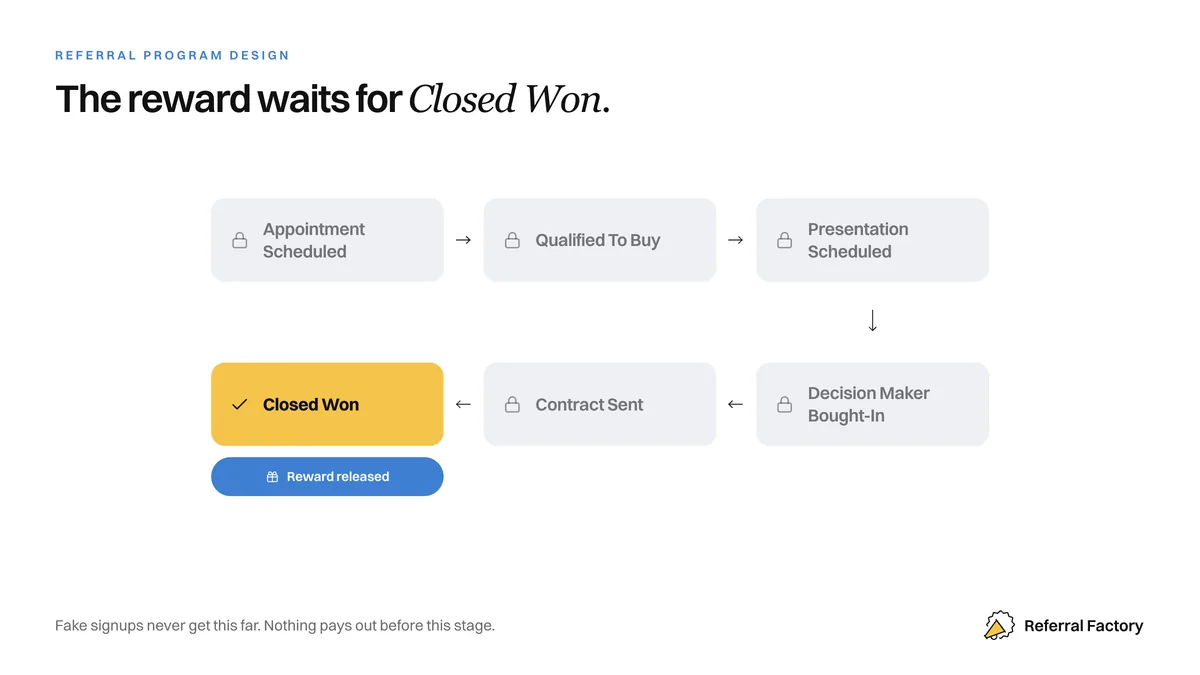
If you pay out the moment someone clicks a referral link, you're paying for traffic, not customers. Tie the reward instead to a real conversion: a purchase, a signed contract, a qualified lead, whatever event actually matters to your business.
Most referral fraud only works because the reward is triggered too early. A fraudster can fake a click, a form fill, even a signup. What they can't fake without spending real money is becoming a paying customer. Once the reward sits on the other side of a genuine conversion, cheating your program stops being free, and that alone kills most of it. Fix the timing and the three layers below become backup, not your main defense.
"Becomes a customer" doesn't have to mean a single signup or a first payment, either. You can stack more than one check into the definition. iKhokha, a payments company whose referral program runs on Referral Factory, learned this the practical way: an earlier version of their program paid the reward once a referred business put through its first small payment, and a few dishonest people worked out they could sign up a card machine, process the bare minimum, collect the reward, and walk away. So the team redesigned the trigger. Now the R500 reward only pays once the referred business is verified and has processed at least R1,000 in real payments, proof it's genuinely trading, and the program checks the IP addresses behind referrals before any payout goes out, so a syndicate gaming the program from a single location gets spotted before the money moves. Thousands of iKhokha's customers now refer through that program, referred businesses convert at close to one in five, and every reward paid is tied to a real, trading customer. Define "converted" as strictly as your business needs, because the stricter the definition, the less there is to cheat. This works even when there's no online checkout at all: if your sales close in meetings or over the phone, the conversion milestone simply lives in your CRM instead, and we've covered how to track referrals when there's no checkout in its own guide.
The hard part is usually seeing that conversion happen without checking manually, especially once your program has tens of thousands of advocates referring at the same time. This is where an integration does the work. An integration is simply a connection between two tools you already use: you link your referral software to your CRM (the software your sales team uses to track leads and deals, like HubSpot or Salesforce) or to your payment provider (the tool that processes your customers' payments, like Stripe). Once they're connected, your referral software can see the moment a referred lead becomes a paying customer and send the reward automatically. No spreadsheets, no manual matching, and no delay for the person who made a real referral.
Layer 1: Catch Duplicate Accounts
The most common type of referral fraud is also the simplest: someone refers themselves with a second email address to claim both sides of the reward.
Watch for shared signals between the referrer and the referred account. The same IP address (the internet address that shows which network someone signed up from), the same device, payment method, or shipping address on both is the giveaway. If the "friend" signed up from the same living room as the person who referred them, it's usually not a friend. Referral software that flags users as suspicious when they sign up from the same IP address, or with near-identical email addresses, catches most of this automatically.
This is the version of fraud that's easiest to automate away. IP checks alone catch most self-referrals without anyone on your team going looking for them, which matters when your referral program has tens of thousands of participants and nobody is reviewing signups by hand.
Layer 2: Cap Volume
A genuine customer might refer a handful of people. Hundreds of referrals from one account in a short window isn't word of mouth. It's usually a bot, or someone reselling links and codes somewhere they shouldn't be.
Put a limit on how many referrals one person can make, or how much they can earn, in a given period. This one rule quietly kills most bulk abuse without adding friction for real referrers: your best advocate referring twelve people a year never notices a cap set at fifty a month.
Caps have a second benefit at scale. They make your reward budget predictable. When you're running a program with tens of thousands of advocates, a per-person earning cap means no single account, legitimate or not, can blow a hole in your payout forecast. That predictability is worth naming in any budget conversation: it's what turns referral spend from an open-ended liability into a line item you can defend, and it feeds straight into how you calculate the ROI of your referral program.
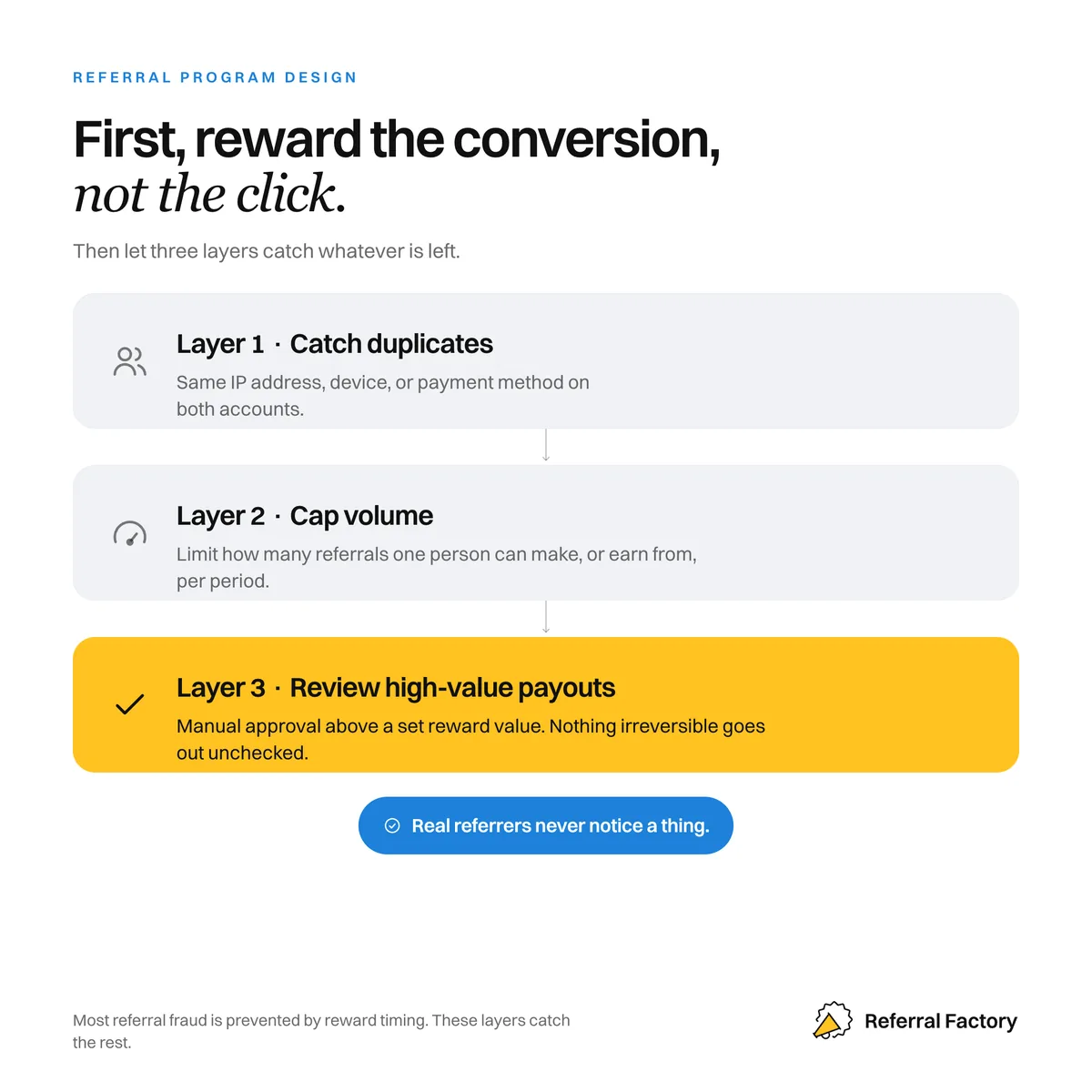
Layer 3: Review High-Value Payouts
Add a review step before money goes out, especially for cash or high-value rewards. A short delay or a manual approval above a certain reward value gives refunds and chargebacks (payments a customer later disputes with their bank) time to surface before a payout is final. This layer matters more the bigger your program gets, because the bigger the reward pool, the bigger the target it makes: checking before you pay is what let iKhokha run cash rewards at scale without the reward pool becoming a liability.
This layer costs you almost nothing in program momentum. Most rewards clear automatically. Even in programs paying out thousands of rewards a month, only the handful above your review threshold ever wait for a human. But it's the layer that saves you when something slips past the first two: the referred customer who buys, triggers the reward, and refunds a week later.
A Few Smaller Defenses Worth Adding
None of these replace the layers above, but they're worth switching on:
- User verification. Before anyone can join your program, as a referrer or as a referred lead, they're sent a one-time code to their email address and have to enter it to continue. That one step proves the email is real and working, which rules out the invented addresses most fake signups rely on.
- One signup per email. Blocks the simplest version of self-referral at the door.
- reCAPTCHA on referral landing pages. This is the "I'm not a robot" check you've seen on other websites. Adding it to your referral pages stops bots and automated scripts from submitting fake referrals in bulk.
Each of these takes minutes to enable and runs silently in the background. Real referrers barely notice them. Fraudsters hit a wall.
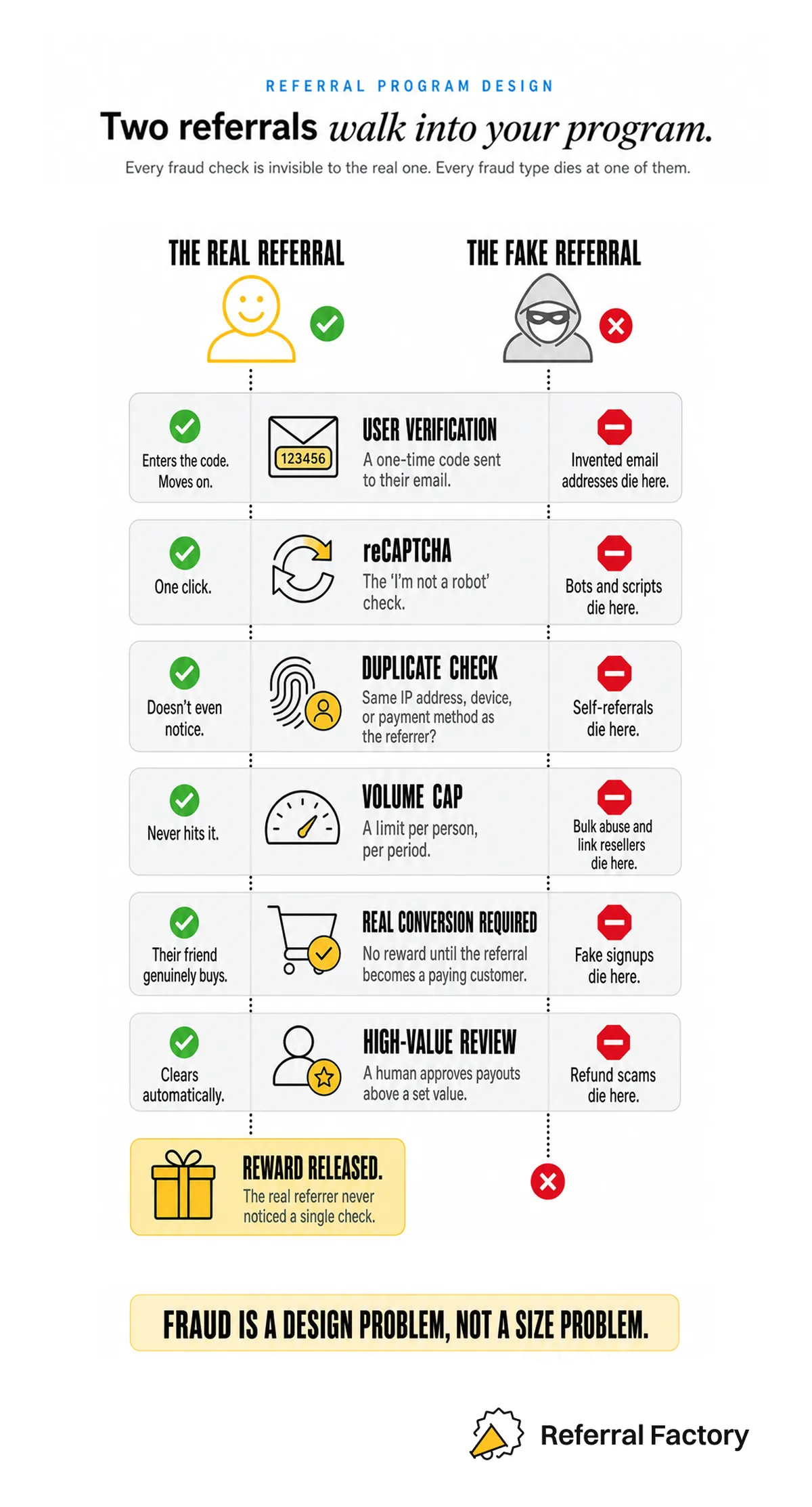
Won't All These Checks Put Real Referrers Off?
No, and it's worth understanding why. Most people don't refer because they've calculated the reward. They refer because they've found something that works and they want their friends to have it too. The reward is a thank-you that removes the awkwardness of recommending, not the reason the recommendation happens. That's why double-sided rewards work so well: the referrer isn't selling to their friend, they're handing them something. We've written more about the psychology behind referrals if you want the full picture.
A genuine customer sharing their link with a few friends sails through every check in this post without ever seeing one. The only people who feel the friction are the ones trying to be fifty customers at once.
Fraud Isn't a Reason to Wait
So how do you prevent referral fraud? Mostly by design.
Reward the moment a lead becomes a customer, not the moment a link gets clicked. Add duplicate detection so self-referrals get flagged automatically, volume caps so bulk abuse never pays, and a review step on high-value payouts so nothing irreversible happens before you've had a look. Do that and fraud stops being a real risk to your referral program, and stops being an excuse not to run one. It also stops being an objection anyone else in the building can raise: a program built this way is one you can put in front of your finance team with a straight face.
See how Referral Factory connects to your CRM or payment gateway →
FAQ
What is referral fraud?
Referral fraud is when someone games a referral program to earn rewards they didn't legitimately generate. The most common forms are self-referral (one person posing as both referrer and referred friend), bot-submitted fake referrals, and bulk sharing of links or codes to strangers who were never going to become customers.
What's the most common type of referral fraud?
Self-referral. Someone signs up again with a second email address to claim both sides of the reward. It's also the easiest to stop: enforce one signup per email and flag accounts that share an IP address, device, or payment method.
Can you prevent referral fraud without adding friction for real customers?
Yes, and that should be the design goal. Reward timing, duplicate flagging, volume caps, and payout review all work in the background. A genuine customer sharing their link with a few friends never encounters any of them.
Do I need separate fraud detection software for my referral program?
No. If your referral platform rewards on conversion and has duplicate flagging, volume caps, user verification, and reCAPTCHA built in, that covers the large majority of real-world referral fraud without a separate tool. These belong on your checklist of referral software features to look for before you choose a platform.
Does referral fraud get worse as a referral program grows?
Attempts increase with visibility, but the share that succeeds shouldn't. Every defense in this post is automated, so it scales with the program: whether you have two hundred advocates or twenty thousand, duplicates get flagged, caps hold, and only payouts above your threshold wait for a human. iKhokha runs cash rewards with thousands of active referrers on exactly this design. Fraud is a design problem, not a size problem.
Referral link generator (free)
We take your website, send it to Referral Factory, and provision a real referral program for your brand. The link you get is a live referral URL your customers can share, backed by tracking and rewards in the app - not a static "generator" preview. This is the fastest way to see what a real referral program would look like for your brand! Try it below...