
Industry-specific guidance showing how referral marketing works in real operating contexts.
By Kirsty Sharman

Short answer: three groups, and only one of them is your clients. Accounting, tax and consulting firms get introductions from their own clients, from the other professionals who sit around the same client, and from their own employees. Those three groups want different things, hear about different trigger moments, and hand you a lead in different ways, so they need three separate referral programs rather than three versions of the same page.
Adam from Referral Factory on how professional services firms actually win referrals.
Ask a firm where its new business comes from and almost everyone says referrals. Ask the same firm how many referrals it got last quarter, which clients sent them and what each one was worth, and it goes quiet. The gap between those two answers is usually a question nobody has written down: who is actually doing the referring.
How buyers actually pick a firm
The numbers in this sector are not close, which is worth establishing before we get to who is doing the recommending.
TaxDome's 2025 Niche Business Accounting Report, based on a survey of more than 350 US business decision makers, found that 92% say referrals are critical when choosing an accountant, and that 58% found their current firm through a peer recommendation rather than advertising or search. The figures are in TaxDome's announcement of the report. Coverage of the same study in CPA Practice Advisor puts the peer referral figure at 57% and notes that only 3% chose an accountant through advertising.
The pattern holds in other professional services. The Legal Services Consumer Panel's 2025 tracker survey on how consumers choose legal services, which ran from February to April 2025 across 3,750 legal services users, found a family or friend recommendation was the single most common reason for choosing a provider, at 18%.
So word of mouth marketing is not a nice extra in this sector. It is how the work arrives. Which makes the next question the operational one: whose mouth.
Who refers professional services firms: the three groups
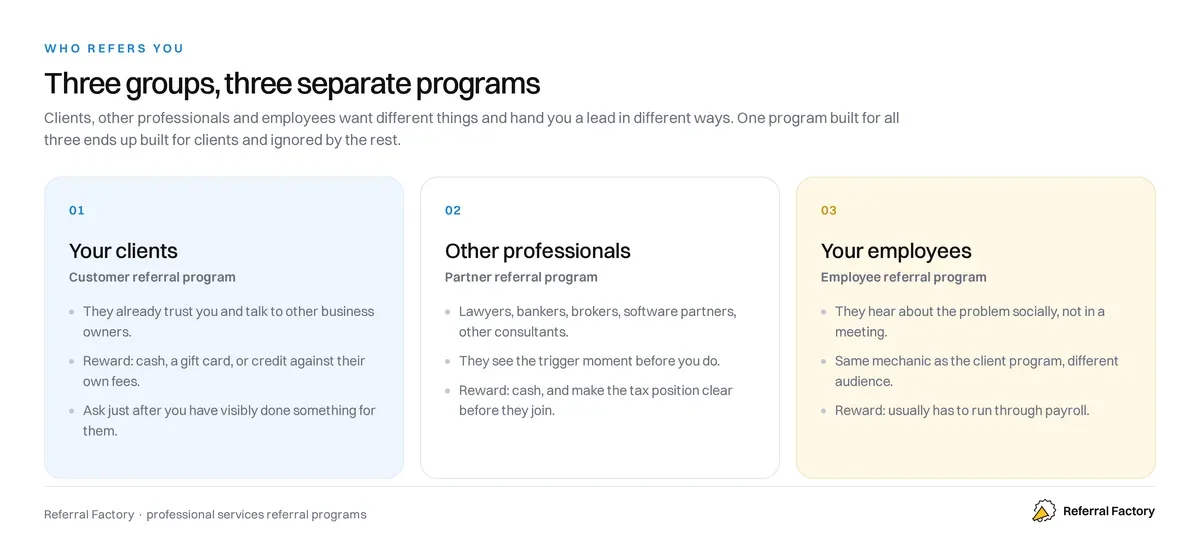
The reason to split them is not tidiness. It is that almost every design decision comes out differently per group.
The reward is different, because credit against your fees means something to a client and nothing to a lawyer. The sign-up page is different, because a client needs one sentence and a partner needs the tax position. The ask is different, because an employee is hearing about a problem at a barbecue and a banker is seeing a funding round close. And the way the lead arrives is different, which is the part that quietly decides whether any of it gets tracked.
One accounting software company we host runs the same mechanic twice, once for its clients and once for its employees. Same rewards, same structure, different audience, different sign-up form. That is the cheapest version of this: you are not building two programs from scratch, you are running one twice with the words changed.
If you want the detail on the employee side specifically, including the fairness questions that come with it, we covered it in our guide to building an employee referral program.
Running the same mechanic for more than one audience is also how a program gets to a size worth measuring. A fintech we work with runs its customer program this way and converts referrals 8x better than paid ads.
The group most firms miss
It is the partners, and the reason is that firms think of referrals as a thank you to clients rather than as a channel.
The other advisers around your potential client see the trigger moment before you do. A company being set up. A business changing hands. A funding round. A family situation that has just become a tax problem. The lawyer, the banker, the broker and the software partner are all in the room at that moment, and you are not.
The most sophisticated professional services program we host doesn't only ask clients to refer. It runs a customer program and a second, separate program for other professionals, and it makes the tax treatment clear to the professionals before they join. That last clause is the bit that makes it work. A partner who finds out about the tax position when the first payment lands is a partner who stops referring.
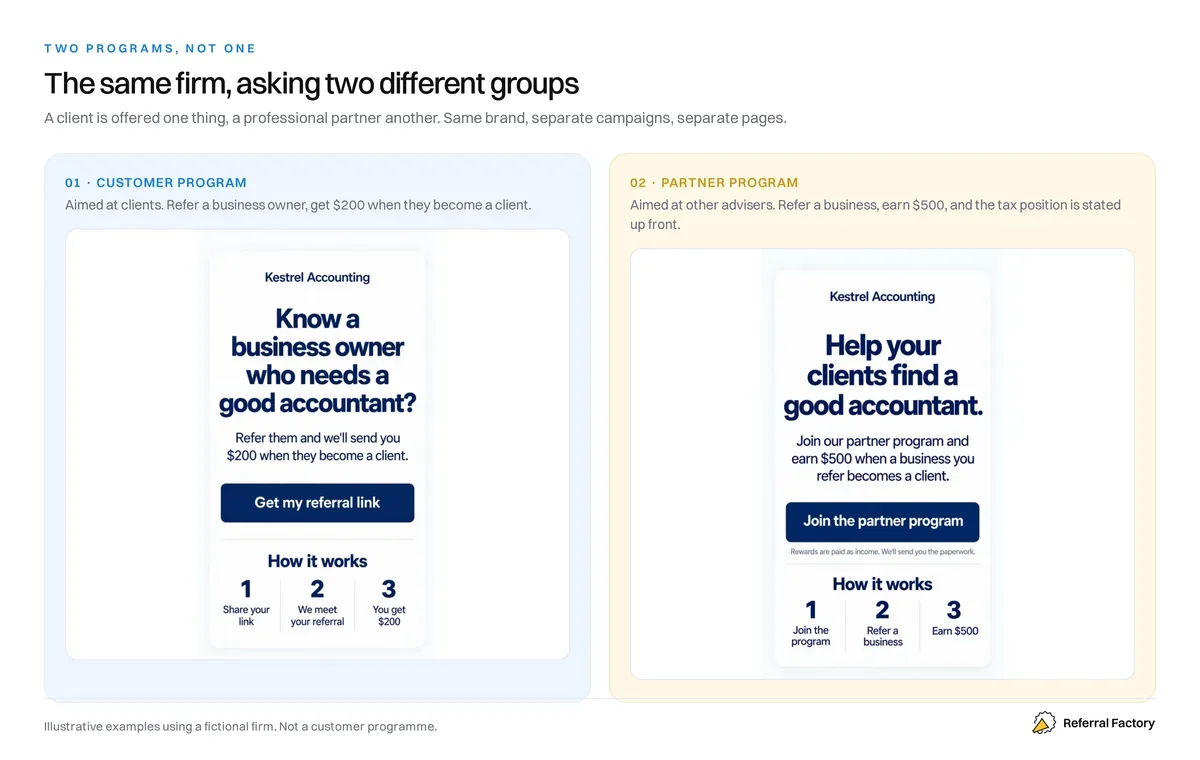
Illustrative examples of referral program sign-up pages using a fictional firm.
What to notice: same firm, two separate pages. The client is asked to refer a business owner, the adviser is asked to refer a business, and the amounts differ because the two groups are being asked for different things. Neither page is a version of the other.
Partner referrals also behave differently once they arrive. They tend to be better qualified, because the person making the introduction understands your work well enough to know when it fits, and they tend to be repeat rather than one-off. That is a different relationship to manage, and it is closer to a partnership than a thank you. Referral partner programs covers how to structure one, and marketing partners explained sets referral partnerships next to the other kinds.
Make it easy for each group to hand you the lead
Different referrers pass you a lead in different ways, and the job is to remove the friction in each case rather than to pick one method and hope.
| Referrer | How they prefer to hand it over | What to give them |
|---|---|---|
| A client | Forwarding a link in a message | A referral link they can paste anywhere |
| A partner, in a meeting | Typing in the name there and then | A lead submission form with their details pre-filled |
| A partner, face to face | Handing something across a desk | Their own link as a QR code on a business card |
| An employee | Mentioning it to you directly | A short internal form, so it still gets tracked |
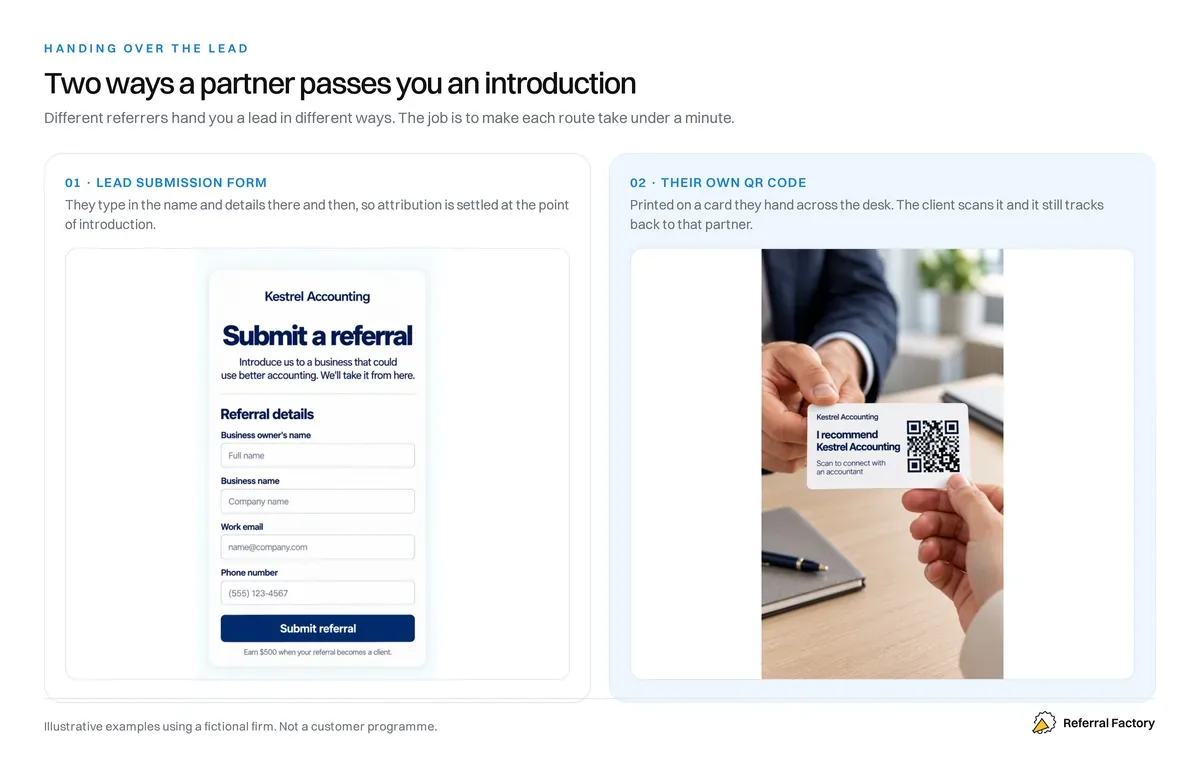
Illustrative examples of a referral program using a fictional firm.
What to notice: neither route asks the partner to find a link later. They either type the name in while the conversation is still happening, or hand over a card that tracks back to them. The introduction gets recorded at the moment it is made.
The lead submission form is the one that changes behaviour most for partner programs. The partner types in the name and details of the person they are introducing, and attribution is settled from the start rather than reconstructed later. The QR code version solves the same problem in the physical world: the client scans it at the desk and the introduction still tracks back to that specific partner.
Whatever route they use, the introduction has to end up somewhere you can count it. Plenty of referrals in this sector never touch a link at all, which is a tracking problem rather than a referral problem, and we wrote about how to solve it in how to capture word of mouth referrals and how to track referrals when there's no checkout.
Start with one group. Pick the one you already have the most goodwill with, run it for a quarter, and add the second program once the first one is producing. The sector picture is in how consulting and service businesses win more clients through referral marketing, and you can see how firms set this up on our consulting referral programs page or in what is referral software.
FAQ
Who refers the most business to accounting and consulting firms?
Clients and other professionals, in roughly that order, with employees a smaller but real third. TaxDome's 2025 survey of more than 350 US business decision makers found 58% had found their current accounting firm through a peer recommendation, and 92% said referrals were critical to the choice.
Should we run one referral program or several?
Several, if you are asking more than one kind of person. Clients, outside professionals and employees need different rewards, different sign-up pages and different asks. Running one program for all three usually means it is designed for clients and ignored by everyone else.
What is a partner referral program?
A program for people who are not your clients but sit near them professionally: lawyers, bankers, brokers, software partners, other consultants. They see the moment a client needs you before you do, and they refer repeatedly rather than once.
Can we pay other professionals for referrals?
In most places yes, as long as the arrangement is disclosed to the client. The compliance work is the disclosure rather than the payment, and it is a decision you make once.
How do we track a referral that never touches a link?
Give the referrer a way to submit the lead directly, through a short form or a QR code tied to them, so attribution is recorded at the point of introduction. Trying to reconstruct it afterwards from memory and email is where most firms lose the data.
Referral link generator (free)
We take your website, send it to Referral Factory, and provision a real referral program for your brand. The link you get is a live referral URL your customers can share, backed by tracking and rewards in the app - not a static "generator" preview. This is the fastest way to see what a real referral program would look like for your brand! Try it below...