
Reward design, incentive strategy, payouts, and commission structures.

By Kirsty Sharman

Short answer: it depends entirely on who is referring you. Credit against future fees is a good reward for a client who will keep buying from you, and it costs you margin rather than cash. It is worth nothing to the three groups who send professional services firms most of their best work: other professionals, employees, and people at client companies who do not pay your invoices themselves. Pay those people in cash or let them choose.
Adam from Referral Factory on choosing between cash and credit.
The appeal of credit is obvious. You are a firm that sells hours, so a discount on hours feels cheaper than money leaving the bank, and it keeps the relationship going. That logic is sound right up to the moment you look at who is actually making your introductions.
Why credit is the obvious answer and the wrong default
Credit against fees has three real advantages. It costs you margin rather than cash, which matters when the reward is released months before the client pays you. It is easy to administer, because it is a line on an invoice rather than a payment run. And it locks the referrer in for another piece of work.
Then you ask who refers professional services firms, and the advantages start falling away. A lot of the best introductions in this sector come from people who will never receive one of your invoices. The lawyer who sees a business changing hands. The banker who sees a funding round. The software partner sitting next to the problem you solve. Your own employees. A finance director at a client company who made the introduction personally.
Credit is worth nothing to any of them. Offer a lawyer 10% off your tax work and you have offered them a discount on something they were never going to buy. Worse, in the one case where credit technically lands, the finance director's employer, it lands on the wrong party: the company gets money off its bill, and the human who put their own reputation on the line gets nothing.
That is the whole argument, and it is why the question is not really cash versus credit. It is: who is this reward for, and can they actually spend it? The general case for different referral rewards and what each one costs you holds here too, but professional services has this extra wrinkle that most reward advice skips.
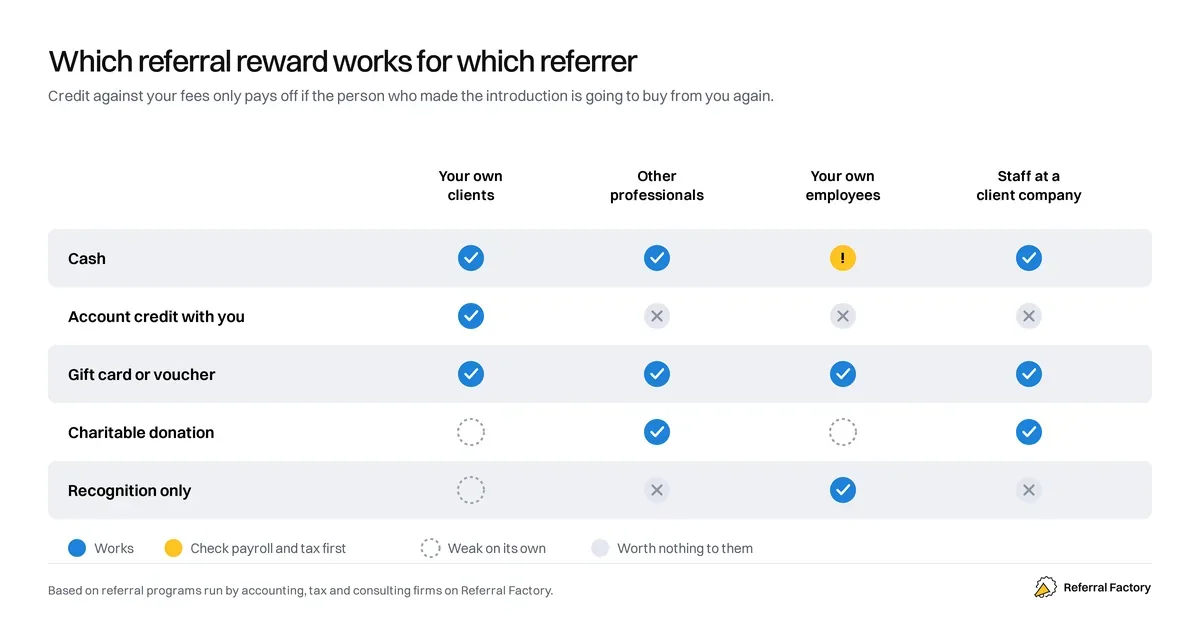
Cash or credit referral reward: which works for which referrer
| Reward | Your own clients | Other professionals | Your own employees | Staff at a client company |
|---|---|---|---|---|
| Cash | Works | Works | Check payroll and tax first | Works |
| Account credit with you | Works | Worth nothing to them | Worth nothing to them | Worth nothing to them |
| Gift card or voucher | Works | Works | Works | Works |
| Charitable donation | Weak on its own | Works | Weak on its own | Works |
| Recognition only | Weak on its own | Worth nothing to them | Works | Worth nothing to them |
Three things in that grid are worth saying out loud.
Cash is the only reward that works for everybody, and it is the one with the most admin. For employees it usually has to run through payroll, which is one of several reasons an employee referral program is worth setting up separately, and for professionals it is taxable income on their side. Neither is a reason to avoid it. Both are reasons to say so up front.
Gift cards are the quiet workhorse. They are the closest thing to cash that avoids payroll, they feel like a thank you rather than a transaction, and nobody has to ask their employer whether they are allowed to accept one. For a firm that wants a single reward across every group, this is usually it.
Credit earns its place in exactly one column. Give a client a credit against next year's fees and you have discounted work they were going to buy anyway, which costs you margin instead of cash and keeps them for another year. That is a genuinely good deal. It is also the only square on the grid where it is true.
If you want the general version of this decision, outside professional services, we set out the main referral program incentives and what the data says about each.
What firms actually pay
We host referral programs for accounting practices, tax firms and consultancies, and the amounts are less standardised than you would expect. Two live examples show the range.
A UK estate planning practice pays 5% commission, and tells its referrers that it works out at around £77 per client. A US business consulting firm pays 10% of its own revenue on the deal, released only once the work is finished and the client's money has landed.
The 5% firm does something the 10% firm doesn't, and it is the more important decision of the two: it says what the percentage comes to. A percentage on its own asks the referrer to estimate your fees, which they cannot do, so they file it under "something, probably not much" and never think about it again. Put the average next to it and the offer becomes a number people can picture.

An illustrative example of a referral program sign-up page using a fictional firm.
What to notice: the offer does not stop at the percentage. It says what the percentage usually comes to, so the referrer is looking at a number rather than a sum they cannot do. The three step strip underneath does the same job for the process.
There is no benchmark here, and I would be careful of anyone who offers you one. No published research establishes a normal referral fee for professional services. What exists is what firms actually do, and they disagree with each other, which is why the useful question is what your own deal is worth rather than what the going rate is. If you want to work that out properly, we set out the arithmetic in calculating the value of a referral reward.
If you want a published number rather than a range, a fintech we work with converts referrals 8x better than paid ads, which is the kind of return that makes almost any sensible reward look cheap.
One mistake worth naming, because it is the most common one in B2B. If a finance director at a client company refers you, reward that person, not their employer. A credit against the company's invoice rewards a business that did nothing and never reaches the human who put their own name on the recommendation.
How to choose, in four steps
- Write down who you are asking. Clients, other professionals, employees, or people inside client companies. Most firms have at least two of these and run them as separate programs, which is also how you end up with a reward that fits each group.
- Rule out anything that group cannot spend. This removes credit for everyone except clients, and it removes recognition-only for anyone outside your own payroll.
- Pick one reward per group and say what it is worth in money. If you go with a percentage, put the average next to it.
- Offer a second option where you can. A choice between cash and a donation costs you nothing and keeps the referrer whose employer has a policy about accepting payments.
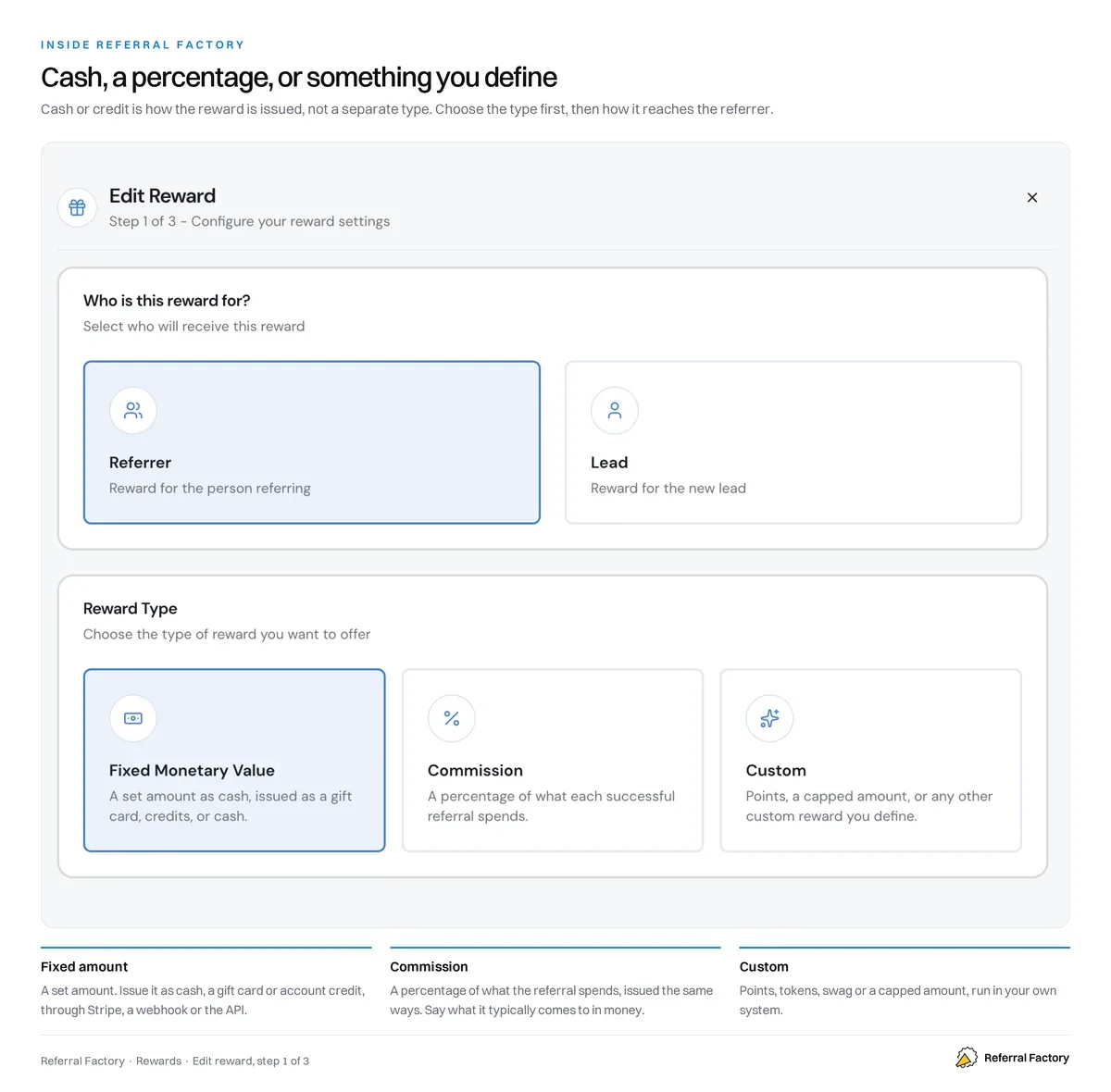
If you reward the referred client as well as the referrer, the same logic applies on their side, which is the thinking behind a double sided referral program. And once the reward is settled, the next decision is when it gets released, which for firms with long sales cycles is its own problem: how to pay a referral reward when the sale takes months.
For how this plays out across the sector, see how consulting and service businesses win more clients through referral marketing and our consulting referral programs page. If you are comparing ways to run it, what is referral software is the place to start.
FAQ
Is cash or credit better as a referral reward?
Cash works for every kind of referrer. Credit only works for clients who will buy from you again, because it is worth nothing to a lawyer, a banker or an employee. If most of your introductions come from outside your client base, cash or a gift card is the safer default.
How much should an accounting firm pay for a referral?
There is no published benchmark, and the firms we host are a long way apart. One UK practice pays 5% commission, which averages around £77 per client. A US consulting firm pays 10% of revenue on the deal. Size it against what a client is worth to you over the relationship rather than against a rate someone quoted you.
Can we offer a discount on fees instead of paying a referral reward?
Yes, for clients. It costs margin rather than cash and keeps them for another engagement. Just don't use it as your only reward, because the moment a non-client refers you, you have nothing to offer them.
Should the referral reward go to the person or to their company?
To the person who made the introduction. Crediting the company rewards an organisation that did nothing and misses the individual who spent their own credibility, which is the thing that makes a second referral likely.
Do we have to pay tax on referral rewards?
The recipient usually does, and the position differs for employees, clients and outside professionals. Tell referrers how the reward is treated when they join rather than when it is paid. Firms that do this lose fewer referrers at the first payout.
Referral link generator (free)
We take your website, send it to Referral Factory, and provision a real referral program for your brand. The link you get is a live referral URL your customers can share, backed by tracking and rewards in the app - not a static "generator" preview. This is the fastest way to see what a real referral program would look like for your brand! Try it below...