
Examples, templates, checklists, and practical inspiration you can adapt quickly.

By Kirsty Sharman

Short answer: yes. In most countries an accountant can pay someone for a referral. What the professional codes attach to it is a condition, not a ban: you have to tell the client. The ACCA Code of Ethics and Conduct asks members to disclose referral fee and commission arrangements to the client in writing, and the AICPA Code covers the same ground in section 1.520, Commissions and Referral Fees. So the compliance job is the disclosure, not the payment.
This is the question that stops most firms before they start. Somebody suggests a referral program, somebody else says we're regulated, we can't pay for work, and the idea dies in the meeting. It's worth getting the answer right, because the thing people are worried about is usually allowed and the thing that actually needs doing is small.
One caveat before we go further. Rules differ by country, by regulator and, in the United States, by state board, and nothing here is legal or professional advice. Check your own regulator's wording once, then design the program around it.
Can accountants pay for referrals? What the professional codes say
Start with the UK, because the wording is unusually clear. ACCA's guidance on accounting to clients for commissions and fees treats a referral fee as a self interest threat, which is the Code's way of saying it could pull you away from acting in the client's interest. It does not ban the fee. It asks you to put a safeguard in place, and the first safeguard it names, at paragraph 310.17(a) of the Code of Ethics and Conduct, is "disclosing to the client in writing any referral fees or commission arrangements paid to, or received from, another professional accountant or third party for recommending services or products".
In the United States the same ground sits in section 1.520 of the AICPA Code of Professional Conduct, Commissions and Referral Fees, and state boards adopt their own version of it. Ohio's is a good example of how plainly it is usually put. Rule 4701-11-04(E) says a permit holder who accepts a referral fee for recommending services, or who pays one to obtain a client, "shall disclose such acceptance or payment to the client". Note what that rule does not say: it does not require the disclosure in writing, and it does not say when. Other states and other regulators are stricter, which is why the state or country you are licensed in is the one that decides.
The pattern repeats almost everywhere we look. Paying for an introduction is allowed. Hiding it is not. That is a much smaller problem than the one most firms think they have, and you only have to solve it once.
Two things sit outside this and are worth naming so you don't trip over them. The first is a finder's fee paid to a professional intermediary who is actively working the deal, which is a different arrangement with different paperwork. The second is financial services, where the rules are their own world: we wrote that up separately in are referral programs legal in financial services.
The three compliance jobs, and you do each one once
Once you accept that the payment is allowed, the work in front of you is short and it is all front-loaded.
| The job | What it actually means | When you do it |
|---|---|---|
| Your own regulator's wording | Read the referral fee clause in your code once, then write the disclosure line into the program terms and conditions | Before launch, once |
| Tax, on both sides | A reward paid to a professional is income. In the US, payments of $2,000 or more in a year trigger reporting, for payments made after 31 December 2025 | Before launch, once |
| The referrer's own employer rules | A finance director at a client company may have a code of conduct about accepting payments from suppliers | Built into the reward choice |
The firms we host that clear compliance fastest are the ones that put the tax treatment in front of their referrers before they join, rather than at the point the first reward is paid. It sounds like a small sequencing detail. It is the difference between a partner reading one sentence while they sign up and a partner getting an unexpected tax question nine months later, which is the moment programs quietly lose their best referrers.
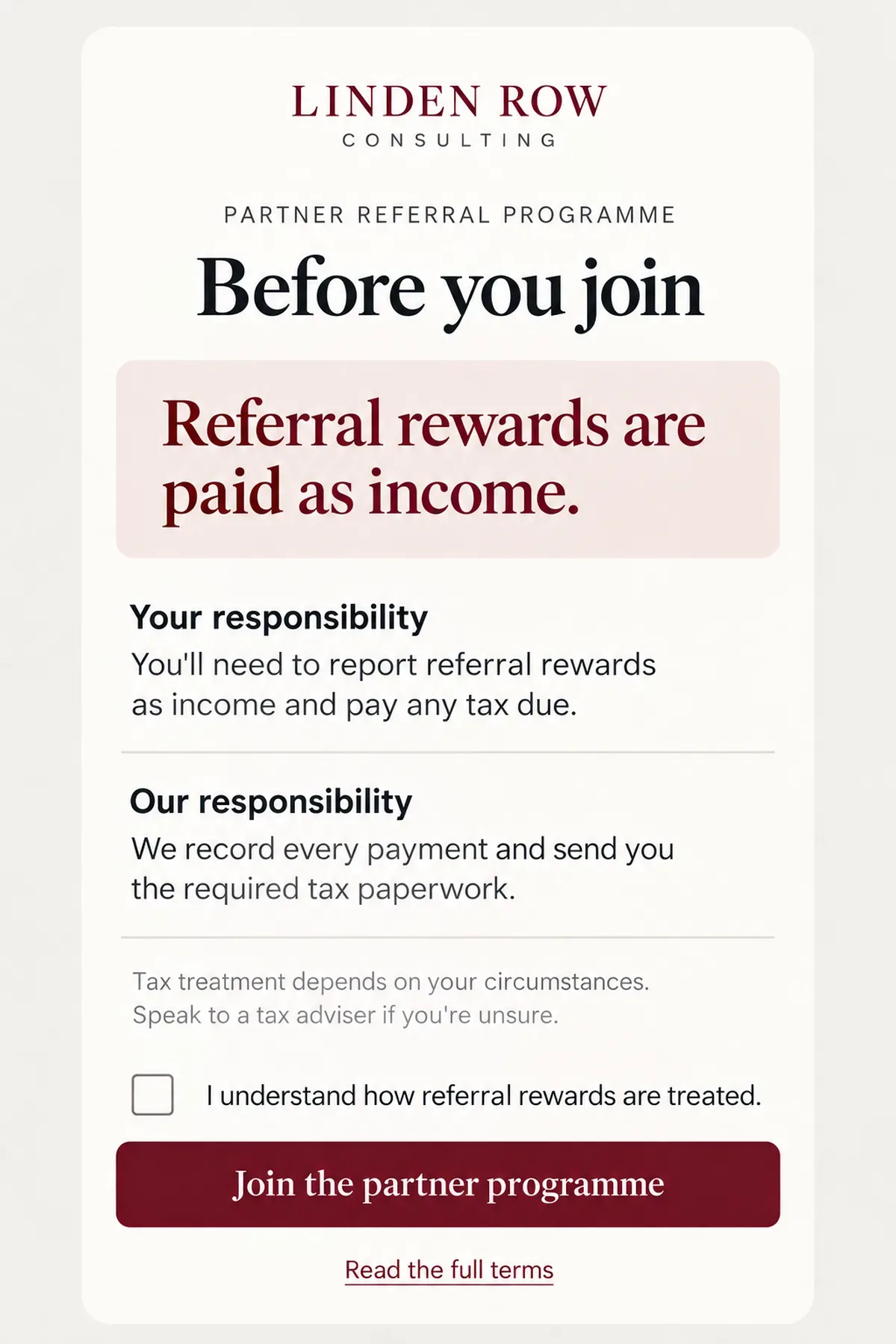
An illustrative example of a referral program sign-up page using a fictional firm.
What to notice: the tax position is on the sign-up page itself, so a partner reads it before they join rather than hearing about it when the first reward is paid. It is also split in two, what the referrer has to do and what the firm will do, which is what stops the question coming back later.
That third row is the one firms forget. You cannot police somebody else's employment contract, and you are not meant to. What you can do is offer a choice of referral reward so that a referrer whose employer frowns on cash has something else to take. A charitable donation in their name, or a credit against their own fees, keeps the person in the program instead of pushing them out of it.
The general, non-sector rules still apply underneath all of this: disclosure to anyone reading a recommendation, data protection on the details you collect, and sensible terms. Those are covered in legal compliance for referral programs.
What a compliant program looks like in practice
Draw the flow out and the compliance work stops being a cloud and becomes one box.
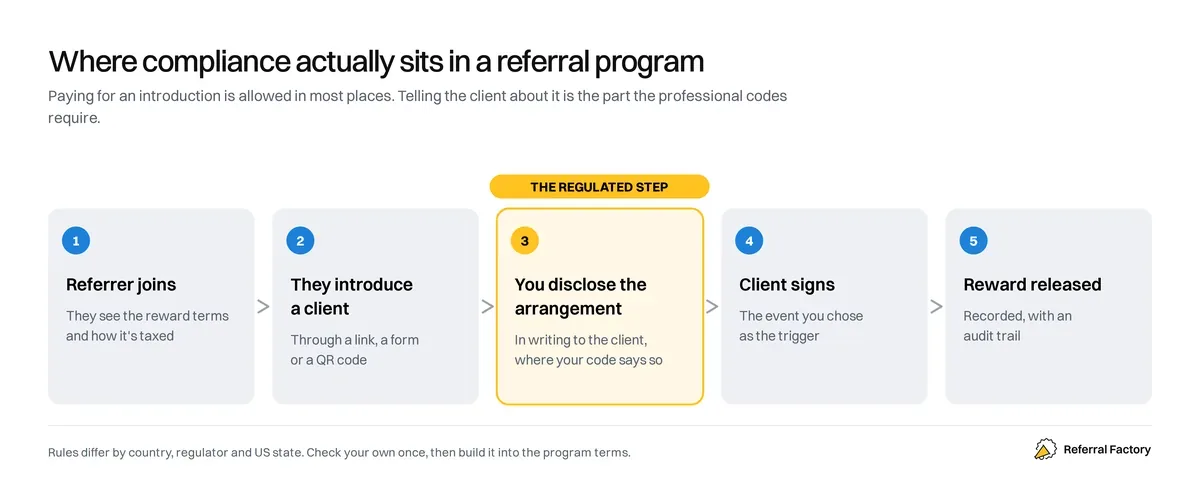
The most sophisticated professional services program we host runs two separate campaigns, one for clients and one for other professionals, and it makes the tax position clear to the professionals before they join. Nothing about that is exotic. It is a sentence in the sign-up page and a sentence in the terms.
The disclosure itself does not need to be a document. For most firms it is a line in the engagement letter saying that you may pay a fee to the person who introduced them, and that it does not change what the client pays you. Say it in plain words. A client who reads it and shrugs is the outcome you want, and that only happens when the sentence sounds normal rather than defensive.
The part worth automating is the record. If a regulator, or a partner, or your own future self asks who was paid what and when, you want an answer that takes a minute. Referral tracking records which client came from which referrer and when the reward was released, which is the audit trail you'd otherwise be rebuilding out of email. Firms in other regulated sectors use the same approach, and we went through it in how referral software helps regulated industries.
None of this is theory. A regulated fintech we work with runs its entire program on that basis, discloses plainly, keeps the record, and converts referrals 8x better than paid ads.
How to get it signed off, in four steps
- Find the referral fee clause in your own code and copy it out. One clause, one afternoon. You are looking for whether disclosure has to be in writing and whether it has to happen before the engagement starts.
- Write the disclosure sentence. One sentence, in client language, that goes in the engagement letter and the program terms. Use the same sentence in both places.
- Decide who you are paying and what you are paying them. Clients, other professionals and employees sit in different positions, and the professionals are the ones with the tax and employer questions. Referral partner programs are worth setting up separately from the client program for exactly that reason.
- Take the sentence, the reward and the flow to whoever signs off. Not the idea. People approve a page they can read; they stall on a concept they have to imagine.
That is the whole compliance project. Everything after it is the ordinary work of running a program: picking the reward, deciding what event releases it, and giving people an easy way to make the introduction. We covered the reward decision for firms with long sales cycles in how to pay a referral reward when the sale takes months, and the broader picture for the sector in how consulting and service businesses win more clients through referral marketing. If you are weighing up building this yourself, start with what is referral software, or look at how firms in your sector set it up on our consulting referral programs page.
FAQ
Can accountants pay for referrals?
In most jurisdictions, yes, provided the arrangement is disclosed to the client. ACCA's guidance asks members to disclose referral fees to the client in writing, and the AICPA Code handles the same ground in section 1.520. Individual state boards and national regulators can be stricter, so confirm your own before you launch.
Does the disclosure have to be in writing?
Under the ACCA Code, yes, for referral fees and commission arrangements. Elsewhere it varies. Writing it down is the safer default anyway, because a line in the engagement letter costs nothing and settles the question permanently.
Is a referral fee the same as a finder's fee?
No. A finder's fee usually goes to a professional intermediary who actively works to put the deal together, and it tends to be larger and governed by a separate agreement. A referral fee is a reward for an introduction. The distinction matters because the paperwork and the expectations differ.
Are referral rewards taxable?
Generally yes, for the person receiving them. In the US the Form 1099 reporting threshold rose from $600 to $2,000 for payments made after 31 December 2025, and it is indexed for inflation from 2027. The practical point is to tell referrers the tax position when they join rather than when they are paid.
What if the person referring us works for one of our clients?
Reward the individual who made the introduction, not their employer, and offer an alternative to cash. Their employer may have a code of conduct about accepting payments from suppliers, which is not yours to enforce but is a good reason to give people a choice.
Referral link generator (free)
We take your website, send it to Referral Factory, and provision a real referral program for your brand. The link you get is a live referral URL your customers can share, backed by tracking and rewards in the app - not a static "generator" preview. This is the fastest way to see what a real referral program would look like for your brand! Try it below...