
Industry-specific guidance showing how referral marketing works in real operating contexts.

By Kirsty Sharman

Short answer: run two programs rather than one. A seasonal client program that works hard in the weeks either side of the deadline, when clients are grateful and paying attention, and an always-on partner program aimed at the lawyers, bankers and bookkeepers who see a business needing a tax adviser in August as readily as in March. The quiet months are only quiet because the ask was built around the deadline.
Adam from Referral Factory on keeping referrals coming after tax season.
Every tax practice knows the shape of its year. A few months where the phone does not stop, then a long stretch where it does. The referral program tends to follow the same curve, and most firms treat that as a fact of the sector rather than something they chose.
Why referrals after tax season dry up
Three things happen at once when the deadline passes, and none of them are about demand.
The moment disappears. A referral ask works best just after you have visibly done something useful, and for a tax firm that moment is concentrated into a few weeks. Once the return is filed, the client goes back to not thinking about tax, which is the whole point of hiring you.
The reward stops being interesting. A discount on next year's return is a long way away in June. The reward did not change, the distance to it did.
The firm goes quiet too. The emails that carried the referral ask were deadline emails. When they stop, so does the ask, and nobody decides to stop asking. It just stops.
So the quiet is a design outcome, not a market fact. The demand for a tax adviser does not disappear in the off season. Businesses are set up, sold, restructured and investigated all year round. What disappears is the mechanism you were using to catch the recommendations.
The tax practices we host that produce introductions across the year all do a version of the same thing: they stop relying on the client, in that moment, as the only route in.
The two-track year
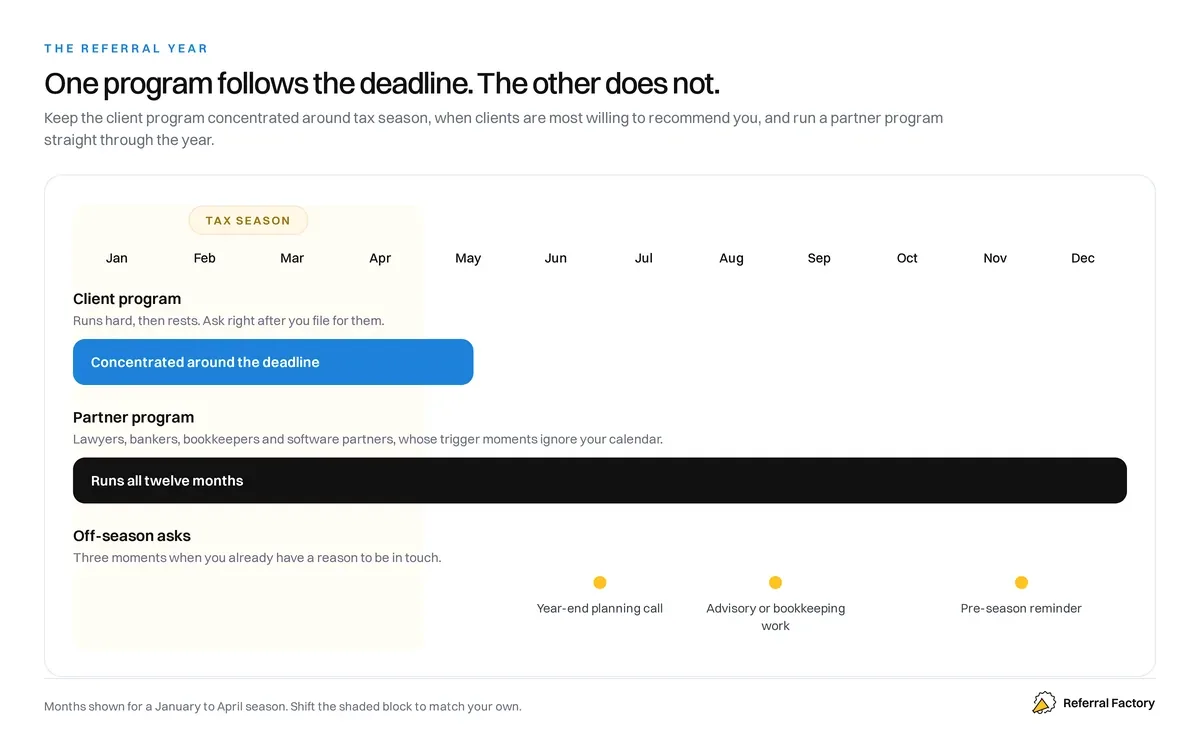
The client program should be seasonal. That is not a failure, it is the correct design. Your clients are most willing to recommend you in the days after you have filed for them, and a program built to catch that moment will always be busier in March than in July. Lean into it rather than fighting it.
The partner program is what covers the rest of the year, because the people in it are not working to your calendar. A lawyer handling a sale, a banker on a funding round, a bookkeeper whose client has outgrown them: all of those happen in August as readily as in March, and the person seeing them is not waiting for a deadline to think of you.
The practical difference is small. You are not inventing a second marketing function, you are running the same mechanic twice with a different audience, a different reward and a different sign-up page. One accounting software company we host does exactly this with clients and employees. The structure is the same, the words are not.
It is worth knowing what a continuous program can return before you decide it is too much trouble. A fintech we work with runs one all year and converts referrals 8x better than paid ads.
What to ask for in the quiet months
The off-season problem is not that clients have stopped liking you. It is that you have stopped having reasons to be in touch. So use the reasons you already have.
| Moment | Why the ask lands | What to offer |
|---|---|---|
| A year-end or planning call | You have just given advice they can use | The client program, with a reward they can picture |
| Advisory, bookkeeping or payroll work delivered | A visible piece of work outside the return | The same ask, attached to that delivery |
| The run-up to next season | Everyone is thinking about tax again before the deadline, not after | A reminder, plus the referred person's landing page |
| Any time, from a partner | Their trigger has nothing to do with your calendar | The partner program, running continuously |
Two things make these asks work rather than feel like marketing.
The first is that the reward has to be reachable now. A discount on next year's return is a promise about a date that is nine months away, which is why it stops working in May. Cash, a gift card or a credit against work they are actually buying this quarter does not have that problem, and our general guide to referral rewards covers how to size one. We go through the options in should professional services firms reward referrals with cash or credit.
The second is that the introduction has to be easy to make in whatever form it arrives. Plenty of off-season referrals happen in a conversation rather than through a link, and if there is no way to record them they are gone. That is a tracking problem with a known fix: how to capture word of mouth referrals.
How to set it up before next season
The off season is the right time to build this, which is the small irony of the whole problem: the quiet months are when you have the time to fix the quiet months.
- List the professionals who already send you work. Most firms can name five without checking. Those five are your partner program, and it does not need to be bigger than that to start.
- Give them a way to hand you a lead that takes under a minute. A short submission form where they type in the name and details, or their own link as a QR code on a card. Different people pass a lead over in different ways.
- Pick a reward they can actually use, and say what it is worth. For outside professionals that usually means cash, and it means being clear about the tax position before they join rather than when they are paid.
- Put three asks in the calendar now. One at the year-end call, one when you deliver advisory work, one in the run-up to the season. Written down in advance, they survive a busy month.
The decision about when the reward is released matters more here than in most sectors, because a partner introduction in August may not sign until the following spring. We went through the options in how to pay a referral reward when the sale takes months, and the compliance question that usually comes up next in are accountants allowed to pay for referrals.
For the sector picture, see how consulting and service businesses win more clients through referral marketing and our consulting referral programs page. Referral tracking is what tells you, next June, whether any of this worked, and what is referral software is the place to start if you are deciding how to run it.
FAQ
Why do referrals dry up after tax season?
Because the ask was attached to the deadline. The moment that prompted it has passed, the reward is now a long way off, and the emails that carried the ask have stopped. Demand for a tax adviser does not disappear in the off season, but the mechanism catching the recommendations does.
Should a tax firm run its referral program all year?
Run two. Keep the client program concentrated around the deadline, when clients are most willing to recommend you, and run a partner program continuously for the lawyers, bankers and bookkeepers whose trigger moments ignore your calendar.
What reward works in the off season?
Something the referrer can use now. A discount on next year's return is nine months away in May, which is why participation falls off. Cash, a gift card or credit against work they are buying this quarter all solve that.
When is the best time to ask a client for a referral?
Just after you have visibly done something for them. For a tax firm that is the week the return is filed, and then again whenever you deliver advisory, bookkeeping or planning work during the year.
How do we keep a partner program going without managing it constantly?
Start with the five professionals who already send you work, give each of them their own link or submission form, and let the tracking handle attribution and reward release. The administration people imagine is mostly the spreadsheet they would have kept instead.
Referral link generator (free)
We take your website, send it to Referral Factory, and provision a real referral program for your brand. The link you get is a live referral URL your customers can share, backed by tracking and rewards in the app - not a static "generator" preview. This is the fastest way to see what a real referral program would look like for your brand! Try it below...