
Examples, templates, checklists, and practical inspiration you can adapt quickly.

By Kirsty Sharman

Short answer: send the referred person to a page built for them rather than to your standard contact form, and tell the referrer what happens after they make an introduction. In professional services a referral starts an evaluation rather than ending one. Most people who get a recommendation still look you up before they make contact, so what they find at that moment is what converts them.
Referred leads do convert better than cold ones. That is well established and it is not what this post is arguing with. The point is narrower: a meaningful share of the recommendations made about your firm never turn into a conversation at all, and the reason is usually something you control.
The step nobody designs for
There is a gap between the recommendation and the first contact, and almost nothing gets built for it.
The Legal Services Consumer Panel's 2025 tracker survey on how consumers choose legal services surveyed 3,750 people who had used legal services, between February and April 2025. It found that 57% of consumers who received a recommendation still looked for additional information about the provider before contacting them. Somebody they trusted told them you were good, and the majority of them went and checked anyway.
That is a reasonable thing to do. People are handing over their accounts, their tax exposure or a business decision, and a recommendation from one person is a strong signal rather than a conclusion. The same report found a family or friend recommendation was the most common single reason for choosing a provider, at 18%, so the recommendation is doing real work. It is just not doing all of it.
Which means your firm gets evaluated twice. Once by the person who recommended you, who already decided. And once by the person they recommended you to, who is sitting with your website open and has never heard of you.
Where the referral actually leaks
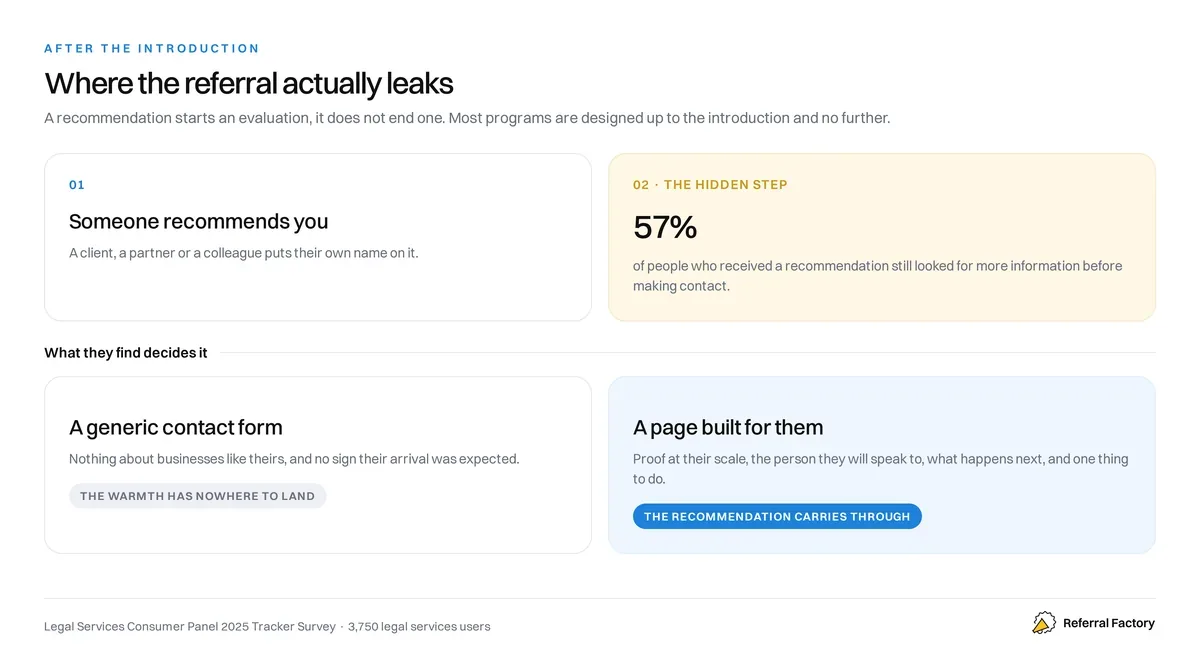
Most referral programs are designed up to the point of the introduction and no further. There is an ask, there is a reward, there is a referral link. Then the referred person arrives somewhere that was built for strangers, and the warmth of the recommendation has nowhere to land.
You can see it in what the page says. A generic contact form tells the visitor nothing about whether you work with businesses like theirs, gives them no reason to believe the person who sent them was right, and gives no sign that their arrival was expected. They were handed a reason to trust you and then shown a page that does not know who they are.
The fix is not a better form. It is a page that assumes the recommendation already happened and picks up the conversation from there.
The payoff for fixing this is large. A fintech we work with converts referred visitors 8x better than paid ads, and plenty of professional services firms are sending that same warm traffic to a page built for strangers.
How to convert a referred lead: what goes on the page they land on
Treat it as a credibility document rather than an offer. The best one we host leads with 400 completed applications, 40 years of combined experience and a client testimonial video, and only then asks for an email address. The order is the point: evidence first, ask last.
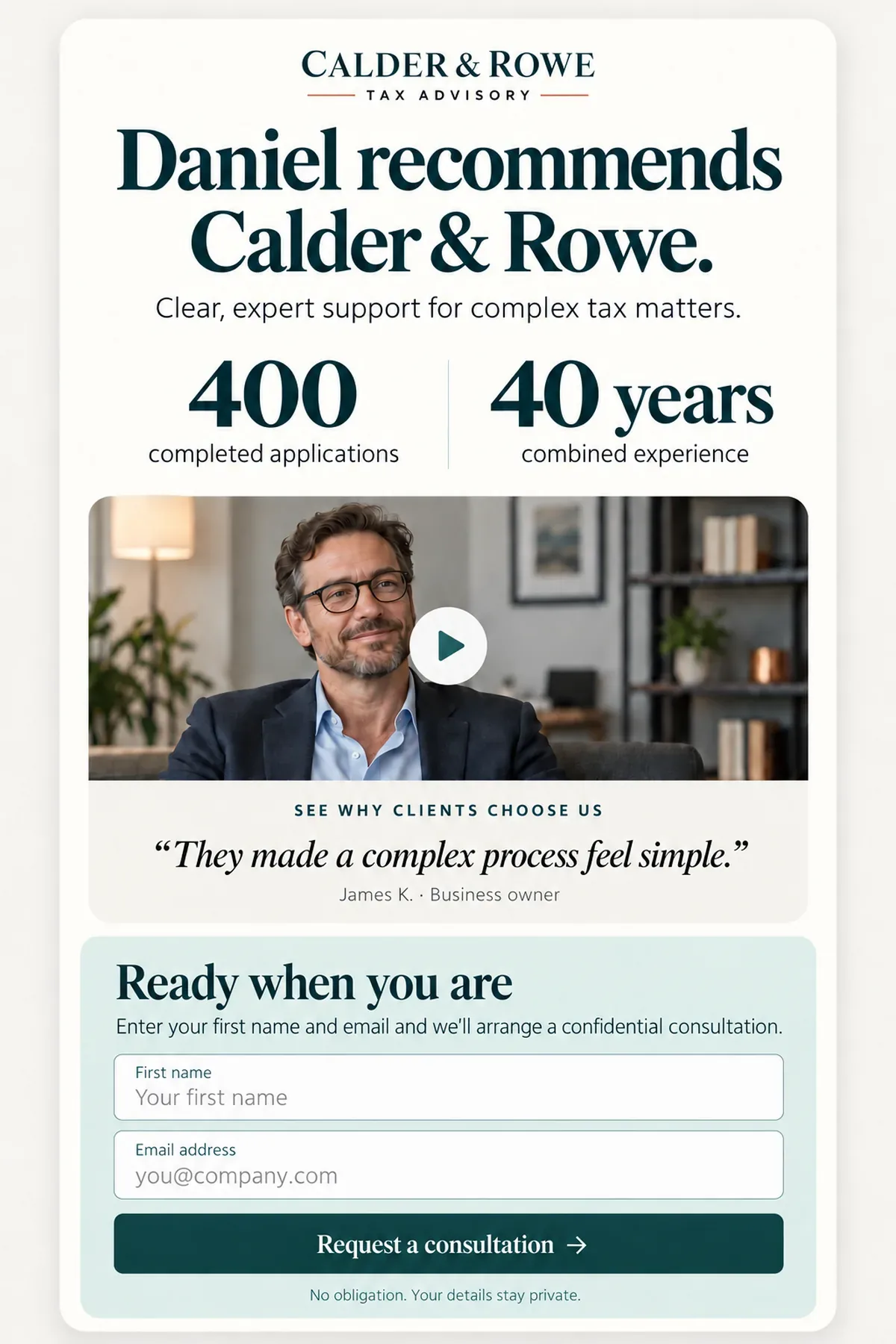
An illustrative example of a referral landing page using a fictional firm.
What to notice: the evidence comes first and the form comes last. A referred visitor gets the track record and a client's own words before anyone asks for an email address, which is the opposite of how most contact pages are built.
Four things earn their place.
| What to show | Why it works on a referred visitor |
|---|---|
| Proof at their scale | They are checking whether you handle businesses like theirs, not whether you exist |
| A named person they will speak to | Removes the fear of being routed into a call centre |
| What happens next, in order | The recommendation told them you were good, not what you are like to deal with |
| One thing to do | A referred visitor arrives ready. Two competing calls to action lose them |
Two more things worth getting right. Put the page on your own brand and your own domain, because a referred visitor who lands on something that looks like it belongs to a software company has just been given a reason to doubt the recommendation. And mention the recommendation itself where you can. A line as plain as "someone thought we'd be a good fit for you" tells the visitor they are in the right place.
This is the same idea as a referral landing page built for conversion, applied to a visitor who already half trusts you.
The other fix: tell people what happens when they refer you
The first fix catches the referral once it has been made. This one is about the referrals that never get made at all, and it is cheaper.
When someone hesitates to refer you, it is usually not because the reward is too small. It is because they are putting their own relationship on the line and they do not know what their friend is walking into. Nobody wants to be the person who recommended the firm that took three weeks to reply.
So publish your referral process. Who the prospect will speak to, what they will be asked for, and how quickly they will hear back. Three sentences on the referral page. It converts the vague risk of recommending you into something the referrer can picture, and it is the single most underused thing in professional services referral programs.
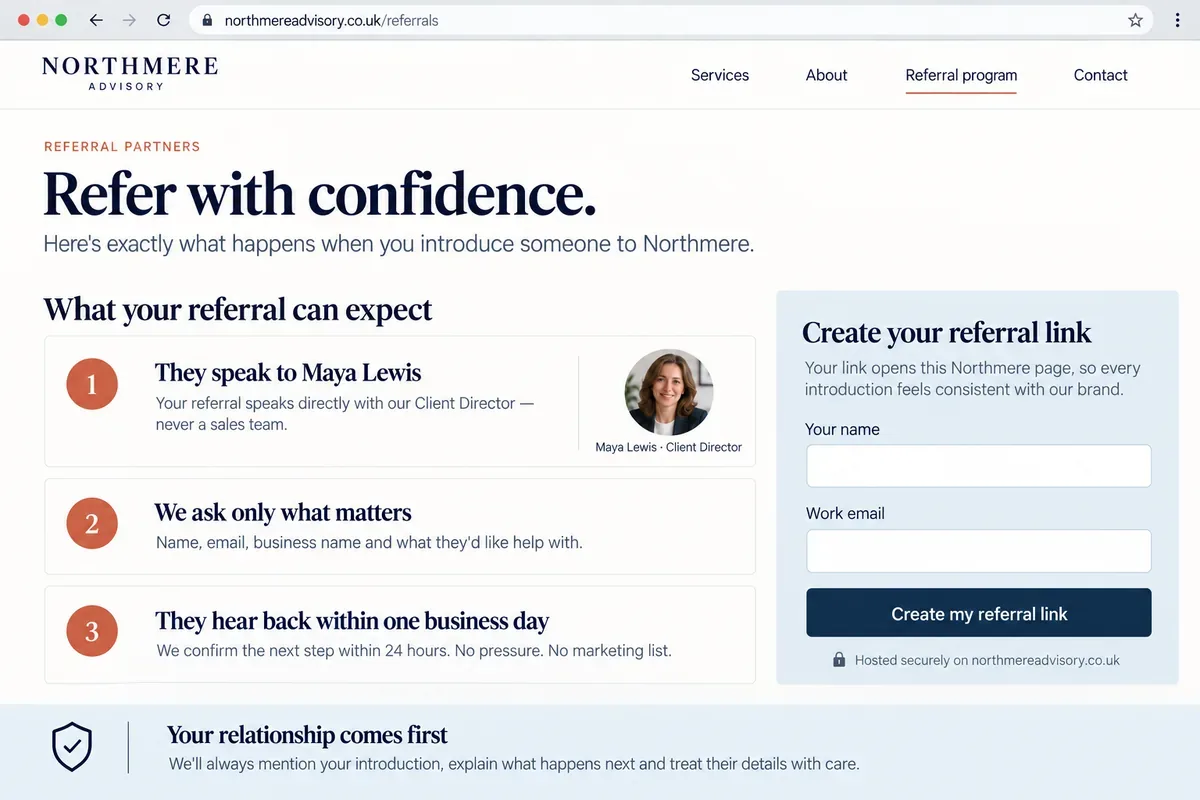
An illustrative example of a referral program page using a fictional firm.
What to notice: the page tells the referrer exactly what their contact is walking into. Who they speak to, what gets asked for, and when they hear back. That is what removes the risk of making the introduction, not a bigger reward.
Then keep both sides informed after the introduction. Tell the referrer what happened. Tell the new client what to expect. That communication is what keeps everyone trusting the firm, and it is also what produces the second referral from the same person. Our guide on qualifying your referrals covers the mechanics of the status updates; referral tracking is what makes them possible without anyone chasing a spreadsheet.
Two related decisions sit next to this one. Not every introduction arrives through a link, and the ones that do not still have to be recorded somewhere, which we covered in how to capture word of mouth referrals. And if you reward the person who made the introduction, the question of what event releases that reward is its own problem in a long sale: how to pay a referral reward when the sale takes months.
For the sector picture, see how consulting and service businesses win more clients through referral marketing, our consulting referral programs page, and what is referral software if you are deciding how to run it.
FAQ
How do you convert a referred lead?
Give them a page built for the introduction rather than a generic contact form, lead it with evidence at their scale and the name of the person they will speak to, and publish what happens after a referral so the person making it knows what their contact is walking into. The recommendation gets you considered. What the referred person finds next is what closes it.
Why don't referred leads convert?
Usually because the recommendation starts an evaluation rather than ending one. The Legal Services Consumer Panel's 2025 tracker survey found 57% of people who got a recommendation still looked for more information before making contact, and what they find at that point is what decides it.
Should referred people get their own landing page?
Yes, and it should read as a credibility document rather than a form. The strongest one we host leads with 400 completed applications, 40 years of combined experience and a testimonial video before asking for an email address.
Does a referral still help if the person researches us anyway?
A lot. The same survey found a family or friend recommendation was the most common single reason people chose their provider, at 18%. The recommendation gets you considered. Your own evidence still has to close it.
Why do people hesitate to refer us even with a good reward?
Because they are risking their own relationship and do not know what their contact is walking into. Publishing what happens after a referral, who they speak to and how fast, removes more hesitation than increasing the reward does.
What should we send the referrer after the introduction?
A confirmation that it arrived, and an update when something changes. Referrers who hear nothing assume nothing happened, and they stop. This is also the point at which most firms discover they have no record of who referred whom.
Referral link generator (free)
We take your website, send it to Referral Factory, and provision a real referral program for your brand. The link you get is a live referral URL your customers can share, backed by tracking and rewards in the app - not a static "generator" preview. This is the fastest way to see what a real referral program would look like for your brand! Try it below...