
Industry-specific guidance showing how referral marketing works in real operating contexts.

For a coding bootcamp or a professional training provider, your most persuasive marketing is a graduate who just landed the job your course promised. Nobody sells a career change like someone who has already made one. This post is about building a referral program around that moment, so the graduate who is buzzing about their new role brings you the next student instead of just posting about it once and moving on.
It is one segment of the picture in our complete guide to referral marketing for education providers. Here the focus is the career-change end of education: bootcamps, upskilling courses and vocational training.
Why training providers are built for referrals
Most education businesses sell learning. Bootcamps and training providers sell an outcome: a job, a promotion, a career pivot, a higher salary. That difference is exactly what makes referrals so powerful here.
Your students are buying hope, and trust is everything. Someone paying real money to change career is taking a genuine risk on a future they cannot see yet. No landing page closes that gap. A friend saying “I did this, and six months later I had the job” does. In a market crowded with courses that all promise the same thing, that kind of proof is the only thing a prospective student truly believes, and it is something you cannot buy as a marketer.
Your best referrer is a graduate with a new job. Think about who is making your case. Not a customer who liked a product, but a person whose life visibly changed because of your course. A recent graduate posting their new job title is the single most credible referrer in any industry, because their success is your proof and their motivation to share is at its peak.
Your students cluster around the pivot. People considering a career change talk to others doing the same thing: in Slack communities, on LinkedIn, in study groups, at meetups. A happy graduate sits in exactly the network of people weighing up the same decision they made a year ago.
Time the ask to the outcome
The single most important move in a training-provider referral program is timing the ask to the win. The moment a graduate lands a role, completes the course, or gets the promotion the training was for, that is when their pride and their credibility both peak. That is when to invite them to refer.
The strongest programs do not leave this to memory. They automate the invitation into a sequence that fires at each natural high point, from enrolment through to certification. Here is how CBD College sequences its referral prompts across a student's journey:
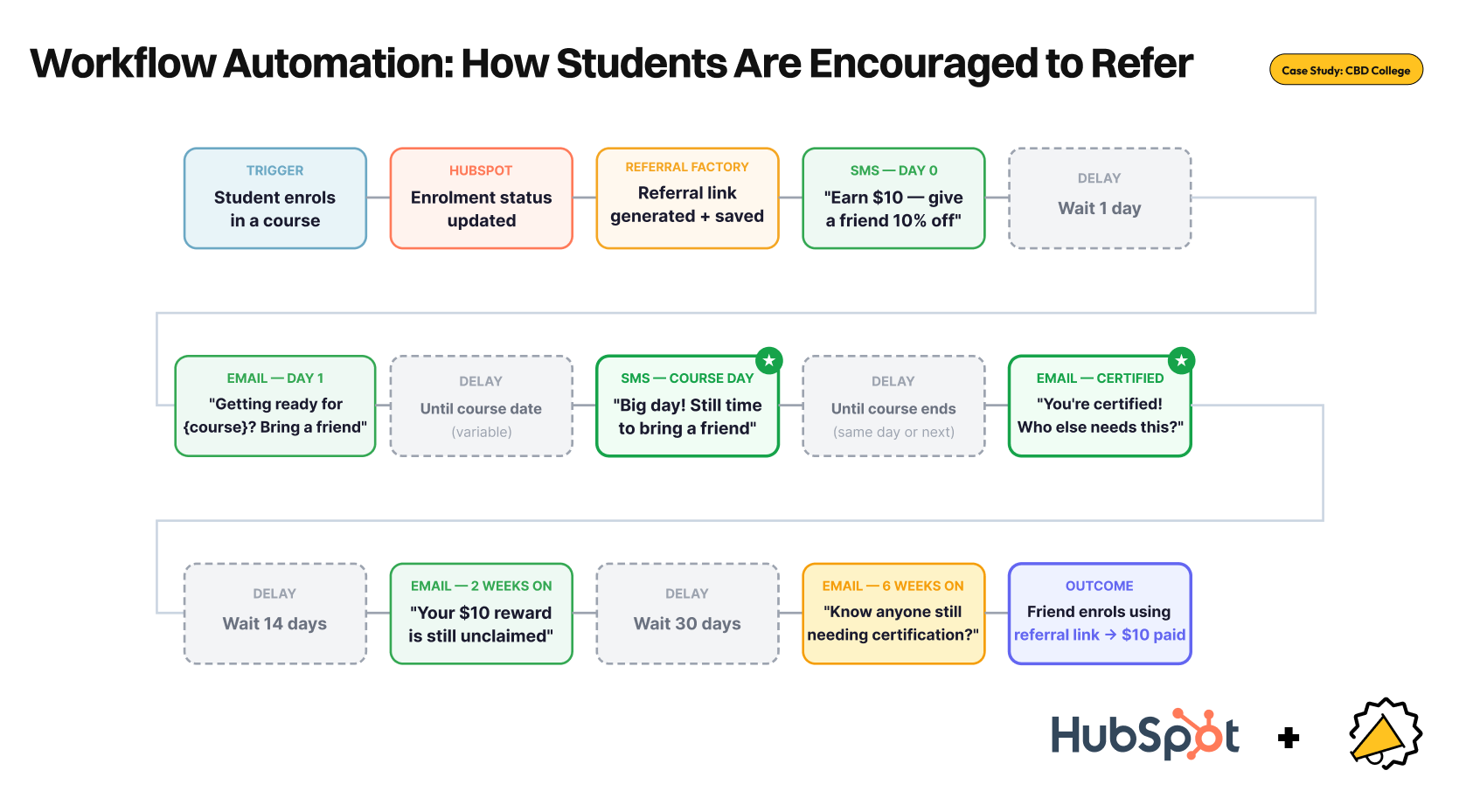
Miss that window and you are asking a busy professional to think about a course they finished months ago. Catch it, and you are asking someone at the exact moment they most want to tell their story.
Reward like the ticket price allows
Bootcamps and training courses are high-value purchases, which changes the reward maths in your favour. Where a school has to keep rewards modest and non-cash, a training provider selling a multi-thousand course can afford a meaningful reward on both sides, and should.
Cash and account credit both work here, and which one wins depends on where the graduate is. A current student still has more to buy from you, so course credit or a discount on an advanced module keeps them in your world. A graduate who has finished and moved into their new job has no reason to want more credit, so cash or a voucher is the honest reward for them.
Make it double-sided either way, so the graduate is handing their friend a discount on the course rather than asking for a favour. Our guide to education referral rewards explains what to offer and when it should pay out across course types.
The proof: a training provider that made it work
CBD College, a compliance training provider, runs a referral program with us that shows what this looks like at scale. It converts 56% of referred people into enrolments, against 11.4% from Google Ads and 10.1% from Meta, so referred students convert at roughly five times the rate of its paid channels. The program has generated over 6,600 referrals, and just 5.5% of the customer base drove the entire channel.
That last number is the pattern everywhere, and it is worth internalising. You are not trying to turn every graduate into a salesperson. You are making it effortless for the motivated few whose success stories sell your course better than any ad, and rewarding them properly for it.
How to build it
Every student gets a unique referral link or referral code at enrolment. The reward is double-sided and set at a level a high-ticket course can justify. The payout rule is clear, whether that is on enrolment, after the first month, or on completion. And the ask is automated to fire at the graduate's moment of success rather than on a newsletter schedule.
Referral Factory connects to tools like HubSpot, Zapier and Stripe, so prompts like these and the reward payouts fire automatically off enrolment and completion. The most successful graduates can also be organised into a named, rewarded student ambassador program that keeps advocacy active between cohorts.
Enter your website and Referral Factory builds a branded campaign for you automatically, pulling your brand straight from your site, then handles the tracking and payouts with no code, so it runs itself between cohorts. For reward ranges and what setup looks like for your sector, the education referral programs page lays it out.
Frequently asked questions
Do referral programs work for coding bootcamps and training providers?
Yes, and the segment is one of the strongest fits in all of education. A compliance training provider running a program with us converts 56% of referred people into enrolments against roughly 11% from Google Ads, because a graduate who landed the job is the most credible referrer a course can have.
Who is the best referrer for a training provider?
A recent graduate who got the outcome your course promised. Their success is your proof and their motivation to share peaks right after they land the job or the promotion, which is exactly when you should ask.
When should a bootcamp ask a student to refer?
Time the ask to the win: graduation, course completion, or a confirmed job placement. Automating the prompt to fire at that milestone beats a generic reminder, because you are catching the graduate at the moment they most want to tell their story.
What reward should a training provider offer?
Because these are high-value courses, you can afford a meaningful reward on both sides. Course credit or a discount on an advanced module suits current students, while cash or a voucher suits graduates who have finished. Keep it double-sided so the referrer is offering their friend a discount, not asking a favour.
How much does a referral program cost to run?
The main cost is the reward itself, which a high-ticket course can comfortably fund from a single new enrolment. Referral software handles the links, tracking and payouts, so the operational overhead is small once it is set up.
How do I track referrals between cohorts?
Give every student a unique referral link or code and let referral software record enquiries, enrolments and rewards automatically, so a referral made months after graduation still gets attributed and paid.
Referral link generator (free)
We take your website, send it to Referral Factory, and provision a real referral program for your brand. The link you get is a live referral URL your customers can share, backed by tracking and rewards in the app - not a static "generator" preview. This is the fastest way to see what a real referral program would look like for your brand! Try it below...