
Industry-specific guidance showing how referral marketing works in real operating contexts.
Referral marketing works better for online courses than almost any other product. Your students already know other people with the same goal, your course costs you almost nothing to give away as a reward, and buying a course is a trust decision no ad can win. The course creators who do this well don't ask for referrals once. They build a referral program into the course itself.
Here's how to set one up, and what the numbers actually look like.
Why online courses are unusually good at referrals
Three things have to be true for a referral program to work. People have to be happy, they have to know someone else who wants the same thing, and you have to be able to reward them without destroying your margin.
Online courses tick all three, and the middle one is the reason.
Your students are clustered. Marketers know other marketers. People studying for a certification know others sitting the same exam. Career changers find each other. Unlike most products, where a happy customer's network is random, a course creator's student list is a map of people who are one conversation away from becoming your next student. That makes word of mouth marketing unusually efficient here. A referral isn't marketing. It's a student telling a friend about something they both need.
Your reward costs you almost nothing. This is the part most course creators miss. If you sell physical products at a $5 margin, you can't fund a reward anyone cares about. If you sell a course, you can give a lesson, a module, or account credit worth $50 to both the referrer and their friend. To your students that looks like $100 of generosity. To you it costs a seat in a class that was running anyway.
Buying a course is a trust decision. The online course market is crowded and almost impossible to judge from the outside. Students are spending their own money on a future outcome: a job, a promotion, a qualification. Nothing closes that gap like a friend saying “I did this course and it was worth it.” Encoura's Eduventures research into how students choose where to study found that 86% named at least one individual as influential in their decision, with peers and family ranking highest on both trust and influence, ahead of advertising and official sources.
Adam from our customer success team on why word of mouth does the heavy lifting in education.
What a course creator referral program looks like
The mechanics are simple. Every student gets a unique referral link, or referral codes if that suits your platform better. When a friend uses it and enrols, the referrer earns a reward and the friend gets an offer.
The decisions that matter are what you reward, when you pay it, and how you ask.
Reward with your own product first
Across the education referral programs running on Referral Factory, the most common reward in the online course and platform segment isn't cash. It's the product itself: account credit, a free lesson, a discount on the next course.
Two reasons this beats cash for course creators.
The first is economics. Credit costs you a fraction of its face value, so you can afford to look generous.
The second is retention. Cash leaves. Course credit brings the student back for another module. One EdTech platform we host rewards referrers with account credit rather than cash, so every successful referral both wins a new customer and extends the referrer's own relationship with the product.
Cash still has a place. It works best when a student is finished with you: a one-off course, a completed certification, an alum with no reason to want more credit. If your students enrol term after term, credit is the stronger play.
Give the friend something too
This matters more than what you give the referrer.
A one-sided program asks your student to sell for you. A double-sided one lets them do their friend a favour. The difference is the sentence they have to send:
- “Use my link so I get $50.” A sales pitch, and an awkward one.
- “Use my link and you'll get your first lesson free too.” A gift.
Among the education programs we see, the double-sided pattern dominates for exactly this reason. One online tutoring business built its whole program on it. Both the existing student and the referred friend received a free tutorial. That program generated 1,715 referred leads in ten months, and over half converted into paying students, against 8% conversion on their paid ads.
Our guide to referral program incentives breaks down how reward structures perform across industries.
Decide when the reward pays out
This is the most overlooked decision in referral program design, and for course creators it's strategic.
Looking across education programs on the platform, reward triggers vary enormously:
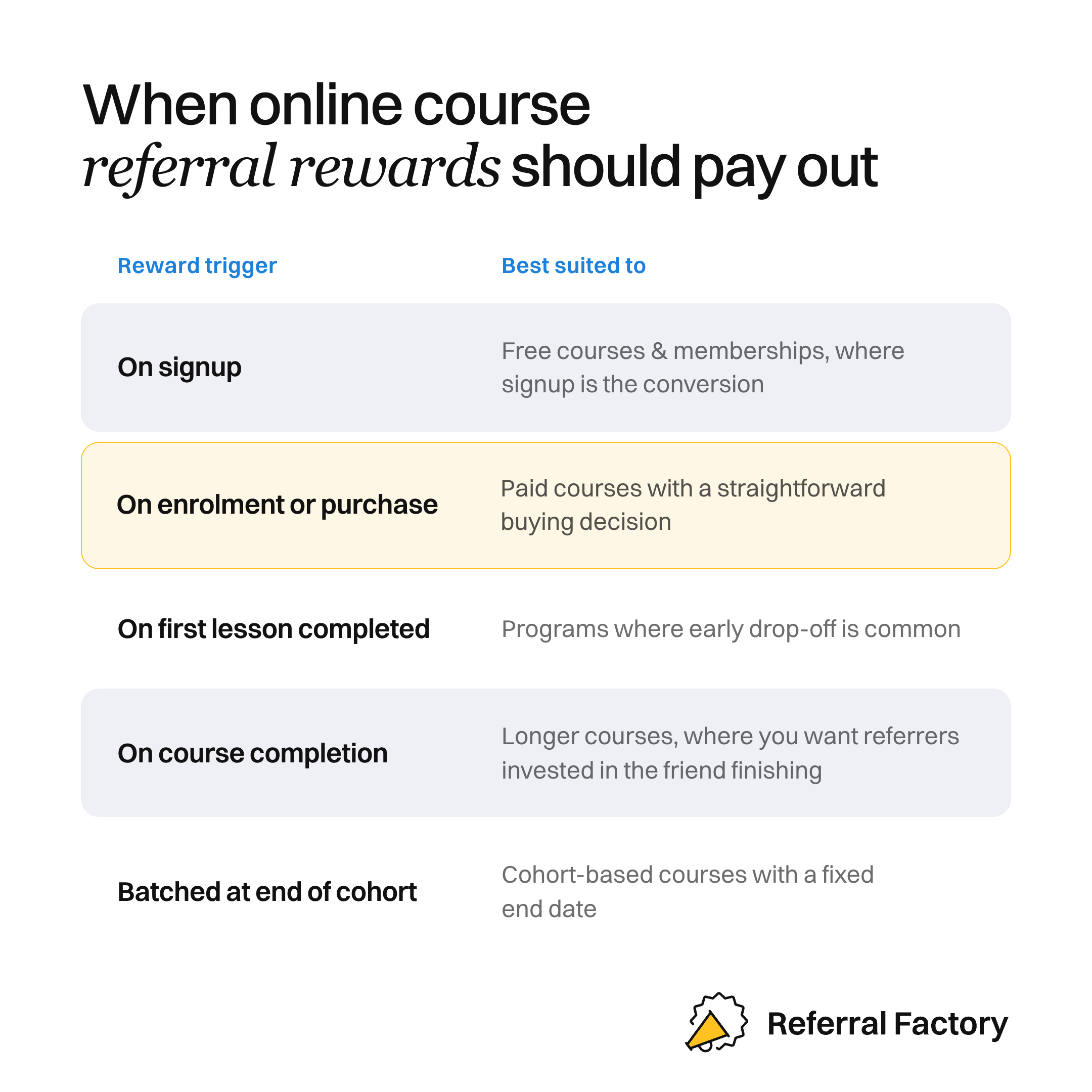
| Reward trigger | Best suited to |
|---|---|
| On signup | Free courses and memberships, where signup is the conversion |
| On enrolment or purchase | Paid courses with a straightforward buying decision |
| On first lesson completed | Programs where drop-off before starting is common |
| On course completion | Longer courses, where you want referrers invested in the friend finishing |
| Batched at end of cohort | Cohort-based courses with a defined end date |
If your course is free to join and you monetise later, reward on signup. Anything stricter kills participation. If you sell a high-value course, protect yourself by rewarding on enrolment or after the first module. One platform we host pays only once the referred student has enrolled and completed a full month of study, which almost eliminates the risk of paying out on someone who never really started.
There's no universally correct answer. There is a wrong one, and it's leaving it vague. Your students should be able to say in one sentence when they get paid. Our guide to education referral rewards compares the timing and reward options across education segments.
Whichever trigger you pick, you need referral tracking software that can see the conversion. Otherwise you're reconciling spreadsheets against your course platform every month, and that dies by week three.
Build the ask into the course
Most course creators run a referral program the way they run a launch. A burst of promotion, then silence. Referrals aren't a campaign. They're a habit.
Online courses have an advantage here, because your product has natural high points built into it. The moment a student finishes a module, passes an assessment, gets their certificate, or posts about their new job, that's when they want to tell someone. Put the ask there.
In practice:
Automate the prompt after a milestone, not on a monthly newsletter schedule. “You just finished module three, know anyone else who'd find this useful?” outperforms a generic reminder because it lands while the student feels good about the decision.
Make the link one tap to share. Most course sharing happens in private channels: WhatsApp groups, Slack communities, DMs. If sharing takes more than one tap, it doesn't happen.
Keep it visible between prompts. A permanent spot in your course platform, your emails and your student dashboard means someone ready to refer on a random Tuesday can find the link without hunting.
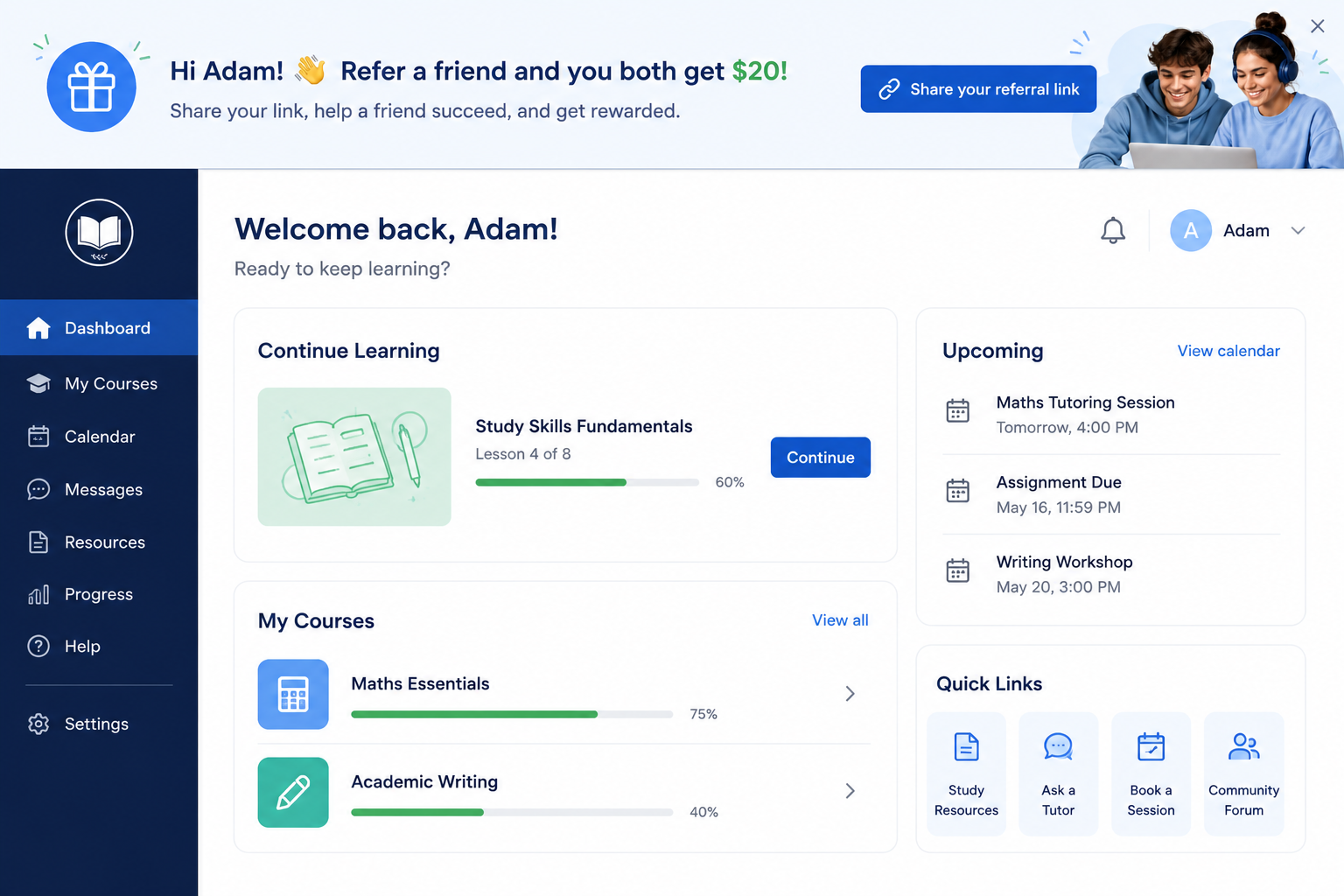
Two programs we host add a leaderboard showing top referrers. For a student audience already competitive about progress, that turns referring into part of the experience rather than a favour to the business. It's the same principle behind turning your happiest customers into brand advocates: recognition motivates people who are already proud of the outcome. In Referral Factory you can build that leaderboard and a branded referrer dashboard without code, so it runs without a developer.
Give the referred friend a real reason to respond
Here's what separates programs that convert from programs that just collect clicks. The strongest ones treat the page a referred friend lands on as the first step of enrolment, not the last step of marketing.
That means more than a form. A short piece of proof, whether a student testimonial, a preview lesson or a demo video, plus a clear next step. Several education programs we host embed a product demo on the friend-facing page specifically so a referred visitor can see the thing before deciding.
Your student has already done the hard part by vouching for you. The page just has to not waste it.
What to expect
Two honest expectations, both from published education referral programs. Our complete guide to referral marketing for education providers gathers more of them across schools, universities and training providers.
Referred students convert far better than paid traffic. The tutoring business above converted over half of referred leads against 8% from ads. CBD College, a compliance training provider running a referral program with us, converts 56% of referred friends into paying students, nearly five times the 11% it was getting from Google Ads and more than five times its Meta Ads.
A small group will do most of the work. At CBD College, just 5.5% of the customer base generated over 6,600 referrals. That's not a failure, it's how referral programs work everywhere. Your job isn't to convince every student to refer. It's to make it effortless for the handful who want to, and to keep asking everyone else at the moments they're most likely to say yes.
Getting started
Four things: a referral link for every student, a reward you can afford to give both sides, a clear rule about when it pays out, and an automated prompt tied to a milestone in your course.
That's a referral marketing program you can build in an afternoon. Enter your website and Referral Factory builds a branded campaign for you automatically, pulling your look and feel straight from your site. Set your reward rule, and it handles the tracking and payouts with no code, so it keeps running long after the launch energy wears off. If you want reward ranges and setup mapped to your corner of education, the education referral programs page lays it out.
Frequently asked questions
Do referral programs work for online courses?
Yes, and they tend to outperform most other channels in education. One online tutoring business generated 1,715 referred leads in ten months, converting over half of them into paying students compared with 8% from paid ads. Courses work well because students know others with the same goal and the reward can be the product itself.
What should I offer as a referral reward for my online course?
Account credit, a free lesson or a discount on the next course usually beats cash. Credit costs you a fraction of its face value and brings the student back for another module, so a single referral wins a new customer and extends an existing one. Cash works better for one-off courses where the student has no reason to return.
Should both the referrer and the friend get a reward?
Yes. Double-sided rewards change what your student has to say. “Use my link so I get $50” is a sales pitch. “Use my link and you'll get your first lesson free too” is a favour. Double-sided is the dominant pattern across the education programs we see, and it's the single easiest way to lift participation.
When should I pay out the referral reward?
It depends on what you sell. Free courses should reward on signup, because signup is the conversion. Paid courses should reward on enrolment or after the first module. Longer programs sometimes wait for course completion. One platform we host requires the referred student to enrol and complete a full month of study before the reward is released.
How do I get students to actually share my course?
Ask at milestones rather than on a schedule. Finishing a module, passing an assessment or receiving a certificate are the moments students want to tell someone. Automate the prompt at those points, make the link one tap to share, and keep it permanently visible in your course platform between prompts.
How many of my students will refer someone?
Fewer than you'd expect, and that's normal. At CBD College, just 5.5% of the customer base drove over 6,600 referrals. Design for the motivated minority: make referring effortless for them, and keep asking everyone else at the moments they're most likely to say yes.
Referral link generator (free)
We take your website, send it to Referral Factory, and provision a real referral program for your brand. The link you get is a live referral URL your customers can share, backed by tracking and rewards in the app - not a static "generator" preview. This is the fastest way to see what a real referral program would look like for your brand! Try it below...