
Industry-specific guidance showing how referral marketing works in real operating contexts.
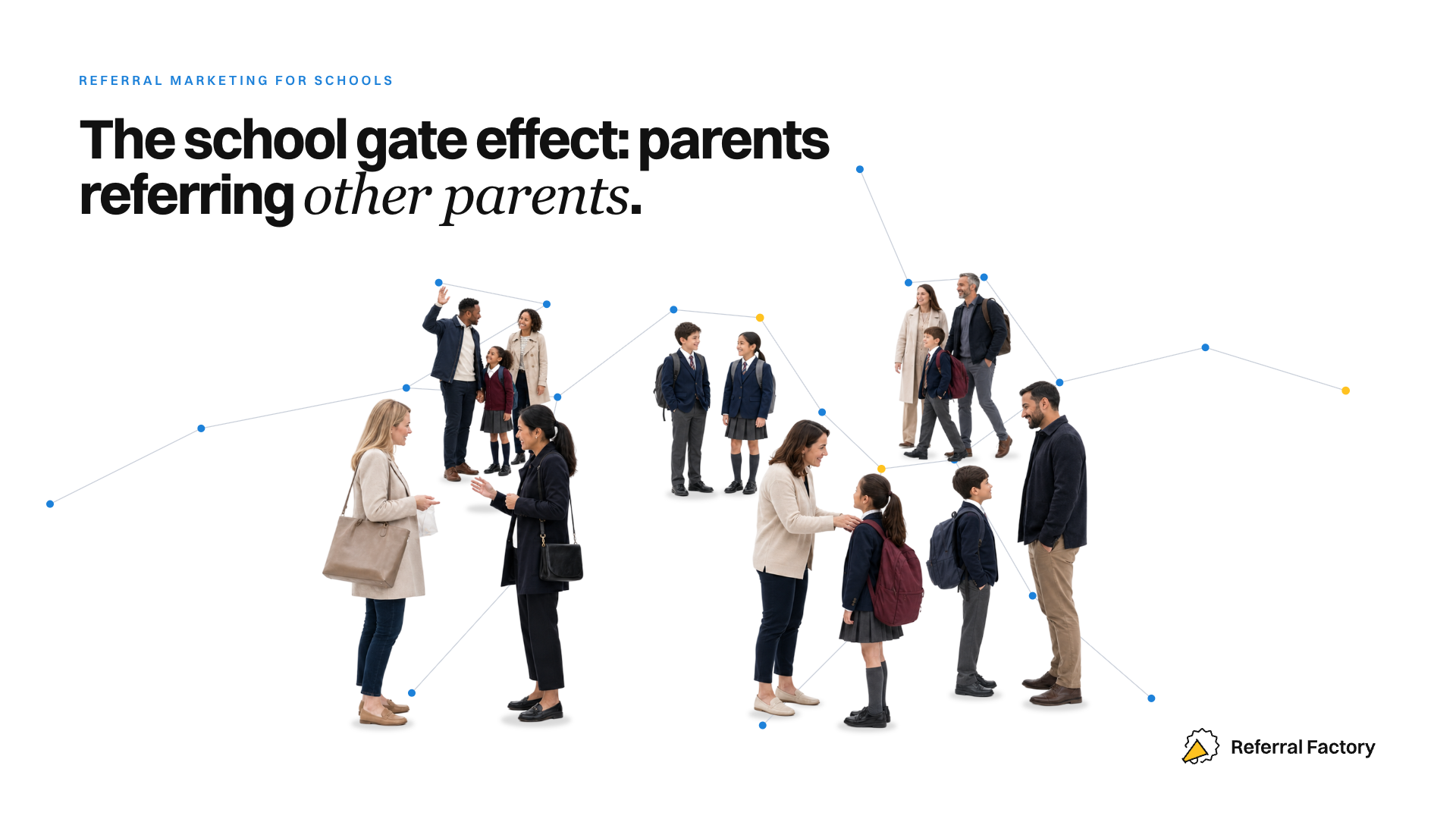
Every morning your most persuasive marketing happens in the car park. Parents stand together at the gate, sit in the same class WhatsApp groups, and swap opinions about your school constantly. When one parent tells another “we love it here,” that outweighs any prospectus or ad you could pay for. This post is about turning that school gate effect into something you can run on purpose, rather than hoping it happens.
It is the parent-focused companion to our complete guide to referral marketing for education providers. Here the whole focus is the people who talk about your school to other families.
Why parents are your strongest referrers
Parents sit in a rare position. They make the enrolment decision, they live with the outcome through their child, and they spend their week surrounded by other parents making the same decision. That combination is what makes them so effective.
They cluster, and they never stop talking. There is a WhatsApp group for the bake sale, another for the hockey club parents, a class chat, a year-group thread, the mums who do the school run together, the dads on the touchline on a Saturday. Your school is already the topic in a dozen of these conversations. Unlike most customers, whose networks are scattered strangers, a happy parent is surrounded by other families who live on the same streets, share the same lifts, and want exactly what they have. The cross-pollination is already happening. All a referral program does is hand it a link to pass along.
They trust each other more than they trust you. Encoura's Eduventures research into how students choose where to study found 86% named at least one individual as influential in the decision, with parents and peers ranking as the most trusted and most influential voices of all, ahead of advertising and official channels. A recommendation from another parent clears doubt in a way your own marketing never can.
Only happy parents refer, which is a feature. A peer-reviewed study of Generation Y parents (Stribbell and Duangekanong, 2022, published in Nature's Humanities and Social Sciences Communications) found that satisfaction is the single factor that directly drives parent word-of-mouth, with service quality and brand trust working only through it. You cannot prompt an unhappy family into recommending you.
So a parent referral program is never about manufacturing praise. It is about making it easy for happy families to do what they already want to, and thanking them for it. If the idea of rewarding referrals sits uneasily with you, our post on whether a school can have a referral program works through that objection in full.
Meet parents where they already talk
The school gate effect is a mobile, private, word-of-mouth channel. Most of it happens in class WhatsApp groups, in DMs, and in person at pickup. That has one big implication for how you run a program: sharing has to be effortless and native to those channels.
Give every family a unique referral link or referral code they can drop into a WhatsApp group in one tap. A parent who has to log into a portal and hunt for a code will never share. A parent who can forward a link between drop-off and their morning coffee will. Referral Factory gives every family that link with one-tap WhatsApp, SMS and email sharing built in, no code needed.
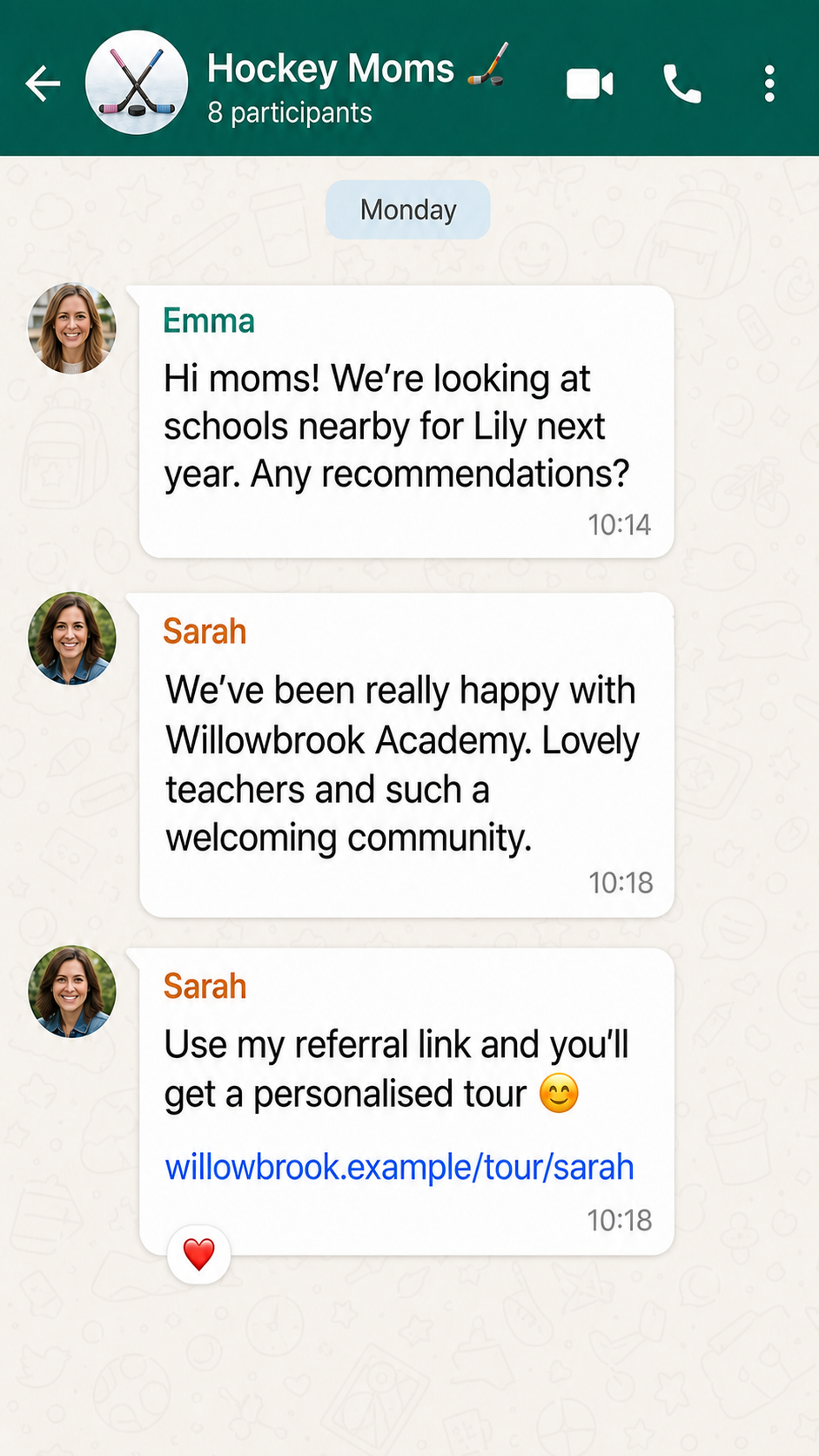
The message a parent sends matters too. Make the program double-sided so the referring parent is offering their friend something, not asking for a favour. “Join us and we both get a little thank-you from the school” is a message a parent will happily forward. “Sign up so I get a reward” is not.
Reward parents like you are grateful, not transactional
For a school, the reward is where a program either feels warm or feels like commission. Cash is usually the wrong instinct with parents. Better options cost little and stay in the spirit of the community: credit toward trips or clubs, priority booking for events, a contribution to the school fund, or a genuine thank-you from the head. Framed as gratitude rather than payment, the reward reinforces the relationship instead of cheapening it. Our guide to education referral rewards explains what to offer and when it should pay out.
Ask at the moments a school actually has
Unlike most businesses, a school runs on a calendar, and that calendar tells you when to ask. The best moments are the ones when a parent already feels proud or relieved: just after their child is accepted, in the glow of the first settled weeks, after a strong parents' evening, on results or awards day, and at re-enrolment when they choose you again.
Admissions also has seasons. A referral push timed just before your main intake window, when other families are actively looking, converts far better than the same ask in the middle of a quiet term. Build the prompt into those high points rather than sending a flat, once-a-year email.
Does it actually work?
Referrals convert far better than paid advertising in education, and parent-driven programs are no exception. A school referral program we host at Referral Factory converts around a quarter of the families it refers into enrolments, a rate most paid channels never reach, with each one a family won by a parent talking to another parent.
More broadly, CBD College, an education provider running a program with us, converts 56% of referred people into enrolments against roughly 11% from Google Ads, and a separate online tutoring business generated 1,715 referred leads in ten months, converting over half of them against 8% on paid ads.
The common thread is trust. In education, the voice that moves a decision is another parent, and a referral program is the tool that lets you put that voice to work.
Getting started
You need four things: a referral link for every family, a reward that fits your community and that you can give both sides, a clear rule about when it pays out, and a prompt built into the proud moments in your school year.
Enter your school's website and Referral Factory builds a branded campaign for you automatically, pulling your school's identity straight from your site, then handles the tracking with no code, so nobody is matching referrals to enrolments by hand. For reward ranges and what setup looks like for your sector, the education referral programs page lays it out.
Frequently asked questions
How do I get parents to refer other parents?
Make it effortless and time it well. Give every family a referral link they can share into a class WhatsApp group in one tap, make the program double-sided so they are offering a friend something rather than asking a favour, and prompt them at proud moments like acceptance, a strong parents' evening or results day.
What is the school gate effect?
It is the informal word-of-mouth that already grows your school. Parents cluster in class groups and at pickup, they trust each other more than they trust marketing, and they recommend schools they are happy with. A parent referral program makes that existing effect visible, trackable and repeatable.
What reward should a school offer parents?
Usually not cash. Credit toward trips or clubs, priority event booking, a contribution to the school fund, or a heartfelt thank-you fit a school better and cost little. Framed as gratitude rather than payment, the reward reinforces the community rather than feeling transactional.
When is the best time to ask a parent for a referral?
At the moments they feel proudest or most reassured: just after acceptance, in the settled first weeks, after a great parents' evening, on results or awards day, and at re-enrolment. Timing a push just before your main intake window, when other families are looking, lifts conversion further.
Which channel works best for parent referrals?
The ones parents already use, which are overwhelmingly mobile and private: class WhatsApp groups, direct messages and in-person chats at the gate. A referral link that shares into WhatsApp in a single tap will always beat a code buried in a portal.
How do I track which parent referred which family?
Give every family a unique referral link or code and use referral software to record enquiries, enrolments and rewards automatically, so admissions never has to reconcile it by hand.
Referral link generator (free)
We take your website, send it to Referral Factory, and provision a real referral program for your brand. The link you get is a live referral URL your customers can share, backed by tracking and rewards in the app - not a static "generator" preview. This is the fastest way to see what a real referral program would look like for your brand! Try it below...