
Industry-specific guidance showing how referral marketing works in real operating contexts.

Short answer: yes. A school can absolutely run a referral program, and it's one of the most natural growth channels a school has, because families already recommend schools they trust. The real question isn't whether you can. It's whether a formal program feels right for a school, and how to run one without it looking like you're paying parents to sell. This post answers both. It sits alongside our complete guide to referral marketing for education providers, which covers every kind of education business, with the focus here on schools.
Adam from our customer success team on whether a school can run a referral program, and how to do it well.
You're almost certainly relying on referrals already
Ask any head of admissions where their new families come from, and “word of mouth” is usually at or near the top. Parents talk through the school gate effect, in class WhatsApp groups, at birthday parties and sports days. A prospective family that arrives already trusting you, because a friend vouched for you, is your cheapest and highest-converting enquiry.
The problem is that this channel is invisible. You can't see who referred whom, you can't say thank you, and you can't encourage more of it. A referral program doesn't create word of mouth for a school. It makes the word of mouth you already earn visible, trackable and repeatable, the same way word of mouth marketing works in every trust-driven category.
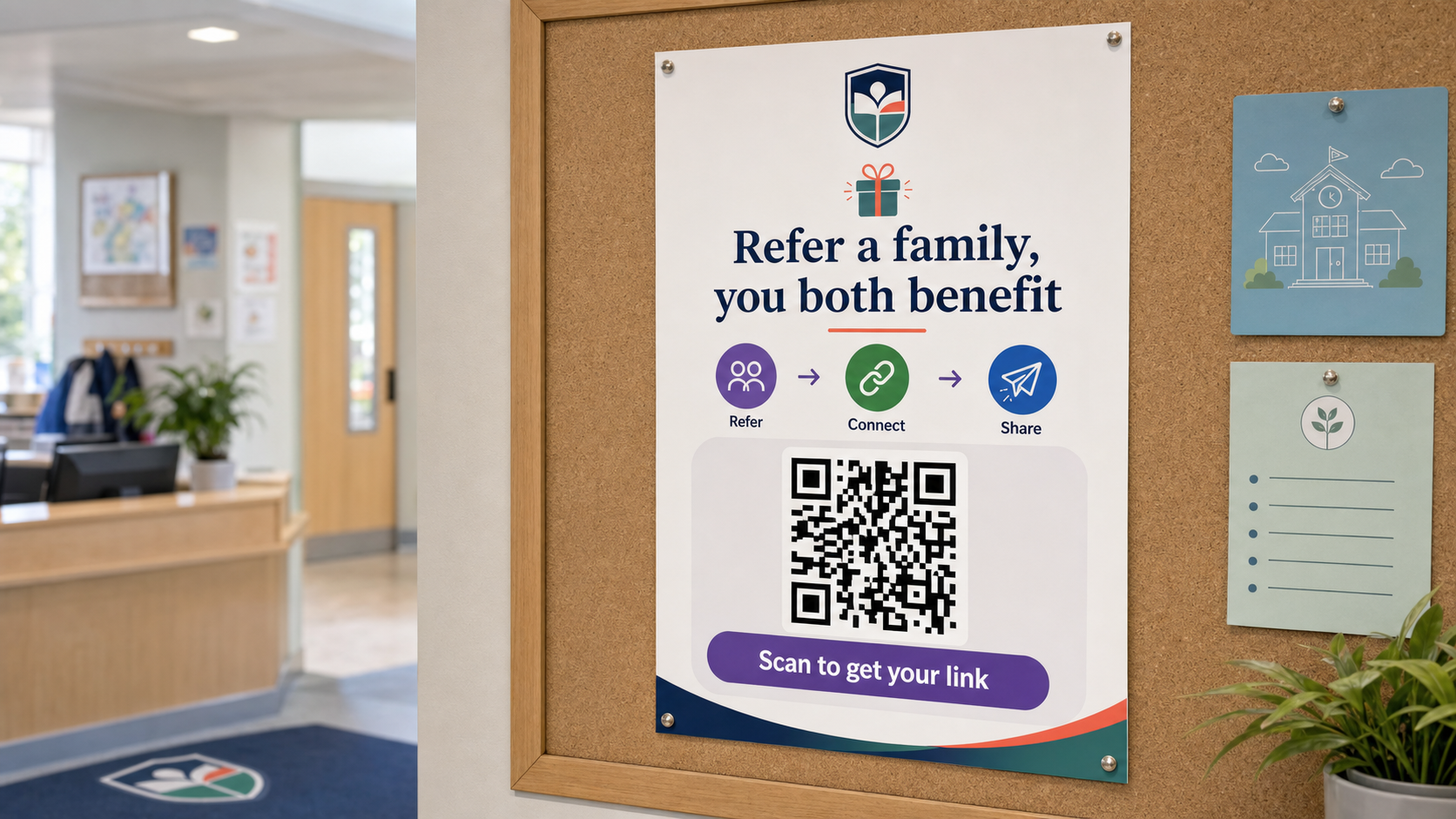
Making it visible can be as simple as meeting parents where they already are. A poster at reception or on the class noticeboard, with a QR code a parent can scan to grab their own link, turns the next school-gate conversation into a trackable referral.
But doesn't paying for referrals feel too commercial for a school?
This is the objection almost every school raises first, and after years of watching education businesses grow through referrals, I think it's misplaced. Schools aren't shops, and dangling cash for a signup would sit awkwardly with the relationship a school has with its community. But a well-built referral program isn't that, and treating it as though it were means leaving your single best growth channel on the table.
Here's why it isn't commercial in the way people fear. A referral program doesn't pay a parent to recommend a school they don't believe in, and it couldn't even if it tried. The largest peer-reviewed study on this question (Stribbell and Duangekanong, 2022, published in Nature's Humanities and Social Sciences Communications and surveying 458 parents) found that satisfaction is the only factor that directly drives parent word-of-mouth. Service quality and brand reputation matter only indirectly, through whether the parent is happy.
In plain terms: you cannot buy a referral from an unhappy family. A reward doesn't manufacture an endorsement. It only removes the friction from something a satisfied parent already wants to do. Framed that way, the reward stops being a payment and becomes a courtesy: a thank-you, a gesture of gratitude to a family who spoke well of you. Frame it as gratitude rather than commission and it stays tasteful and entirely appropriate for a school.
Seen that way, a program isn't more commercial than the status quo. It's more transparent than it. Schools already run quiet, informal versions of this, a fee waiver here, a “bring a friend” nudge there. A proper program replaces those one-off side-deals with one clear, fair, openly stated offer that every family can see. And it lets you say thank you, which the school gate never does.
The tone is set by what you reward and how you ask, not by whether a program exists. Get those right, which the rest of this post covers, and a referral program reads as community-building, not selling.
What a school referral program actually looks like
The mechanics are simple and the same ones that work in any sector, adapted to a school's calendar and community.
Every family gets a unique referral link or referral code they can share in a WhatsApp group or forward by email. When a referred family enquires and enrols, both sides receive a reward. Making it double-sided matters more for a school than almost anywhere else: it turns the ask from “help me fill places” into “do a friend a favour”. The referring parent is giving, not selling.
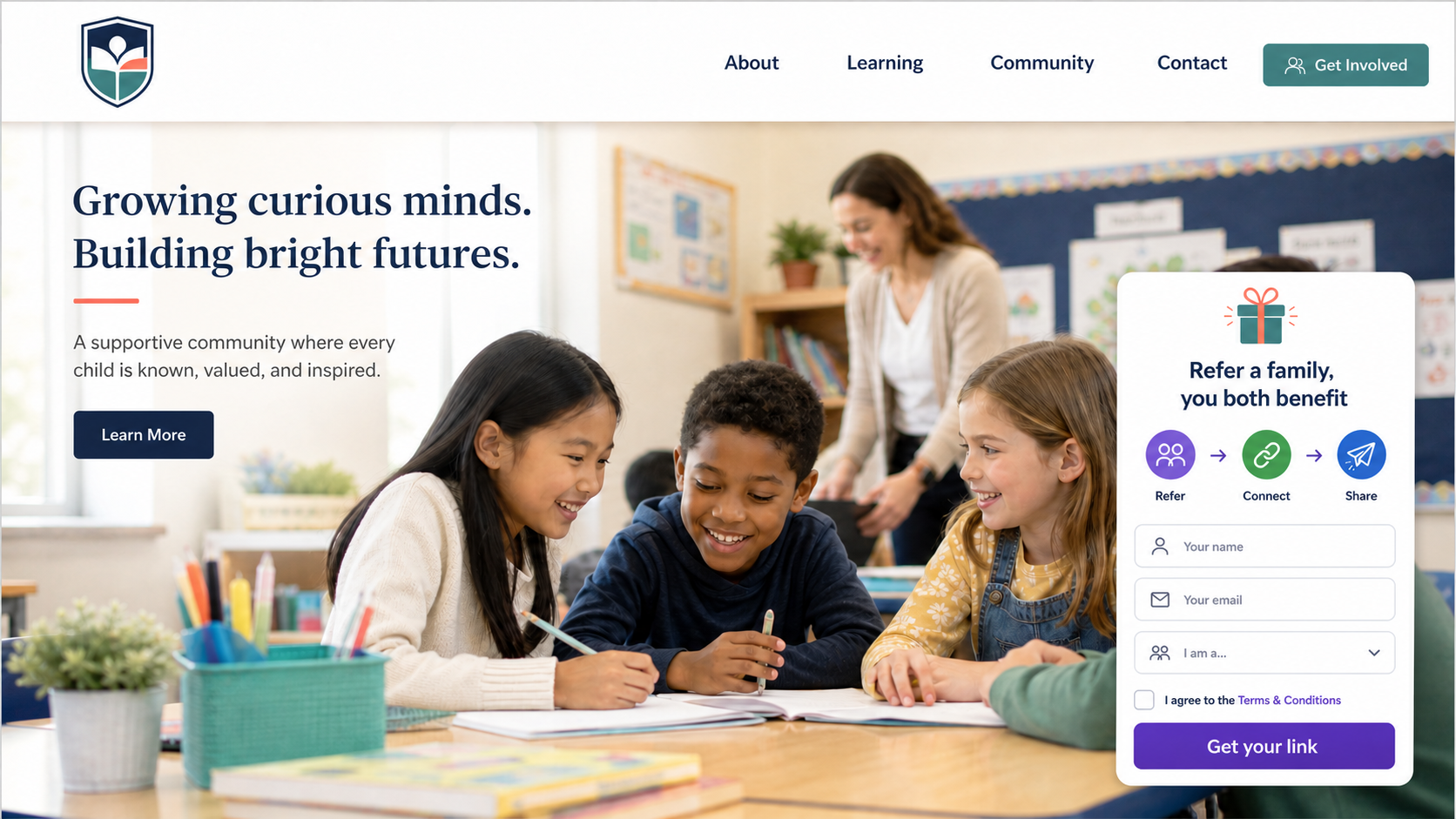
In practice this lives on your own website. A simple “refer a family” widget on the school site lets a parent grab their link in a couple of clicks, without an admissions officer having to hand it out one by one. Referral Factory gives you that widget and a branded sign-up page without code, so your IT team never has to get involved.
The three decisions that shape the program:
What you reward. For a school, this is where the “commercial” worry is won or lost. Community-oriented rewards usually fit better than cash.
When it pays out. Schools run on a calendar, so tie the reward to a real admissions milestone: on enquiry, on acceptance, or once the new family completes their first term. Rewarding after the first term protects you from paying out on a family that never really starts.
How you ask. Put the invitation at the moments families feel best about you: acceptance, the first week, a great parents' evening, results or a school production. A prompt that lands right after a proud moment outperforms a generic newsletter line every time.
Rewards that feel right for a school
Cash works in some sectors. In a school it's usually the wrong instinct, and the choice most likely to make a program feel transactional. The good news is that schools have better options that cost little and reinforce the community rather than cutting against it: credit toward trips, uniform or materials; priority booking for events or clubs; a contribution to the school fund or a chosen cause in the family's name; or a genuine, personal thank-you from the school.
The principle is the one I make about all education referrals: your own offering is a high-value, low-cost reward. A place on a workshop, an extra session or a term of a club can look like real generosity to a family while costing the school very little. Our guide to education referral rewards explains what to offer and when it should pay out.
Does it actually work? The evidence
Referrals convert far better than paid advertising in education, and schools sit squarely inside that pattern.
Take a school referral program we host at Referral Factory. Around a quarter of the families it refers go on to enrol, a conversion rate most paid channels never reach, and every one of them is a new family won by parents telling other parents.
The pattern holds across education. CBD College, an education provider running a referral program with us, converts 56% of referred people into enrolments, against 11.4% from Google Ads and 10.1% from Meta. That's roughly five times the return of paid channels, from families who arrive already trusting the institution because someone they know vouched for it. A separate online tutoring business generated 1,715 referred leads in ten months, converting over half of them, compared with 8% conversion on its paid ads.
The reason is the same one the research points to: in education, the most trusted and most influential voice in a family's decision is another parent or peer, not an advertisement. Encoura's Eduventures research found 86% of prospective students named at least one individual as influential in where they chose to study, with family and peers ranking highest of all. A referral program is the tool that lets a school harness a voice it can't buy.
How to set one up
You need four things: a referral link for every family, a reward that fits your community and that you can afford on both sides, a clear rule about when it pays out, and a prompt built into the moments families feel proudest of the school.
Enter your school's website and Referral Factory builds a branded campaign for you automatically, pulling your school's identity straight from your site. Set your reward and payout rule, and it handles the tracking and reward payouts with no code, so admissions isn't reconciling spreadsheets by hand. You can have it running before your next intake window. For reward ranges and what setup looks like for your sector, see the education referral programs page.
Frequently asked questions
Can a school have a referral program?
Yes. Schools can and do run referral programs, and referrals are one of the most natural growth channels a school has because families already recommend schools they trust. A program makes that existing word of mouth visible, trackable and rewardable.
Doesn't paying for referrals feel too commercial for a school?
It doesn't have to. Research shows only satisfied parents refer, so a reward can't manufacture an endorsement. It only removes friction from something happy families already do. Keeping rewards non-cash and community-oriented, and asking at natural moments, keeps the program feeling like community-building rather than selling.
What reward should a school offer?
Usually not cash. Credit toward trips, materials or clubs, priority event booking, a contribution to the school fund, or a heartfelt thank-you tend to fit a school better and cost little. Offering a place on a workshop or an extra session is a high-value, low-cost reward unique to education.
Who refers most in a school, parents, students or alumni?
For most schools it's parents, because they make the enrolment decision and talk to other parents constantly. Students and alumni matter too, especially for senior years and higher education, but a K-12 program usually centres on parents.
When should a school ask for referrals?
At the moments families feel best about you: on acceptance, in the first week, after a strong parents' evening, or around results and school events. Tie the reward payout to a real admissions milestone such as enrolment or completion of the first term.
How does a school track who referred whom?
Give every family a unique referral link or code and use referral software to record enquiries, enrolments and rewards automatically. That removes the manual reconciliation that makes informal “bring a friend” schemes fall apart.
Referral link generator (free)
We take your website, send it to Referral Factory, and provision a real referral program for your brand. The link you get is a live referral URL your customers can share, backed by tracking and rewards in the app - not a static "generator" preview. This is the fastest way to see what a real referral program would look like for your brand! Try it below...