
Reward design, incentive strategy, payouts, and commission structures.
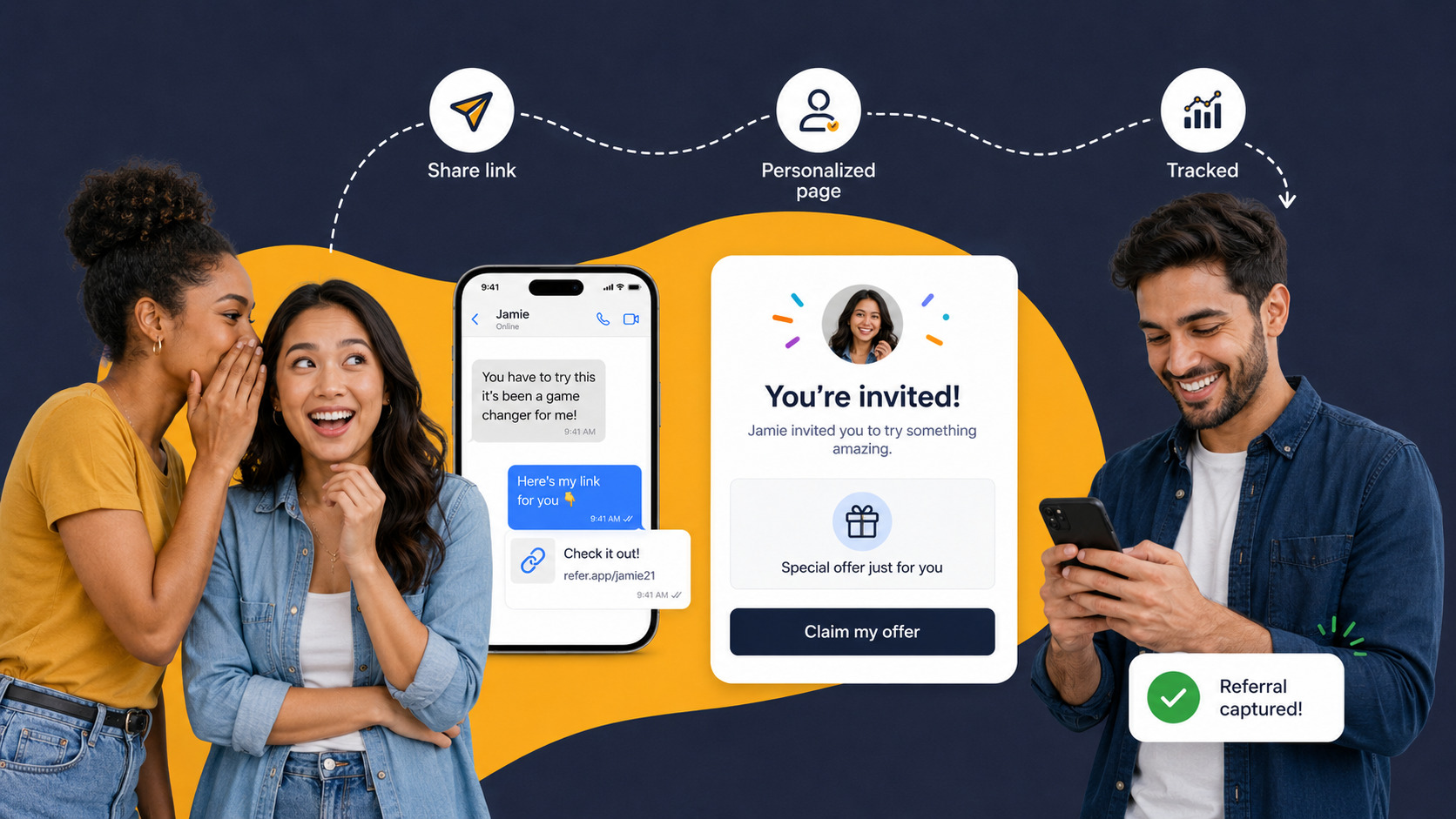
Word of mouth has always been one of the most powerful ways to win new customers.
Before paid ads, search engines, social media, or review sites, people found businesses because someone told them where to go. A friend recommended a shop. A neighbour suggested a service. A colleague mentioned a tool.
That part has not changed. People still trust recommendations from people they know.
What has changed is what happens after the recommendation.
Today, word-of-mouth referrals happen across WhatsApp, DMs, emails, sales calls, online communities, customer portals, search engines, AI tools, and offline conversations. Someone might hear about your brand from a friend at a party, Google you the next day, fill out a contact form, and become a customer three weeks later.
You may win the customer, but still have no idea who really referred them.
Most businesses do not need to create word of mouth from nothing. If they have a good product, a strong service, and happy customers, people are probably already talking about them. The real challenge is capturing those recommendations before they disappear into private conversations, unattributed website visits, forgotten sales calls, or messy spreadsheets.
Word of mouth is people talking about your brand. A referral program makes sure those conversations turn into trackable growth.
What Does It Mean to Capture Word-of-Mouth Referrals?
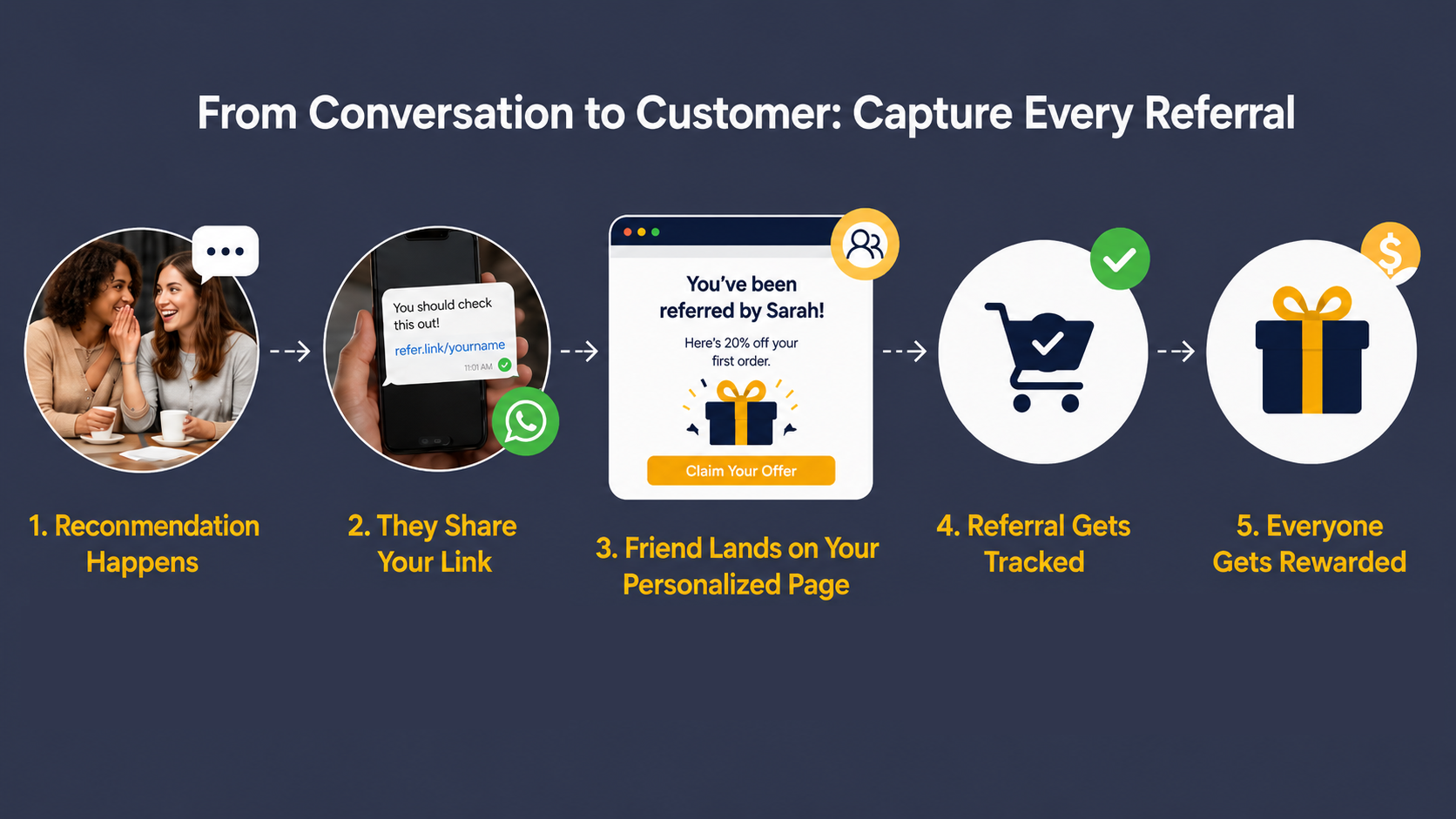
Capturing word-of-mouth referrals means giving customers a simple way to recommend your business and giving your team a way to track what happens next.
It means you can see who made the referral, who was referred, whether the referred person became a lead, whether that lead became a customer, and whether the original customer should be rewarded.
Without this, word of mouth is valuable but difficult to measure. You may know customers are talking about you, but you cannot easily prove which conversations are turning into leads, sales, or revenue.
A referral program gives word of mouth a system. It gives customers a clear way to share, referred friends a clear place to go, and your business a way to track, qualify, reward, and report on referrals.
But referral software does not magically create word of mouth.
A great product earns word of mouth. A referral program captures it before it disappears.
First, Give People Something Worth Talking About
Before you can capture word of mouth, you need to earn it.
People will not recommend something they do not value. If your product is poor, your service is unreliable, your customer experience is frustrating, or your business does not deliver on its promise, no referral program can fix that.
Positive word of mouth starts with value.
That value could come from your product, pricing, support, speed, results, onboarding, or the way you make customers feel. You do not need to be the only business in your category. Most brands have competitors. The real question is: what makes you worth mentioning?
Maybe your software saves customers hours every week. Maybe your support team solves problems quickly. Maybe your course helps students get real results. Maybe your installation team is professional and on time.
That is what gets people talking. The psychology behind referrals shows that people are more likely to recommend brands when there is trust, value, and a clear reason to share. Once they are talking, your job is to give those conversations somewhere to go.
Why Word-of-Mouth Referrals Fall Through the Cracks
Word-of-mouth referrals often do not disappear because customers are unwilling to recommend you. They disappear because the business has no clear way to capture the recommendation when it happens.
A customer talks about your brand. Their friend shows interest. But then the friend Googles you, fills out a normal contact form, speaks to sales, or comes back later through another channel.
You may still win the customer, but you lose the connection between the person who recommended you and the person who converted.
For example, a customer is at a party and tells a friend about the great experience they had installing fibre in their home. The friend Googles the company the next day, fills out a contact form, and becomes a customer a few weeks later. The business gets the sale, but the original customer is never recognised.
The same thing can happen in B2B. A colleague recommends an email platform to someone in the marketing team. The marketer later asks ChatGPT about the platform, clicks a link, signs up for a trial, and starts sending emails. The software company may attribute that signup to AI search or website traffic, but the original source was a colleague's recommendation.
This is the challenge with modern word of mouth. The conversation and the conversion often happen in different places. If there is no referral link, QR code, lead submission form, referral landing page, CRM field, or tracking process in place, the referral can easily get lost.
Where Word-of-Mouth Referrals Get Lost
| Where the referral happens | How it gets lost | How to capture it |
|---|---|---|
| WhatsApp or private message | The friend visits your website later with no attribution | Give customers unique referral links |
| Sales call | The referrer is mentioned but not logged | Add referral source fields to your CRM |
| In-person conversation | There is no digital trail | Use QR codes, referral cards, or lead submission forms |
| Customer email | The intro is forwarded manually without tracking | Use personal referral links and referral landing pages |
| Social or community group | The brand mention is not attributed | Send traffic to a trackable referral page |
| Support interaction | A happy customer is not asked in the moment | Trigger a referral ask after positive support experiences |
| Customer portal or app | Active customers are never prompted to refer | Surface referral links inside the logged-in experience |
The goal is to make sure that when a customer is ready to recommend you, they have an easy and trackable way to do it.
The 6-Step Framework for Capturing Word-of-Mouth Referrals
1. Plan the Referral Journey Before You Ask
Before you ask customers to refer, decide how the program will work.
Who can refer? Who can be referred? What will the customer get? What will the referred friend get? What needs to happen before a reward is issued? Who follows up with referred leads? Who owns the program internally? How will rewards be tracked?
This planning matters because once referrals start coming in, the details can get messy quickly.
For example, if you reward customers simply because a friend fills out a form, you may end up paying for low-quality leads. But if you only issue a reward after the friend becomes a paying customer, you protect your budget and reward the action that actually matters.
2. Ask at the Moment of Highest Trust
The best time to ask for a referral is when the customer has just experienced value. If they had a great experience on Monday and you ask them on Friday, the moment may have passed.
For home services, this might be after a successful installation. For SaaS, it might be after onboarding, activation, renewal, or a key product milestone. For education, it might be after a module is completed. For ecommerce, it might be after purchase, delivery, or a repeat order. For insurance, it might be after a renewal, claim approval, or positive support experience.
Do not wait for customers to remember to refer. Ask when they are most likely to feel good about your brand.
3. Give Every Customer an Easy Way to Share
If referring feels like effort, fewer customers will do it.
Your customers should not have to write their own message, search for your website, explain the offer, or figure out where to send their friend.
Give them a clear way to share, such as a unique referral link, QR code, WhatsApp share button, email share button, referral portal, website widget, lead submission form, or link inside their customer dashboard.
The more obvious the referral path, the more likely customers are to use it.
4. Send Referred Friends to a Personalized Referral Page
One of the easiest ways to lose referral attribution is to send referred friends to a generic homepage.
A homepage might explain your business, but it does not always recognise who made the referral, show the friend offer, capture the lead, or connect the friend back to the customer who referred them.
A personalized referral page is usually a better option. This is how referral links work: each customer gets their own unique referral link, and when they share it with a friend, that friend lands on a page connected to the person who made the referral.
That page should show the offer, capture the friend's details, connect them to the original referrer, set expectations, and trigger the right follow-up.
This is how you stop a warm recommendation from becoming anonymous website traffic.
5. Track the Referral Through to a Meaningful Conversion
Not every referred lead should count as a successful referral.
Someone clicking a link is not the same as becoming a customer. Someone filling out a form is not always the same as taking a valuable action.
Before you launch your program, define what success means. It might be a completed purchase, a booked demo, a paid subscription, an approved account, an installed service, an enrolled student, a signed contract, a renewed policy, or a first invoice paid.
This matters because rewards should be linked to value. If you reward too early, you may end up paying for leads that never convert. If you track the wrong success metric, your referral program can look active without actually driving revenue.
CRM and payment integrations are useful because they connect referrals to the systems where valuable customer actions already happen.
6. Close the Loop With the Customer
A referral does not end when the friend signs up.
To encourage repeat referrals, tell the customer when their friend signs up, when the referral qualifies, when their reward is due, and when the reward has been issued. Thank them for spreading the word and remind them that they can refer again.
This is part of the customer experience. When customers feel recognised and valued, they are more likely to keep referring.
Best Places to Capture Referrals by Industry
The best capture point depends on when your customers experience value and where they already interact with your brand.
| Business type | Best referral capture moment | Best capture method |
|---|---|---|
| Home services | After installation or job completion | QR code, referral link, lead submission form |
| SaaS | After onboarding, activation, renewal, or a product milestone | In-app referral link, customer portal, email automation |
| Education | After module completion, course completion, or student success | Course portal, student email, referral landing page |
| Ecommerce | After purchase, delivery, or repeat order | Post-purchase email, referral link, customer account |
| Insurance | After renewal, claim approval, or positive support experience | CRM-triggered email, advisor prompt, referral form |
| Offline businesses | After an in-person customer interaction | QR code, printed card, lead submission form |
The best referral programs are not separate from the customer journey. They are built into it.
How to Promote and Measure Your Referral Program
A referral program does not work if nobody knows it exists.
One common mistake is launching a program, sending one email, and then wondering why referrals are slow. You need to make the referral opportunity visible at natural moments.
You can promote your referral program through launch emails, newsletters, post-purchase emails, customer portals, in-app messages, website widgets, QR codes, support follow-ups, sales conversations, invoice emails, course completion emails, and renewal emails.
This is why automation helps. If referral asks rely on someone from marketing remembering to send a campaign every month, they can easily be forgotten. But if referral communication is built into your customer journey, the ask keeps happening in the background.
Once you have a system to capture referrals, you can also start tracking word of mouth and how it contributes to growth.
Useful referral metrics include referral links generated, referral shares, referral link clicks, referred leads captured, qualified referrals, referral conversion rate, revenue from referrals, reward cost, referral customer acquisition cost, top referrers, best-performing channels, best-performing capture points, and time from referral to conversion.
The goal is not just to know that people are talking. The goal is to understand which customers are referring, which moments create referrals, and which referrals turn into revenue.
Common Mistakes That Cause Referrals to Disappear
Even strong brands lose referrals when the process is unclear.
The most common mistakes are not asking customers for referrals, only promoting the program once, waiting too long to ask after a positive experience, making the program too complicated, offering a reward nobody wants, issuing rewards too early, tracking the wrong success metric, not making referrals part of the sales or support process, and not clearly explaining what the reward is or when it will be issued.
These mistakes are easy to make, but they are also easy to fix. Keep the program simple, ask at the right moment, make sharing easy, and reward customers after a meaningful action.
When Referral Software Makes Sense
If you only have a handful of customers, you may be able to manage referrals manually for a while. You could create simple links, use spreadsheets, or track referrals one by one.
But as your customer base grows, manual referral tracking becomes messy. It becomes harder to give every customer a unique link, know who referred whom, track whether referred leads converted, issue rewards accurately, and report on referral revenue.
Referral software makes sense when you want to give every customer a unique referral link, let customers share through email, WhatsApp, social, QR codes, or direct links, send referred friends to a branded referral landing page, track referred leads and conversions, connect referrals to your CRM or payment system, automate referral emails, approve rewards after qualification, and avoid managing everything in spreadsheets.
The point of referral software is not to manufacture trust. Your product, service, and customer experience do that.
The point is to capture the trust you have already earned and turn it into a trackable, repeatable growth channel.
FAQs About Capturing Word-of-Mouth Referrals
Can word-of-mouth referrals be tracked?
Yes. Word-of-mouth referrals can be tracked when customers are given a unique referral link, QR code, referral form, or personalized referral page that connects the referred friend back to the customer who shared it.
What is the difference between word of mouth and referral marketing?
Word of mouth is the recommendation itself. Referral marketing is the system businesses use to capture, track, reward, and scale those recommendations.
What is the best way to capture word-of-mouth referrals?
The best way to capture word-of-mouth referrals is to ask customers at the right moment, give them an easy way to share, send referred friends to a personalized referral page, and track whether those referrals become valuable leads or customers.
Give Word of Mouth Somewhere to Go
Word of mouth is already happening. Your customers are having conversations, sharing recommendations, and mentioning your brand to friends, family, colleagues, neighbours, and communities.
The question is whether your business is ready to capture those moments before they disappear.
A great product or service gives people a reason to talk. A referral program gives those conversations a path to follow. It helps you capture the referral, track the lead, attribute the sale, reward the customer, and repeat the loop.
That is how word of mouth becomes more than something you hope for. It becomes a channel you can measure, manage, and grow.
Referral link generator (free)
We take your website, send it to Referral Factory, and provision a real referral program for your brand. The link you get is a live referral URL your customers can share, backed by tracking and rewards in the app - not a static "generator" preview. This is the fastest way to see what a real referral program would look like for your brand! Try it below...