
Tracking referrals, attribution logic, ROI, qualification, and conversion visibility.

Referral programs can be one of the most cost-effective ways to grow, but only if you know what they’re truly delivering.
Without clear measurement, it’s easy to overestimate results, miss hidden costs, or scale the wrong incentives.
That’s why understanding how to calculate the ROI of a referral program matters, because it shows you whether referrals are truly profitable, efficient, and valuable over the long term.
In this guide, we’ll break down the metrics that power accurate ROI, show you what “good” performance looks like, and highlight the pitfalls that often distort results. By the end, you’ll have a practical framework to evaluate your referral program with confidence and improve it based on evidence, not guesswork.
How to Calculate Referral Program ROI
When calculating the true ROI of your referral program, you’re essentially comparing what you gain (revenue from referred customers) against what you spend (all program-related costs).
The simplest, most widely used formula is:
ROI = (Referral-Generated Revenue – Total Program Cost) ÷ Total Program Cost × 100
This formula gives you a percentage that shows how much return you’re getting for every dollar (or euro) you invest, a standard approach also used by top referral-marketing platforms.
If you’d rather skip the manual math, you can plug your numbers into our referral calculator, which applies the same formula automatically and shows your ROI instantly.
What to Include in the Calculation
- Referral-Generated Revenue: This is the total revenue you attribute to customers who came in via your referral program. Make sure to include not just their first purchase, but any upsells, cross-sells, or recurring revenue (if applicable).
- Total Program Cost: This isn’t just the rewards you pay out. It should account for:
- Reward costs (both referrer and referee)
- Platform or software fees for your referral tool
- Marketing and promotional spend to drive referrals
- Administrative overhead (time, operations, maintenance)
Example Calculation
Imagine your referral program generated €80,000 in revenue over a quarter. During the same period, you spent:
- €6,000 on referrer rewards
- €2,000 on referee rewards
- €1,500 on the referral software
- €500 on administrative costs
That gives a total cost of €10,000. Plugging into the formula:
ROI = (80,000 – 10,000) ÷ 10,000 × 100 = 700%
That means for every €1 you spent on the referral program, you earned €7 in revenue, a strong return.
The Importance of Measuring the ROI of a Referral Program
Referral ROI measurement tells you whether your program is creating real, profitable growth, or just activity.
A referral program can generate new customers and buzz, but without ROI tracking you can’t confirm the value of those outcomes. Measuring ROI connects referrals to business results like revenue, margin, retention, and lifetime value, giving you a clear view of what the program truly contributes.
Why ROI tracking is important
Tracking ROI shows you what your referral program is truly delivering.
- Proves whether referred customers generate more revenue than the program costs.
- Reveals how referral performance compares to your other acquisition channels.
- Confirms whether referred users deliver stronger long-term value and loyalty.
How measurement improves strategy
When you know the ROI, you can optimize the program with confidence. You’ll see which segments refer most, which rewards drive high-quality sign-ups, and where drop-offs happen in the referral funnel. This turns your program into a continuous improvement loop instead of a set-and-forget campaign.
In practice, teams that understand how to measure referral program ROI can scale what works and cut what doesn’t.
Why leadership buy-in depends on ROI
Executives fund what they can verify. ROI turns referrals from a “marketing idea” into a measurable growth engine with accountable results. Strong referral program performance measurement provides the evidence leadership needs to approve budget, support cross-team resources, and keep the program running long term.
The bottom line: if you aren’t measuring referral ROI, you can’t accurately judge profitability, efficiency, or customer va
Key Metrics to Be Tracked
Here’s the thing: ROI sounds like the ultimate scoreboard, but it’s only meaningful if you know what’s driving it. Think of ROI as the final grade, and the metrics below as the tests, quizzes, and homework that explain why you earned it. If you skip the tracking, you’re left guessing. If you track the right indicators, you can see what’s working, what’s stalling, and what to fix before you pour more budget into the program.
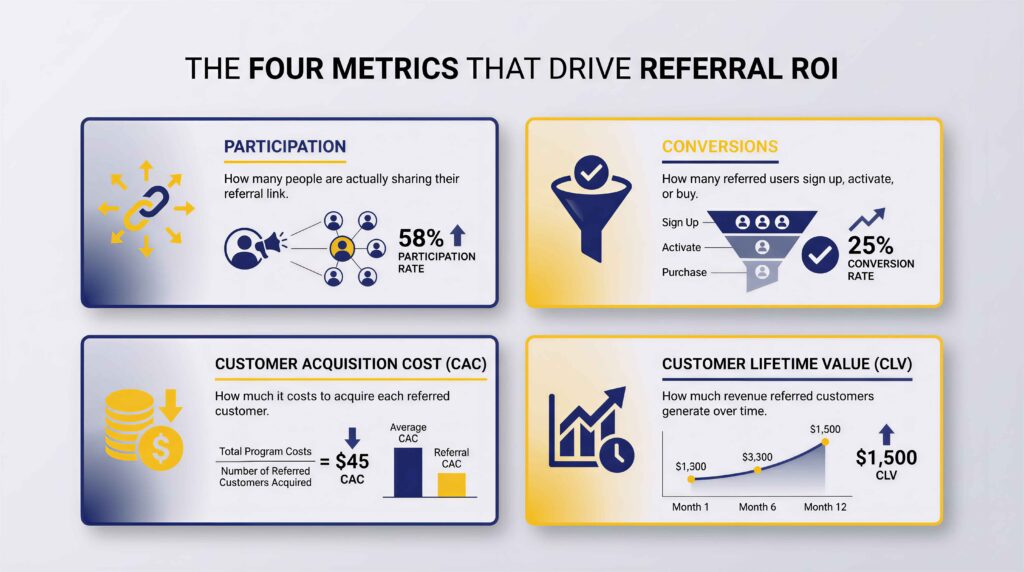
This section breaks down the most useful performance signals for referral success. They help you understand momentum (are people sharing?), effectiveness (are referrals converting?), efficiency (what’s it costing you?), and long-term value (are these customers sticking around?). Put together, these metrics are the foundation for accurate referral program ROI and smarter decisions.
Participation/Engagement
Participation rate answers the simplest, most important question: are people actually referring? It measures how many customers, clients, or partners are actively sharing referral links or codes relative to your total eligible base.
Why does this matter so much? Because referrals are a behavior, not a banner ad. Even the best incentive structure won’t work if the program feels buried, confusing, or not worth the effort. A healthy participation rate means your audience gets the program and feels motivated to share it. Low participation is a flashing red light that something is off—maybe the reward isn’t compelling, the referral flow is clunky, or people don’t trust the brand enough to recommend it.
Engagement also signals emotional buy-in. If customers are willingly putting their reputation on the line by referring you, that’s a strong trust indicator. High engagement usually means your incentives are aligned with what your audience values, and that your product experience is referral-worthy.
What to look at here:
- Percentage of eligible users who share at least once
- Number of shares per participant (are they casually sharing or advocating hard?)
- Time-to-first-referral after sign-up or purchase
If you’re running an enterprise referral program, participation is especially telling because large audiences often include multiple segments. You may find that a small but passionate group is driving most shares, great insight for targeting, messaging, and reward tuning.
Conversion Metrics
Participation gets the referral engine started. Conversion metrics tell you whether that engine is producing real business outcomes.
This category tracks the percentage of referred leads who take a meaningful action, like signing up, booking a demo, or completing a purchase. It’s where you move from “people are sharing” to “people are joining and buying,” which is what leadership ultimately cares about.
Conversions matter because referrals can look busy on the surface (lots of links sent, lots of clicks) while producing weak results underneath. If referred traffic isn’t converting, your program may be attracting the wrong audience, the landing experience might be mismatched, or the incentive could be pulling in low-intent users.
What to track:
- Click-to-signup conversion rate
- Signup-to-purchase (or activation) conversion rate
- Overall referred lead-to-customer conversion rate
- Funnel drop-offs (where referred users bail out)
The nice thing about referral conversion data is that it’s actionable fast. A drop at signup might mean the form is too long. A drop at purchase could mean pricing friction or weak onboarding. Each conversion metric points to a specific lever you can pull.
Also, good conversion tracking is the bridge between metrics and ROI. If someone asks how to calculate ROI of a referral program, conversion rates are one of the first building blocks you’ll use to tie referrals to revenue.
Customer Acquisition Cost (CAC)
CAC in a referral context is straightforward: how much does it cost to acquire a customer through referrals? That includes incentive payouts (to referrer and referee), plus any platform costs, creative, and operational time.
Referral CAC is often lower than paid channels because trust does part of the selling for you. A warm recommendation beats a cold ad almost every time. But “often lower” doesn’t mean “always better,” that’s why CAC tracking is important.
Comparing referral CAC to other acquisition costs is one of the clearest ways to demonstrate efficiency. If referrals bring in customers at a fraction of your paid CAC, you’ve got an argument for scaling the program. If your referral CAC is creeping up, that might mean your reward is too generous, your fraud controls are weak, or that you’re paying for customers you would have gotten anyway.
What goes into referral CAC:
- Total incentives paid ÷ number of referred customers acquired
- Platform and tool costs allocated per referred customer
- Any extra campaign spend to promote the program
With a referral software, CAC becomes easier to calculate accurately because incentives, referral attribution, and customer counts live in one place. Without it, teams often underestimate costs or miss hidden operational effort.
Customer Lifetime Value (CLV)
CLV is your long-game metric. It measures the total revenue a referred customer generates over their relationship with your business, after purchase, across renewals, upgrades, and repeat buys.
Why is this a big deal for referrals? Because referred customers are usually higher-trust customers. They arrive with social proof already baked in. That tends to translate into stronger retention, more engagement, and bigger lifetime value. Not always, but frequently enough that it’s one of the biggest ROI multipliers in referral marketing.
Tracking CLV lets you answer questions like:
- Do referred users stay longer than paid users?
- Do they spend more over time?
- Are they more likely to become repeat buyers or upgrade?
Even small CLV differences matter. If referrals cost slightly more than expected but produce customers who stick around twice as long, your ROI is still excellent. This is exactly why CLV has to be part of the measurement stack, not an afterthought.
CLV is also where strategy gets smarter. Say two rewards bring in the same number of customers. If one reward attracts higher-CLV customers, that’s the better incentive, even if the short-term numbers look equal.
Bringing CLV into your tracking is one of the best practices for referral roi calculation, because it prevents you from optimizing only for quick wins instead of sustainable growth.
To put it all together: participation tells you if the program has fuel, conversions tell you if it’s working, CAC tells you what it costs, and CLV tells you whether the customers are worth it. Track these consistently, and ROI stops being a fuzzy estimate and turns into a clear, defendable growth story.
Best Practices for Referral ROI Calculation
Enterprise referral programs don’t fail because referrals “don’t work.” The main reason they fail is because they’re treated like a side campaign instead of a system. At scale, small gaps, unclear goals, messy tracking, weak incentives, turn into big ROI leaks.
The good news is a few repeatable practices can keep your program efficient, credible, and growing.
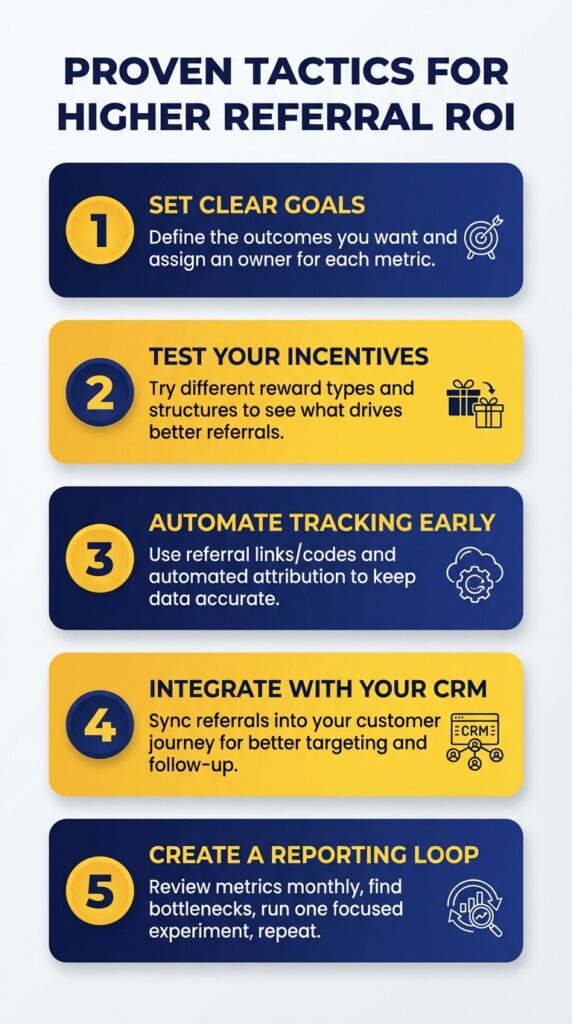
Set clear goals before you scale
Start with outcomes, not tactics. Decide what success means for your business right now.
Examples of enterprise-level goals:
- Acquire net-new customers in high-LTV segments
- Increase expansion or renewals through partner referrals
- Reduce blended CAC by shifting mix toward referrals
Once goals are defined, map each to a metric (participation, conversion, CAC, CLV) and an owner. If you can’t name who’s responsible for a goal, it’s not a real goal yet.
Test incentives like a product team
Incentives are the engine of behavior, but they’re not “set once and forget.” What works for customers may not work for partners, and what works in one region may flop in another. Make testing part of the program’s rhythm.
What to experiment with:
- Double-sided vs. single-sided rewards
- Cash, credit, upgrades, perks, status
- Tiered rewards (more value for more referrals)
- Time-based boosts (limited-time multipliers)
Keep tests clean: one variable at a time, with a clear success metric.
Automate tracking and attribution early
Manual referral tracking collapses under enterprise volume. Automate attribution so you can trust the numbers and move fast.
Key automation steps:
- Use unique referral links or codes per referrer
- Track events across the funnel (share → click → signup → purchase → retention)
- Flag fraud patterns automatically (self-referrals, duplicate accounts, suspicious velocity)
Automation doesn’t just save time; it protects ROI from hidden cost creep.
Integrate with your CRM and lifecycle tools
Referral programs work best when they’re woven into your customer journey, not bolted on top. CRM integration lets you:
- Attribute referrals to accounts and pipelines
- Trigger referral prompts at the right moments (post-NPS, renewal, milestone wins)
- Segment referrers by value and behavior
- Personalize follow-ups for referred leads
This is where enterprise programs outperform smaller ones, because you can coordinate across marketing, sales, customer success, and partnerships.
Build an optimization + reporting loop
Enterprise referral ROI improves through iteration, not launch hype. Set a reporting cadence, monthly minimum, and make it visual and blunt.
Your loop should include:
- Review core metrics and anomalies
- Identify the bottleneck (participation, conversion, CAC, or CLV)
- Run a focused experiment
- Report outcomes and roll forward what wins
When leadership sees steady learning and improvement, buy-in becomes automatic.
Bottom line: treat your enterprise referral program like a living growth system—goal-driven, test-led, automated, integrated, and constantly optimized. That’s how ROI compounds over time instead of plateauing after launch.
Common Pitfalls and How to Avoid Them
Even strong referral programs can show “bad ROI” if the measurement is sloppy. Below are the mistakes that most often give wrong results, plus fixes that make your numbers reliable and your strategy sharper.
Pitfall 1: Under-counting the real cost of referrals
Many teams only include the reward payout, then wonder why CAC looks unrealistically low. True program cost also includes platform fees, fraud prevention, campaign spend, internal ops time, and any discounts given to referees.
Fix: build a cost checklist and track it monthly:
- incentives paid (both sides)
- software/platform costs
- marketing/creative spend to promote referrals
- operational time (support tickets, reward approvals, partner management)
Then calculate CAC and ROI using the full cost base.
Pitfall 2: Counting every referred customer as “incremental”
Referrals can cannibalize customers who were already going to buy. If you treat all referred conversions as net-new, ROI gets inflated.
Fix: estimate incremental lift. Two practical approaches:
- Holdout testing: keep a small segment unexposed to referrals and compare conversion.
- Pre/post + channel match: compare referred customers to similar non-referred cohorts.
Use incremental revenue (not raw revenue) in ROI.
Pitfall 3: Ignoring indirect and halo benefits
Referral programs don’t only produce direct signups. They drive brand searches, site visits, social proof, and higher NPS, which feed other channels. Several guides note tracking traffic and advocacy signals alongside revenue.
Fix: Report a “core ROI” plus a “halo dashboard.”
- Core: revenue, CAC, CLV.
- Halo: referral traffic, repeat visits, NPS/CSAT changes, brand search lift.
Keep them separate so leadership sees both without confusing causality.
Pitfall 4: Using the wrong tracking window
Short windows make referrals look worse than they are because referred customers often convert or expand later; long windows can over-credit referrals for unrelated growth.
Fix: define consistent periods:
- Attribution window: e.g., 30-90 days for first conversion.
- Value window: cohort CLV measured over 6-12 months.
Lock these in, and don’t change them mid-comparison.
Pitfall 5: Not tracking long-term value by cohort
A referral program might boost signups but attract low-quality users if the incentive is too “deal-driven.” CLV is repeatedly highlighted as essential for judging true ROI.
Fix: cohort referred users by month and compare retention, repeat purchase, and expansion to non-referred cohorts. If CLV dips, tighten targeting or adjust rewards.
Pitfall 6: Messy attribution and fraud leakage
Manual spreadsheets miss cross-device journeys, double-count shares, and fail to catch self-referrals or incentive gaming.
Fix: Use verified referral program software with automated attribution, event tracking, and fraud rules (duplicate detection, velocity limits, self-referral blocks). This protects ROI and keeps reporting credible.
Takeaway: Most “ROI problems” aren’t program problems, they’re measurement problems. Fix the cost base, incremental logic, windows, and attribution, and you’ll finally see what your referral engine is really worth.
Driving Long-Term Growth Through Referral ROI
When you measure referral ROI accurately, referrals stop being a “nice bonus” and become a growth channel you can plan around.
You know what each referral costs, what it returns, and which levers reliably lift performance, so scaling feels like a smart investment, not a gamble. Just as importantly, understanding referral program performance lets you put a budget where it actually compounds: the incentives, audiences, and touchpoints that bring in high-value customers again and again.Track it well with a software like Referral Factory, and your referral program turns into a predictable engine for long-term acquisition and retention.
Referral link generator (free)
We take your website, send it to Referral Factory, and provision a real referral program for your brand. The link you get is a live referral URL your customers can share, backed by tracking and rewards in the app - not a static "generator" preview. This is the fastest way to see what a real referral program would look like for your brand! Try it below...