
Reward design, incentive strategy, payouts, and commission structures.

Referrals start with an advantage most acquisition channels have to earn: trust. When a customer, colleague or partner recommends a business, the person they refer already has context for why that business may be worth considering.
Enterprise Referral Programs: The Four Questions To Answer Before You Pitch One
At enterprise scale, though, launching the campaign is often the easy part. The harder part is making the referral program work inside an established organisation. It may need to connect with CRMs, payment systems and marketing tools, pass security and procurement reviews, track referrals accurately across a longer customer journey, automate communication and rewards, and work across different teams or markets.
A successful enterprise referral program needs to fit the systems and processes the business already uses while still being easy for marketing teams to operate and improve. In this article, we’ll break down the strategy, technology, security, implementation and promotion decisions that help larger referral programs succeed.
What is an Enterprise Referral Program?
An enterprise referral program is a structured system that helps large organisations capture, track, and manage referrals across multiple teams, business units, and regions. It goes beyond simple customer or affiliate programs by supporting long sales cycles, complex approval workflows, and the operational needs of enterprise-level growth.
The difference is not simply company size or the number of referrals generated. Enterprise complexity usually comes from the environment around the program: multiple teams or markets, existing CRM and operational workflows, longer sales cycles, more complex qualification rules, security and privacy requirements, procurement, and a larger number of customer touchpoints. An enterprise referral program needs to work within that environment rather than create another disconnected process.
Here’s what makes it different:
- Designed for large teams with different roles and responsibilities
- Works across multiple business units, partner channels, and regions
- Handles complex processes that involve marketing, sales, and customer success
- Automates tasks to save time and reduce manual follow-ups
- Connects with your CRM and other tools so everyone stays on the same page
- Includes compliance, security, and audit features enterprises need
- Scales smoothly as more advocates and referrals come in
What makes an enterprise level referral program powerful is that it aligns the entire organisation.
Everyone is finally looking at the same data, speaking the same language, and pushing in the same direction. Marketing sees which advocates bring the strongest lead, sales knows which referrals are most likely to convert, and customer success understands which relationships spark more advocacy.
Overall, as the product gets clearer insight into who spreads the word and why, the whole system feels more connected.
Why are Enterprise Referral Programs Important?
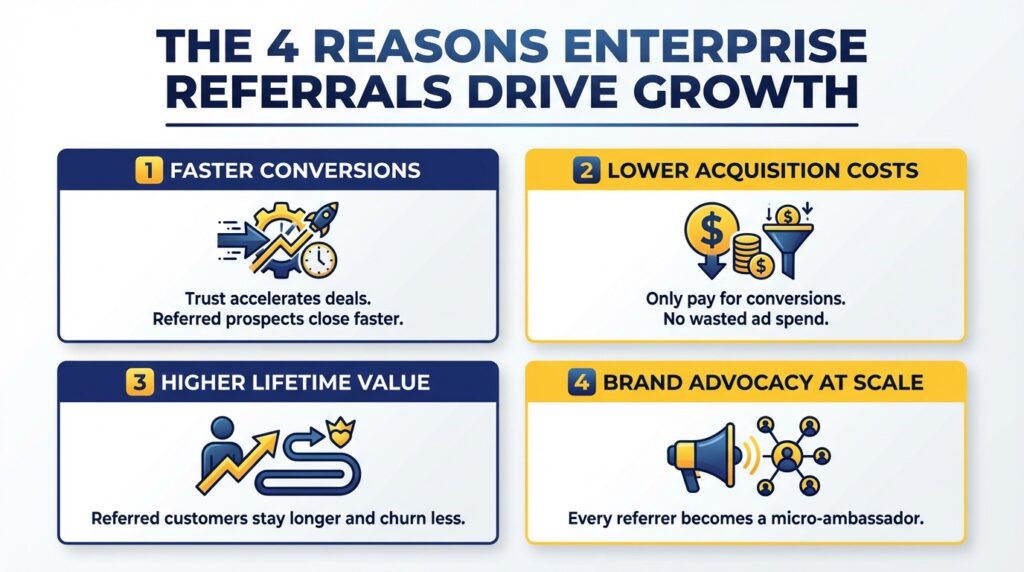
1. Faster Conversions, Driven by Trust
We’ve said it before, we’ll say it again: referrals work because they start the conversation with credibility already in place.
When a satisfied customer or trusted partner recommends your product, the prospect arrives confident and ready to engage. They need less convincing and move through the sales process more smoothly.
Big players like Salesforce and HubSpot build parts of their enterprise referral strategy around this principle. Referred prospects progress faster because someone they already respect has vouched for the solution.
2. Lower Acquisition Costs
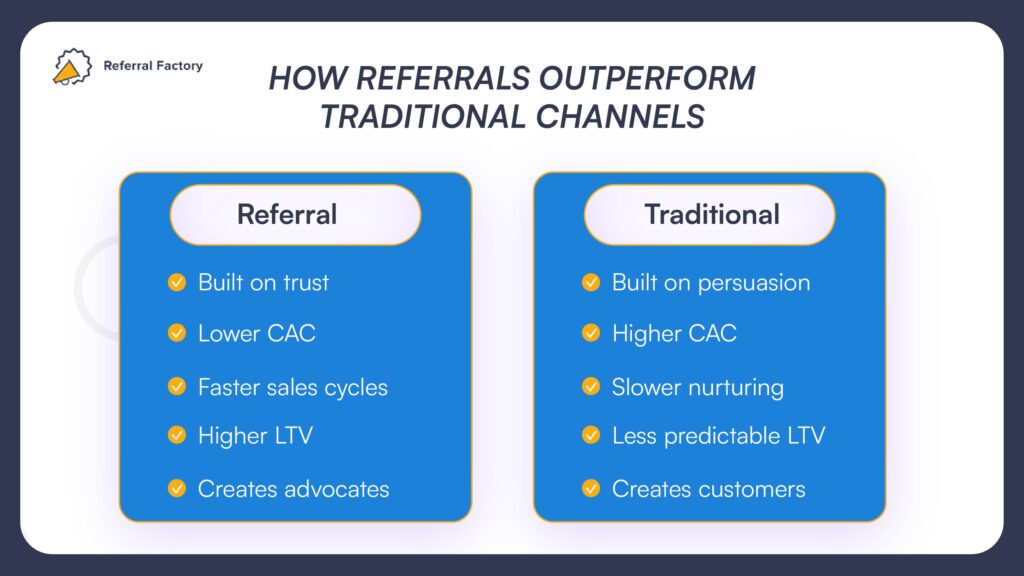
Referrals are more cost-efficient than most traditional channels. Paid ads, events, and large outbound teams require constant investment, but a corporate referral program only rewards successful conversions.
If a lead doesn’t convert, you haven’t spent unnecessary budget. For enterprises managing hundreds or thousands of leads, this can add up to significant savings. B2B software companies see lower customer acquisition costs by encouraging clients to introduce new users, and B2C brands like Stitch Fix and HelloFresh experience similar benefits when loyal customers participate in structured refer-a-friend programs.
3. Higher Lifetime Value
Customers who come through referrals often arrive with more context and confidence than a completely cold lead. That stronger starting point can support better engagement and retention over time. For enterprise teams, the important part is measuring referred customers as their own cohort so you can compare conversion, retention and customer value against other acquisition channels.
4. Stronger Brand Advocacy at Scale
The best thing about referrals is that they not only bring new customers but turn them advocates. Every person sharing your product becomes a micro-ambassador, helping your brand reach corners of the market that traditional campaigns rarely touch.
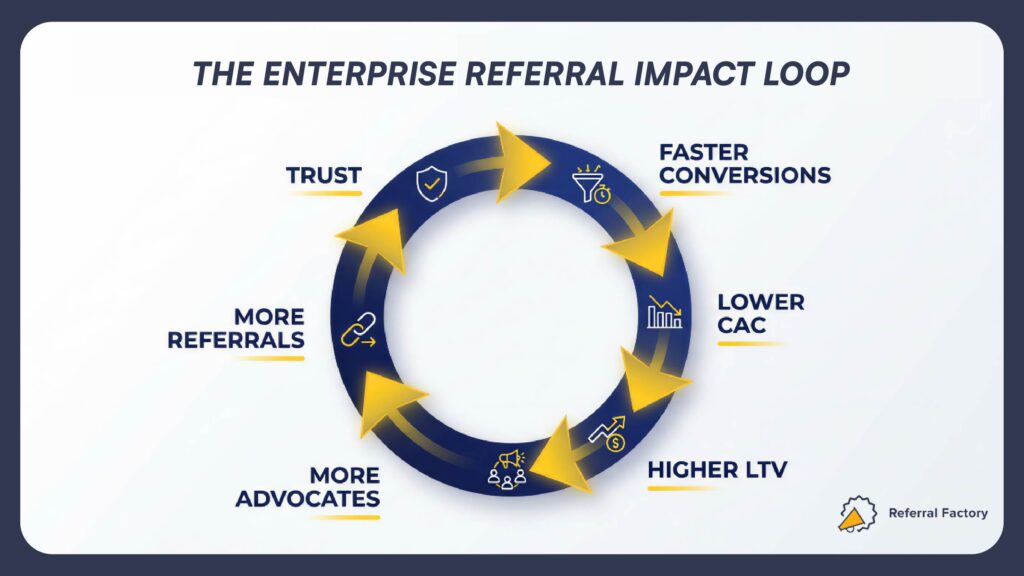
Combine this with faster conversions, lower acquisition costs, and higher retention, and referrals become a growth engine that’s efficient and sustainable.
Key Elements of a Successful Enterprise Referral Strategy
A large‑scale referral marketing program creates a system that scales across teams, business units, and workflows. At the enterprise level, referrals need structure, automation, and alignment to work consistently, especially when multiple stakeholders and complex processes are involved.
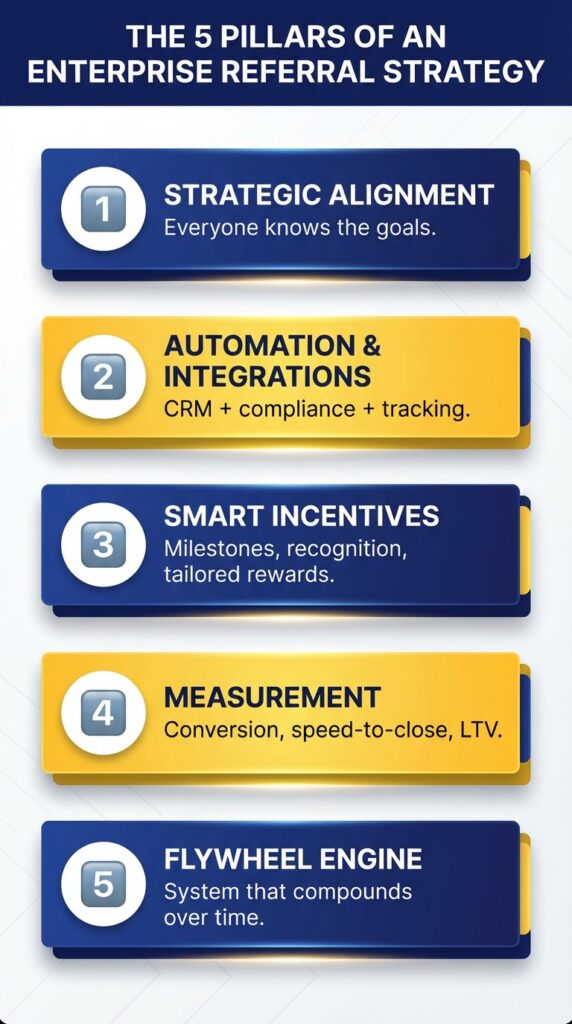
1. Strategic Design and Alignment
A successful enterprise referral strategy starts with clear objectives and organizational alignment. Everyone from marketing to sales to customer success needs to understand how referrals fit into broader business goals.
Mapping where referrals are likely to come from, identifying key advocates, and defining clear success metrics sets the program up for long-term impact. Without alignment, even well-intentioned initiatives can get lost in operational noise.
2. Automation, Integrations, and Compliance
At enterprise scale, the referral program needs to fit into systems and workflows that already exist. A larger business is unlikely to replace its CRM, payment process or customer communication tools just to accommodate referrals, so the referral platform needs enough flexibility to connect to those systems instead.
That can mean using direct integrations, automation tools, APIs or webhooks to move referral activity between the systems that already manage the customer journey. The aim is not to add more tooling or more admin. It is to let the system that already knows when a lead, purchase, enrolment, completed job or other commercial milestone is valid remain the source of truth.
This also reduces dependence on developer resources. Marketing teams should be able to manage and improve the referral program without needing engineering support for every campaign change, while technical teams still have the integration options they need for more complex workflows.
Security and compliance need to be considered at the same time. Before launch, understand what customer data the program actually needs, where that data will be stored, who can access it, and what security, privacy or procurement requirements the organisation has to meet.
3. Incentives and Advocacy Mechanics
The most effective enterprise programs combine thoughtful incentives with advocacy mechanics. Rewards should motivate different types of participants, from individual customers to partner teams, without overcomplicating the process. Enterprise teams often use flexible referral rewards to keep advocates engaged while keeping operations simple.
Recognition, milestone-based rewards, or small transactional incentives can all work, depending on the audience. Clear communication about how the program works is key.
When advocates know exactly what to do and what they receive in return, participation and engagement increase significantly.
Key elements of effective incentives include:
- Flexible reward structures for different types of advocates
- Recognition for high-performing participants
- Milestone-based rewards tied to conversions rather than signups
Keep the Referral Experience On-Brand
For an established brand, the referral journey should feel like a natural part of the customer experience. Sending customers to a heavily vendor-branded page or asking them to share unfamiliar-looking links can create unnecessary friction.
Look for referral software that can match your brand, use your own domain and keep referral links consistent with the brand customers already recognise. This matters even more when people are cautious about clicking links they do not recognise or when the organisation has strict brand guidelines.
The goal is simple: customers should feel as though they are referring directly through your business, not being passed into an unrelated third-party experience.
4. Measurement and Feedback Loops
Measuring outcomes is critical for any corporate referral program. Tracking referral-to-conversion rates, time-to-close, and customer lifetime value allows enterprises to understand what is working and where to optimize.
Collecting feedback from advocates makes sure the program stays relevant and easy to use. Iterating based on real-world data helps the strategy evolve and strengthens the quality of enterprise customer acquisition via referrals over time.
5. Building a Self-Reinforcing Referral Engine
The ultimate goal of an enterprise referral strategy is to build a self-reinforcing loop, a referral flywheel.
- Start with early champions: Identify your strongest advocates (customers, partners, internal teams) and engage them first.
- Make it repeatable: Create shareable templates, advocate kits, and internal tools so referrals aren’t ad hoc.
- Promote adoption: Embed referral prompts in product experiences, account reviews, and partner discussions.
- Reward + reinvest: Use part of the value generated by referred customers to reinvest in the program,either by increasing rewards or by funding advocate engagement initiatives.
Over time, this loop reduces reliance on paid acquisition, because your growth begins compounding through real relationships.
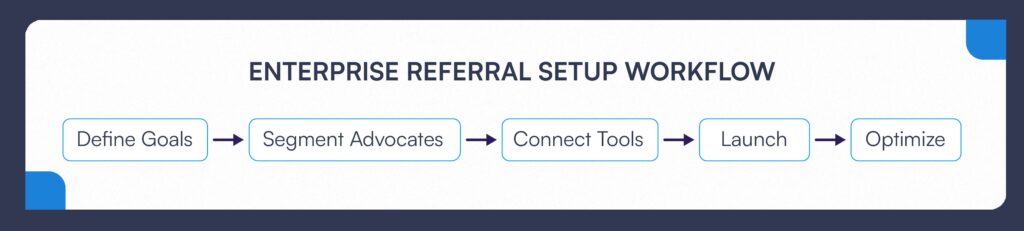
Steps to Implement an Enterprise Referral Program
Implementing an enterprise referral program becomes far easier when you break it into clear, structured steps that guide your team from planning to launch to long-term optimization.
1. Setting Clear Objectives
Start by deciding what you want this program to achieve. Think of it as giving your strategy a destination so every decision becomes easier. Your objectives might focus on enterprise customer acquisition via referrals, higher quality leads, stronger partner participation, or more predictable revenue growth.
Before you lock in targets, it can also help to estimate your potential referral volume. Tools like our referral calculator give you a quick baseline for how many referrals you could generate based on the size of your existing customer or partner database.
When your goals are specific, measurable, and tied to wider business priorities, you are not just launching another marketing initiative but building a channel that can grow alongside the organisation.
Scope your first ask deliberately. Asking for approval to launch across the whole business is a large request with a lot of unknowns attached, and it invites everyone in the room to find a reason to wait. Asking for sign-off on a proof of concept is a much smaller decision: one segment, a defined period, and an agreed measure of success, decided upfront so nobody can move the goalposts later. A pilot at that size puts nobody's core business at risk, which is what colleagues in legal, sales and finance are usually worried about. When it works, you are no longer asking anyone to back an idea. You are showing them a result.
2. Identifying Target Participants
Once the direction is set, shift your attention to who will actually drive your referrals. This includes existing customers, key accounts, partners, channel resellers, and even internal teams. Each group brings a different kind of reach and influence: the more you understand their motivations, communication styles, and what value looks like to them, the easier it becomes to design a program they will want to participate in.
3. Get Security, Legal and Procurement Approval Early
For larger organisations, a referral program often needs approval from more than the marketing team. Information security, legal, procurement, IT and data teams may all have requirements that need to be met before a new supplier or platform can go live.
Work through these requirements early. Confirm what customer data the program needs, where it will be stored, how it is protected in transit, who can access it, how it can be deleted, and whether the business has specific data-residency or hosting requirements. It is much easier to solve these questions before implementation than after the campaign has already been designed.
When evaluating a referral-software provider, look for recognised security standards and privacy controls that make the review process easier. Referral Factory is SOC 2 Type II and ISO 27001 certified and supports GDPR-compliant referral programs. For organisations with stricter data-control requirements, Enterprise customers can also run the sensitive referral-data layer inside their own approved environment so the organisation controls where that data is stored and who can access it.
4. Choosing the Right Referral Program Software for Enterprises
Selecting enterprise referral software is not only about finding a tool that can create referral links and rewards. The platform needs to fit the way the organisation already operates and remove work rather than introduce another process that teams have to maintain manually.
Before choosing a platform, evaluate whether it can support the requirements that matter to your business:
- Integration flexibility: Can it connect to the CRM, payment, marketing and operational systems your teams already use?
- Tracking and attribution: Can it reliably connect the person who referred, the person referred and the event that confirms a successful referral?
- Automation: Can qualification, communications, reward approvals and payouts be automated where appropriate?
- Brand control: Can you fully white-label the experience and use your own domain?
- Security and compliance: Can the vendor meet your security, privacy, legal and procurement requirements?
- Data hosting: Are there options for organisations with strict data residency or hosting requirements?
- Multiple campaigns and markets: Can different programs or regions be managed without rebuilding the infrastructure each time?
- Reporting: Can teams understand which advocates, campaigns and channels are driving commercially valuable outcomes?
- Implementation and support: Is there experienced support available to help the organisation get through setup, stakeholder approval and launch?
- Promotion and communication: Can the platform help you tell customers about the program and keep referrers and referred customers updated?
- Scalability: Can the platform support large customer databases and referral volumes as the program grows?
5. Integrating CRMs, Payment Systems, and Internal Tools
Larger businesses already have systems that own different parts of the customer journey, so a referral program should fit into that infrastructure rather than sit beside it. Depending on the business, referral activity may need to connect with a CRM, ERP, payment gateway, marketing platform, customer-support tool or operational system.
Referral Factory supports this through direct integrations with tools such as Salesforce, HubSpot, Pipedrive, Monday.com, Zoho, Intercom and ServiceTitan, as well as Zapier, Make, n8n, API and webhooks. This gives teams different ways to connect referrals to existing workflows without requiring developers to build and maintain the whole referral system from scratch.
The most important decision is the qualifying event. Decide which system already knows when a referral has become commercially real - for example a closed deal, paid invoice, enrolment or completed job - and use that event to qualify the referral and trigger the next step.
Enterprise example: A multinational B2B payment-solutions business with more than 1,000 employees connected Referral Factory to Salesforce so every referred lead could flow directly into the sales process its team already used. In one year the program generated 5,691 referred leads, with 3,758 converting into customers - a 66% referral conversion rate.
6. Launching Internally and Externally
A referral program cannot generate referrals if customers do not know it exists. Promotion should be part of the program design from the beginning, not something added after launch.
Start internally so sales, customer success, support and other relevant teams understand how the program works and when to mention it. Then build referral promotion into customer touchpoints that already exist. Depending on the business, that might include lifecycle emails, post-purchase or post-service messages, customer portals, newsletters, account reviews, in-product prompts, SMS, website placements or offline materials.
Do not rely on a single launch email. Customers may need reminders at moments when satisfaction or engagement is high, while both the referrer and the person referred may need automatic notifications about invitations, referral status, qualification and rewards. Built-in referral communications make it much easier to keep participants informed without creating another manual workflow for the marketing team.
Example: CBD College connected Referral Factory with HubSpot so referral promotion, lead routing and follow-up could become part of the existing student lifecycle. Referral activity could be triggered after course completion, referred leads could flow back into HubSpot for nurture, and rewards could be connected to the appropriate outcome. The program has generated more than 6,600 referrals and more than 3,700 enrolments, with a 56% referral-to-enrolment conversion rate.
7. Give the Program a Clear Owner
A referral program can have the right software, rewards and integrations and still underperform if nobody is responsible for driving it forward. Give the program a clear owner who can coordinate internal stakeholders, implementation, launch, promotion, reporting and ongoing improvements.
This is also where experienced onboarding and account support can save a large organisation time. Many businesses choose referral software because they do not want to allocate internal engineering and operational resources to building and maintaining referral infrastructure themselves. Having a team that understands referral programs can help the organisation get through implementation faster and avoid common mistakes.
The software should make the marketing team more independent, not create a new dependency on developers for every change. Technical teams can still support the integrations and security requirements that need them, while marketing can operate and optimise the program day to day.
8. Tracking, Measuring, and Optimizing
The final step is ongoing improvement. Monitor how referrals move from share to conversion, identify bottlenecks, and adjust incentives or messaging when needed. Real-time insights help you deepen engagement and increase ROI. Over time, you will see patterns that show which audiences refer the most, which offers resonate, and which channels deliver the highest value.
This feedback loop turns your program into a long-term growth engine that strengthens with every cycle.
Common Pitfalls and How to Avoid Them
Even the best enterprise referral programs can stumble if certain challenges aren’t addressed early. Understanding the common pitfalls helps you design a program that runs smoothly and scales effectively. Here are some of the most frequent mistakes and how to avoid them:
- Lack of internal alignment
When marketing, sales, and customer success aren’t on the same page, referrals fall through the cracks. Make sure everyone knows their role, understands the process, and is motivated to support the program. Regular check-ins and shared KPIs can keep teams aligned. - No clear program owner
When responsibility is spread across several teams, optimisation and follow-up can disappear between them. Give one person or team clear ownership of performance, promotion and ongoing improvement. - Overly complex processes
If the referral process is confusing or time-consuming, advocates won’t participate. Keep submissions, tracking, and reward redemption simple. Clear instructions and intuitive software go a long way in keeping engagement high. - Making marketing dependent on developers
Complex integrations may need technical support, but everyday referral-program changes should not become engineering tickets. Choose software that gives marketing enough control to manage and improve the campaign independently. - Poor incentive design
Rewards that don’t motivate your audience can kill participation. Tailor incentives to different advocate types, customers, partners, or internal teams, and tie them to meaningful milestones, not just signups. - Ignoring compliance and security
Large enterprises must handle data carefully. Failing to enforce privacy, security, or audit controls can cause legal headaches. Use software that includes built-in compliance features and always stay up to date with regulations. - Starting implementation before approval
If security, legal or procurement can block the platform later, involve them early. Confirm the requirements before the team spends time building workflows that may need to be changed. - Limited visibility into performance
If you can’t see how referrals move through the pipeline, it’s impossible to optimize. Integrate tracking into your CRM and reporting tools so you know which advocates, campaigns, and channels are performing best. - Neglecting communication with advocates
Even enthusiastic advocates need guidance. Provide regular updates, reminders, and tips to keep them engaged. A lack of communication can make your program feel forgotten or confusing. - Launching without a promotion plan
A strong referral offer will not help if customers rarely see it. Decide where and when the program will be promoted, and build ongoing reminders into the customer journey rather than relying on one launch announcement. - Focusing on quantity over quality
Getting lots of referrals is meaningless if they don’t convert. Focus on targeting advocates who influence your ideal customers. Track quality metrics, like conversion rate and deal size, to ensure your program drives real business value. - Failing to iterate
Markets and enterprise workflows change. If you launch and forget, participation and ROI will drop over time. Continuously gather feedback, test new messaging, adjust incentives, and refine processes to keep your program effective.
Paying Out Before the Referral Is Real
At enterprise volumes, a referral reward is worth gaming. Programs that pay on a sign-up rather than on a genuine outcome attract people who sign up, do the minimum, collect the reward and disappear. One payments company we work with, iKhokha, ran into exactly this, and fixed it by moving the qualification point. Nothing pays out now until the referred business is genuinely trading, and there are checks before every payout.
The wider lesson is that your definition of a successful referral is also your fraud protection. Decide what a real outcome looks like before you launch, whether that is a first purchase, a funded account, a signed contract or a customer who is still active after three months. That decision is what your referral tracking has to be able to see. Changing that definition once people are already earning rewards is far harder than setting it correctly at the start.
Turning Referrals Into a Long-Term Growth Channel
Referral programs work because they combine trust, automation, and scale. When designed well, they turn satisfied customers and partners into reliable advocates who help drive new business, shorten sales cycles, and strengthen relationships.
This impact compounds over time. Each referral builds credibility, expands your network, and keeps your pipeline moving. Now is the ideal moment to refine your enterprise referral strategy and turn advocates into a sustainable growth engine.
Referral Factory helps mid-market and enterprise teams launch, integrate, promote, track, qualify and reward referral programs without building and maintaining the infrastructure internally. Teams can create fully branded referral experiences, connect referral activity to existing systems, automate customer and referral communications, run multiple campaigns, and meet more complex security and data-hosting requirements as the program grows. If you want to talk through your workflow, integrations or rollout requirements, book a demo with our team.
Referral link generator (free)
We take your website, send it to Referral Factory, and provision a real referral program for your brand. The link you get is a live referral URL your customers can share, backed by tracking and rewards in the app - not a static "generator" preview. This is the fastest way to see what a real referral program would look like for your brand! Try it below...