
Tracking referrals, attribution logic, ROI, qualification, and conversion visibility.
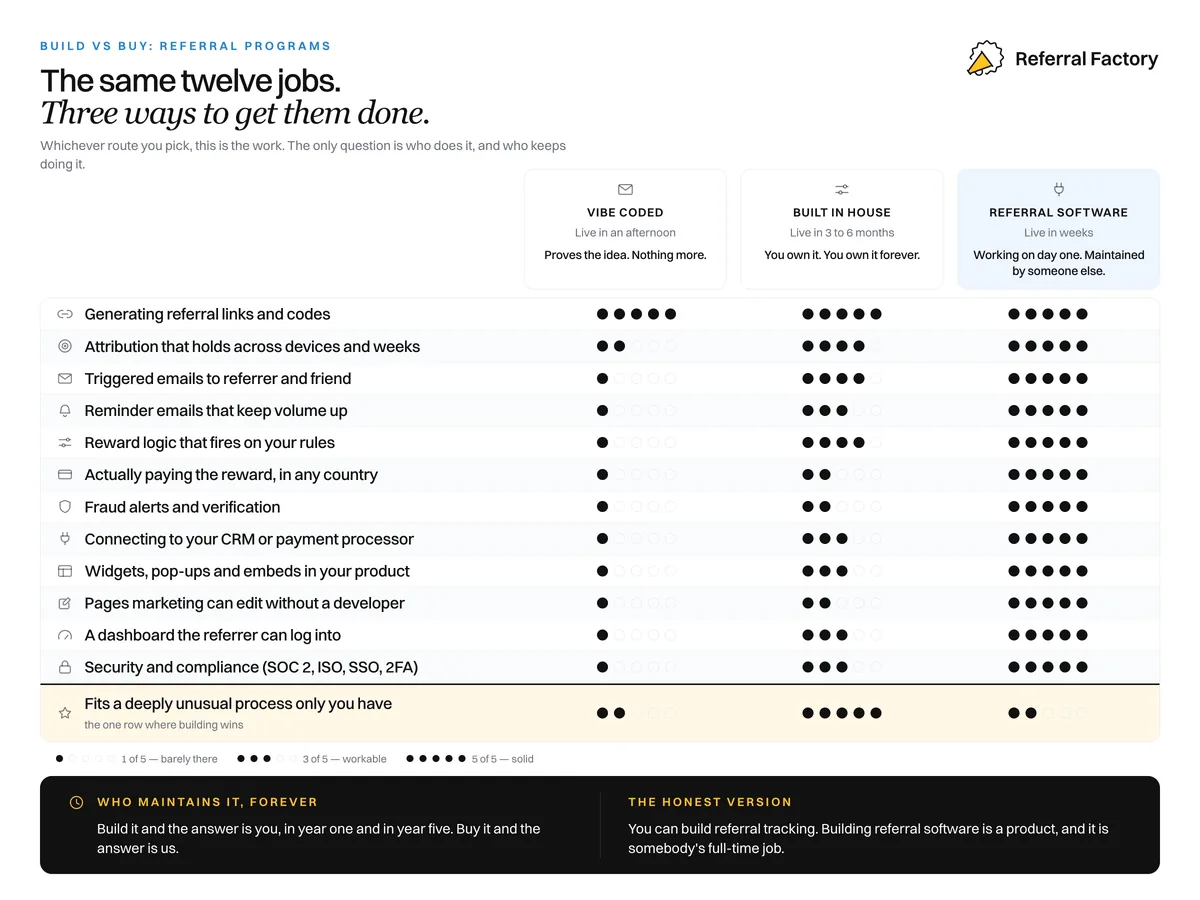
Short answer: Your engineers can build referral tracking, and with AI you could even vibe code it in an afternoon. But referral tracking is not the same thing as referral software. Tracking is one feature of it, and the simplest one. The software also has to handle the triggered and reminder emails to both sides, reward logic that fires on its own, a way to actually pay the reward, fraud alerts, pages your marketing team can change without a developer, and a live connection to whichever system tells you a referral converted. Building all of that is bigger than it looks, and then you maintain it forever. Buy it unless referrals are your core product, you need reward logic no platform supports, or you have a team whose actual job this will still be in year three.
Every few weeks someone tells me they are thinking about building their own referral software instead of buying it. Usually it is a CEO, usually the company has a good engineering team, and usually the question arrives with a bit of an edge: what do you actually do that we can't do ourselves?
It is a fair question and it deserves a straight answer. So here it is, including the cases where building genuinely is the right call.
Yes, your engineers can build referral tracking
A competent engineer can build referral tracking. Generate a unique link for each customer, capture the click, attach it to the sign-up, store it. A week of work, maybe less. With an AI coding assistant, faster again.
I am not going to pretend otherwise, because anyone who has built software knows it is true, and a vendor who tells you it is hard loses your trust in the first paragraph.
Here is the part that catches people out. Referral tracking is not referral software. Tracking is one feature of it, and all it does is record a referral that has already happened. Referral software is everything that gets the referral to happen in the first place, and everything that has to happen after it. If you want the detail on the tracking piece itself, we have written it up separately in how to track referral customers and in our guide to what referral software actually does.
Can you just vibe code a referral program?
This is the version of the question I get now, and it deserves its own answer, because AI genuinely has changed part of this argument. Two years ago building your own meant a scoped engineering project. Today someone can have a working referral link generator by the end of the afternoon without writing much code at all.
So yes, you can vibe code something that makes a link. The problem starts immediately after that.
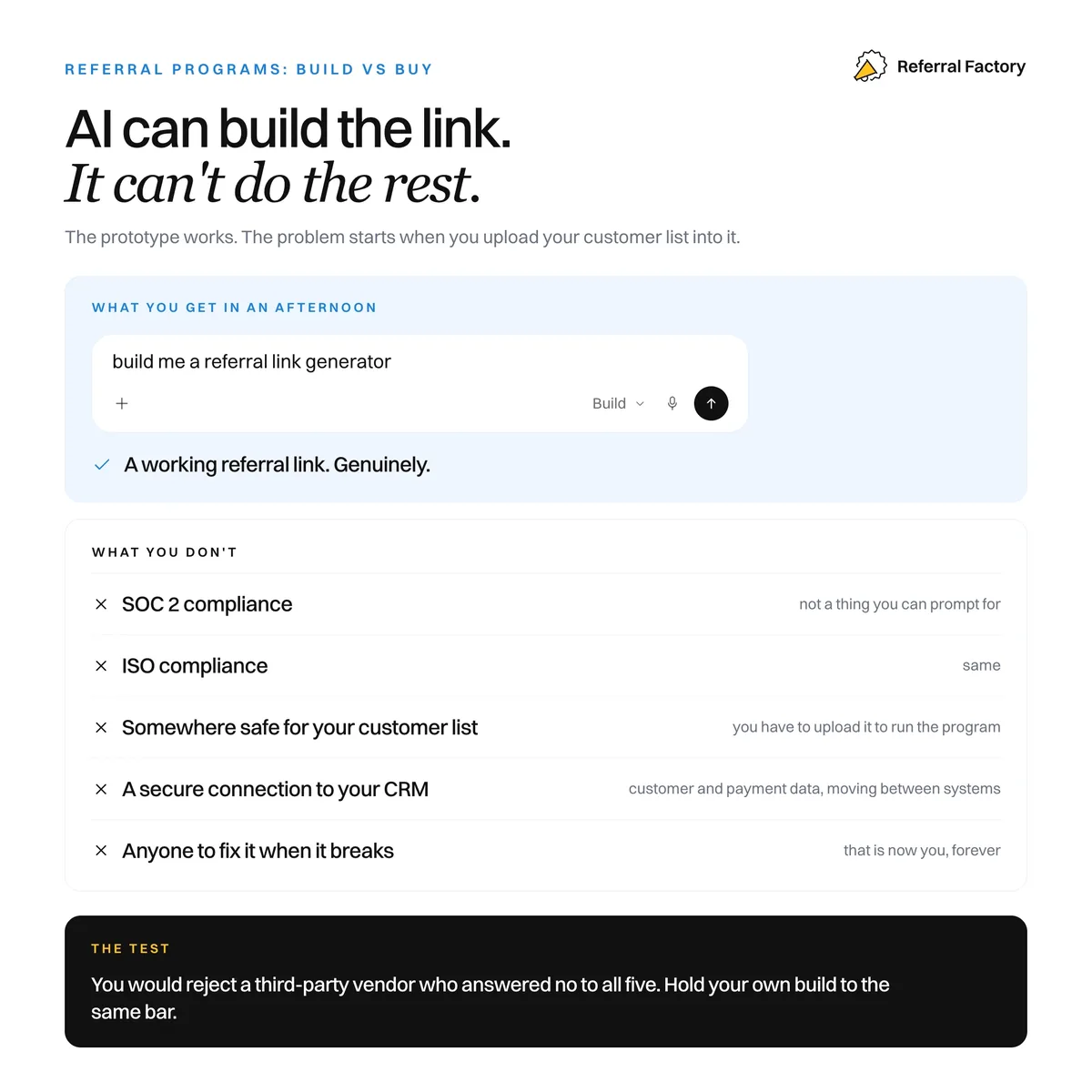
You have to upload your customer base into it. That is the bit people skip past. A referral program does not work on a link alone, it works on knowing who your customers are, contacting them, and paying them. So the tool you built on a Tuesday afternoon now holds your customer list.
Ask the questions you would ask of any vendor. Is it secure? Is it SOC 2 compliant? Is it ISO compliant? For a vibe coded internal tool the answer is no, and it is no for a while, because compliance is not a feature you prompt your way to. If your legal or security team would not approve a third-party tool with those answers, they should not approve yours either.
The second problem is that a working prototype makes the job look much smaller than it is. Generating a link is the easy 5% that AI does brilliantly. The other 95% is the long list of small, unglamorous mechanics: I refer you, you fill in your details, I get an email, you get an email, you convert, my reward has to fire, and I need somewhere to log in and watch my referrals. None of that is hard because prompting is hard. It is slow because you have to work out every one of those nuances yourself, and you only discover most of them once real customers are in the system.
So the honest answer is that AI has made it faster to build the wrong 5%, and has not touched the rest. And it has done nothing at all about the part that comes after launch, which is maintaining it.
What referral software does beyond tracking
Write down everything the software has to do for a referral program to actually produce referrals, and the list gets long fast.
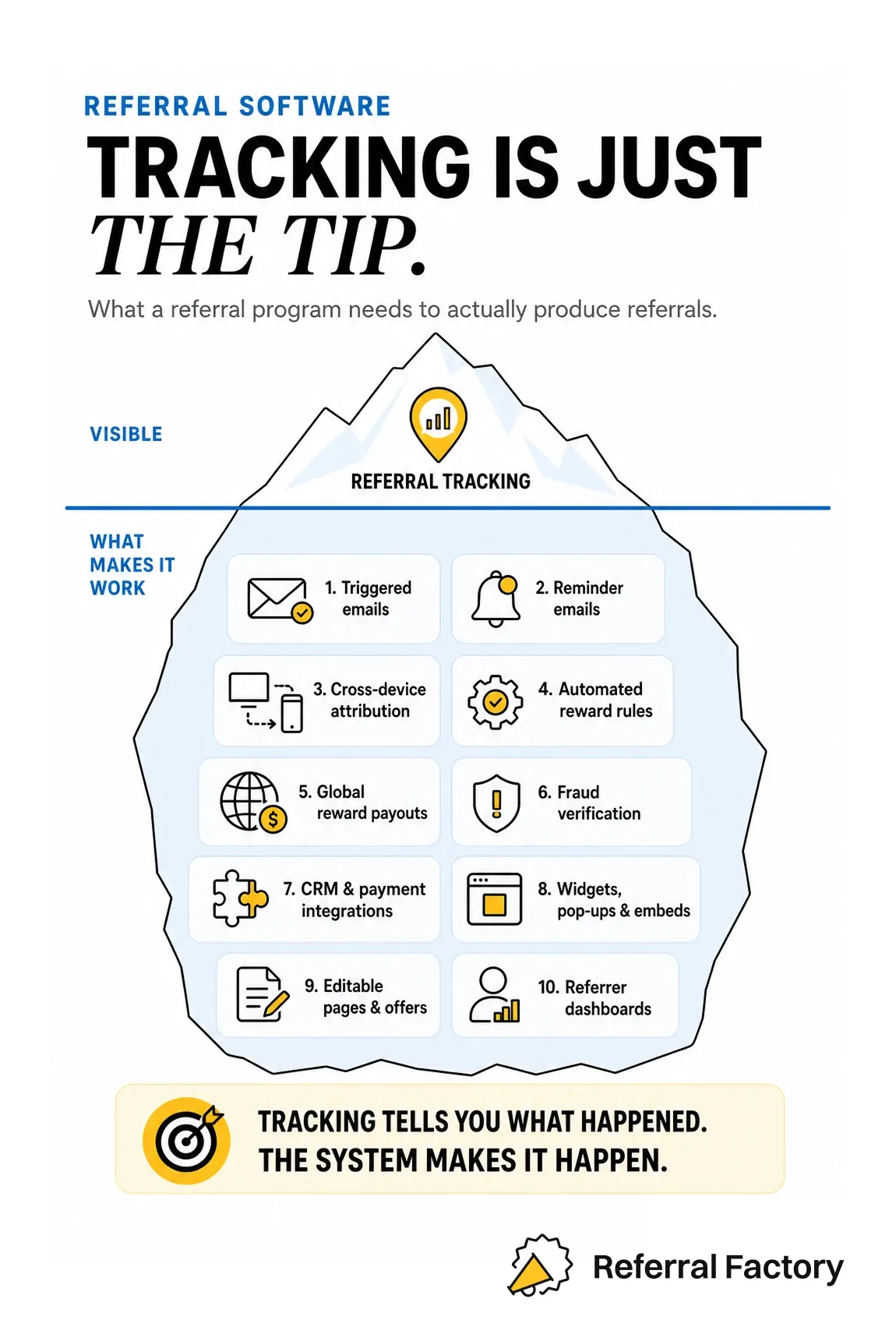
| What the software has to do | What it looks like when it's missing |
|---|---|
| Triggered emails to both the referrer and the friend, at every step | People join, hear nothing, and forget |
| Reminder emails | Referral volume falls off a cliff after week three |
| Attribution that holds across devices and weeks, on links and codes | Disputes you can't settle and numbers finance won't accept |
| Reward logic that fires on your rules | Someone checks a report and pays out by hand every month |
| A way to actually pay the reward | Cash, gift cards, PayPal, account credit, in whatever country they're in |
| Fraud alerts and verification | You pay real money for fake sign-ups and find out afterwards |
| Integration with your CRM or payment processor | No reliable way to know a referral converted |
| Widgets, pop-ups and embeds for logged-in and logged-out users | The program lives on one page nobody visits |
| Pages and offers marketing can edit | Every wording change is a developer ticket |
| A dashboard the referrer can log into | They can't see what they've earned, so they stop |
A few of those deserve more than a row.
Reminder emails are the single biggest driver of referral volume, and the thing homegrown builds almost never have. People join a referral program with good intentions and then get on with their day. Someone has to nudge them, at the right moment, without becoming spam.
Reward logic is not "reward when they sign up". It is reward when the referred customer has done the thing that makes them worth rewarding for, which is usually not sign-up. Different rewards for different tiers, countries, products. Every rule you add is a branch someone has to build, test and then keep working. A double-sided referral program, where both people get something, doubles that logic before you have added a single condition.
Fraud protection has to be designed in from the start. Any reward attracts a few people who try to cheat it: self-referrals, one person with twenty email addresses, syndicates working from a single location, referrals that qualify and then vanish. Most in-house builds discover this after they have paid out. We wrote a full guide on how to prevent referral fraud, and it is worth reading before you scope a build, not after.
And then there is the long tail. Dozens of small details that only surface once real customers are using the thing, and that an engineer who has never run a referral program has no reason to anticipate.
That is the actual build. Not the tracking.
So when someone says "we could build our own referral program", the honest translation is "we could build our own referral software". That is a product, it is somebody's full-time job to keep working, and it is a much bigger commitment than the tracking demo that made it look easy.
The bit everyone forgets: it has to plug into your source of truth
Here is the requirement that turns a weekend build into a real engineering project, and it is the one nobody scopes for.
To pay a reward you have to know the referral actually converted. Your referral tool does not know that. Your CRM knows it, or your payment processor knows it, or your billing system knows it. So the tool has to connect to whichever of those is your source of truth, read the right event out of it, and act on it. HubSpot, Salesforce, Stripe, Pipedrive, Zoho, Intercom, or your own product through an API or webhook.
That is three separate problems at once.
Building the connection. Every one of those systems has its own API, its own auth, its own idea of what an event looks like. This is real engineering work, and it is work your team has to repeat for each system you connect.
Keeping it working. Those platforms change. When an API version is deprecated, someone on your team has to notice and fix it, or rewards silently stop firing and you find out when a customer complains.
Securing what moves between them. Customer records and payment events are now flowing between your systems and something you built. That data has to be handled properly at every step, which is a much higher bar than "it works on my machine". This is where a vibe coded solution gets genuinely risky, and it is the reason your security team will have opinions about it.
Buying skips all three. The integrations already exist, somebody else maintains them, and the compliance is already in place.
The cost nobody budgets for: it never finishes
Michael Goodbody, former Global Head of Marketing and Communications at Robinhood, put this better than I could:
"It's usually pretty easy to get a referral system set up. It's really hard to get it maintained for all of its life and updated for all of these developments of law and stuff... you end up finding it's a priority for 3 months [or] 6 months and the maintenance of it is the problem."
His advice to marketers and CMOs was blunt: ultimately buy, don't build.
That matches what I see. The build gets attention for one quarter because it is new and somebody is excited about it. Then the roadmap moves on, the engineer who built it changes teams, and eighteen months later a customer is disputing a reward and nobody can explain the logic. Building a referral program is a one-off cost you can estimate. Maintaining one is a permanent cost you can't. In a regulated business it is worse again, because the rules change underneath you, which is the whole argument for referral software built for regulated industries.
The mechanic that actually decides it: who owns a design change
If you take one thing from this, take this.
Getting a referral program live at a large company needs more from your engineering team than anyone expects going in. You want a widget in the customer dashboard. You want the referral link in the newsletter, which somebody has to hand-code. You want the landing page to match a campaign. Each of those is a small ask, and each small ask joins the same queue behind everything else engineering is doing.
Build it yourself and that never stops. Every time marketing wants to change the reward wording, the design, the offer, or the page, it is a ticket, and the ticket waits.
Buy it and the first install is the only ticket. With Referral Factory, engineering pastes in one script, once. After that the design lives in Referral Factory, the marketing team changes it directly, and the script pulls whatever the current version is. Marketing keeps control. Engineering gets their afternoon back and never has to think about it again.
That is not a small convenience. In most companies the thing that kills a referral program is not the idea and not the budget. It is that the marketer who wants it does not control the developers who have to build it.
What buying looks like in practice: iKhokha
iKhokha is a South African fintech with its own in-house development team. Building a referral program was well within reach. They bought instead, ran it as a proof of concept, and it proved its value.
Thousands of business owners have now signed up to recommend them. Close to one in five of the businesses those referrers send goes on to become an active, paying customer, against about 2.55% for a paid search click in finance and insurance. So their referrals convert nearly eight times better than paid advertising. The whole program sits with the marketing team rather than with engineering, and no developer has access to it.
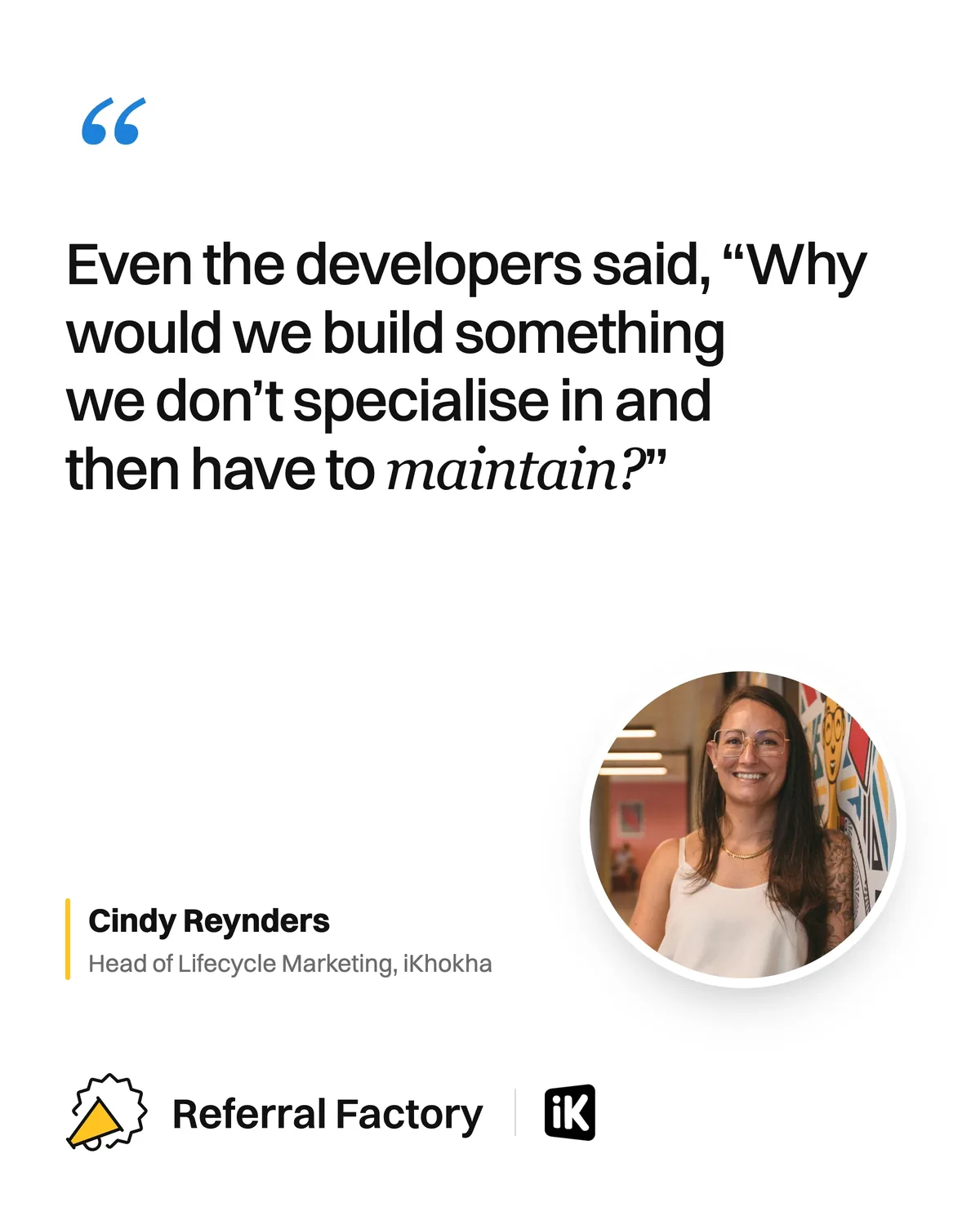
Their Head of Lifecycle Marketing, Cindy Reynders, described the decision like this:
"Even the developers said, why would we build something we don't specialise in and then have to maintain?"
The full story, including how they designed the program so people can't cheat the rewards, is in the iKhokha case study. If you want more of the same in banking and financial services, there is also a B2B financial services business converting two of every three referrals.
When building is actually the right call
There are real cases.
Referrals are your product, or close to it. If the referral mechanic is the core loop of the business rather than a growth channel alongside others, own it. Build it.
You need something no platform does. Deeply unusual reward logic, a regulated payout structure specific to your industry, referral behaviour tied tightly to a product mechanic nobody else has. If you have genuinely checked and no tool does it, build.
You have a team whose actual job this is. Not engineers who could build it. Engineers who will still own it in year three, with a product manager attached and room on the roadmap. That team exists at some companies. It is rarer than people think.
We do turn people away on this basis. Some of the businesses that come to us want something so specific and so wired into how they operate that our honest advice is to build it themselves. They know what they are doing and they want something genuinely unique, and no off-the-shelf tool is going to be the right answer for them. Every business is different, so the answer is different.
If none of those describe you, you are not choosing between building and buying. You are choosing between buying and building something you will quietly resent by next winter.
What I would actually do
Buy it, run it as a proof of concept, and let the results decide.
That is the sequence the smartest teams use. Launch in weeks rather than quarters, with a real reward and real customers, and find out whether referrals are a channel worth investing in for your business. If the answer is no, you spent a few months of licence fees instead of a few quarters of engineering. If the answer is yes, you have a working program producing revenue while you decide what to do next, and you almost certainly leave it where it is. That is also the fastest route to a proper enterprise referral program, because you are scaling something that already works instead of specifying something that doesn't exist yet.
So the question to put to your team is not "can we build this". You can. Ask "do we want to still be maintaining this in three years, instead of the thing we are actually good at".
Word of mouth happens by chance. A referral program makes it happen on purpose. The machinery that makes it happen on purpose is exactly what you would be building, and then keeping alive.
Want to see what it looks like before you decide anything? Start a free trial or book a demo, and the referral calculator will show you roughly what referrals could add. If you would rather start from the mechanics, read how to build a customer referral program.
FAQ
Can you vibe code a referral program?
You can vibe code something that generates a referral link, and quickly. What you can't vibe code is somewhere safe to put your customer list. To run the program you have to upload your customer base into the tool you just built, and it has no SOC 2 or ISO compliance behind it. You would reject a third-party vendor with those answers.
Should you build your own referral program or buy referral software?
Buy it, in almost every case. Building the tracking takes about a week, but a working program also needs reminder emails, rule-based reward payouts, fraud controls and pages marketing can edit, and all of that needs maintaining permanently. Build only if referrals are your core product loop, you need reward logic no platform supports, or you have a team who will still own the system in three years.
Is it cheaper to build your own referral program?
Usually not, but cost is rarely the deciding factor. The build itself is a few weeks of engineering. The permanent costs are maintenance, manual reward payouts, fraud you absorb before you fix it, and the referral revenue you didn't earn during the months you spent building. Compare all of those, not just the first version.
How long does it take to build a referral program in house?
Basic referral tracking takes about a week. A working program with triggered emails, reminders, rule-based rewards, fraud checks and marketing-editable pages is a multi-month project, and it never fully finishes because it needs maintaining as your product, your stack and your regulations change.
What can't you build yourself?
Almost anything is buildable given enough time. The parts teams consistently underestimate are attribution that holds up weeks later across devices, reminder sequences, fraud and verification controls, and letting marketing change the design without a developer. Attribution is the one capability buyers most often admit they can't replicate.
Do you need developers to launch Referral Factory?
Once, briefly. Engineering pastes in a single script and is finished. After that the marketing team builds and edits the program itself. iKhokha, a fintech with its own development team, runs its entire program without giving a developer access to it.
When should you build your own referral program instead?
When referrals are the core product loop rather than a growth channel, when you need reward logic no platform supports, or when you have a dedicated team who will still own the system in three years. Outside those cases, buying and running a proof of concept answers the question faster and cheaper.
Referral link generator (free)
We take your website, send it to Referral Factory, and provision a real referral program for your brand. The link you get is a live referral URL your customers can share, backed by tracking and rewards in the app - not a static "generator" preview. This is the fastest way to see what a real referral program would look like for your brand! Try it below...