
Examples, templates, checklists, and practical inspiration you can adapt quickly.
By Kirsty Sharman
Short answer: There is no single referral marketing strategy. Yours comes down to three questions: who can actually refer you, how often can you reach them, and what is one of them worth. The answers change as a business grows, which is why a company starting out, a company growing, and an established company need three different referral programs.
Adam from Referral Factory on how referral marketing strategies change across the three stages.
Why one referral marketing strategy doesn't fit every business
Search this topic and you get the same advice everywhere: run a competition, offer a points system, use tiered rewards, copy Dropbox. None of it is wrong. The problem is that a gym and an insurance broker are handed the same list, and those two businesses have almost nothing in common. One sees a customer three times a week, usually right after a workout. The other might speak to a customer once a year, at renewal, by email.
A strategy that works starts from what is actually true about your business. Three questions get you most of the way there.
| Question | What it decides |
|---|---|
| Who can actually refer you? | Whether your referrers are customers, employees, partners, or people with an audience you want |
| How often can you reach them? | Whether the ask is casual and repeated, or deliberate and rare |
| What is one of them worth? | How large the reward can be, and how much human attention each referral deserves |
The quickest way into all three is the size of your business, because that one thing moves every answer at once.
Stage 1: you are starting out
You have no customers yet, or very few. The handful you do have can refer someone, but it will not add up to enough to matter, because only a small share of any customer base ever refers. That is not a reason to skip referrals. It means your referrers are different people.
At this stage they are your network, your partners, and anyone who already has the audience you want. If your business is online, that means borrowing an audience somebody else built: newsletter writers, community owners, creators, the people writing the roundups your buyers read before they choose. If your business is offline, it is also whoever serves your customer before you do. The plumber meets the homeowner before the solar company does. The accountant talks to the business before the insurance broker does.
Some people call this affiliate marketing. The label matters less than the fact that the job is identical: somebody sends somebody, and you need to know who to thank and who to pay. It is word of mouth marketing with a paper trail.
This is where it usually goes wrong, because people run it on memory. Someone says "Sarah sent me", you make a mental note, and three months later you have no idea who sent what or what you owe them. Give every referrer their own referral link and track it from the first week. Referral tracking software records who referred who, whether that person is a customer, a partner, or a creator.
One warning. Most advice aimed at businesses this size points at a refer-to-win competition, because those campaigns collect names fast. They also fill a database with people who wanted the prize. If you run one, make the prize something only your actual customer would want, and take the shorter list of better-fit leads.
Stage 2: you are growing
Now you have real customers, and something is true here that will not be true later. You can still reach them one at a time. Maybe you know their names. Maybe you simply have a list small enough to write to properly. Either way the ask can still be personal, and a personal ask is usually the highest converting thing you will ever do in referral marketing.
What that looks like depends on the business. If you speak to your customers, ask on the call, right after they have told you something is working. If you never speak to them, send an email that reads like a person wrote it, to the customers you already know are happy.
The ask does not need to be automated yet, and it is better if it is not. The tracking should be automated from day one. Ask like a human, track like a machine.
Before you launch, settle two things. First, work out what one paying customer costs you today. That number is the ceiling on your referral program incentive, and spending under it means every referral saves you money. Second, decide what counts as a converted referral, and be strict. Not a signup, not a form fill. The moment money changes hands.
When to ask, and how often
This is the part almost nobody writes about, and it matters more than the reward.
Asking once does not work. When you ask someone in the moment, they usually do not have anybody in mind. Somebody buys a car from you, you ask who else is in the market, and they go blank. Not because they do not want to help. Because nobody keeps a list of friends who need a car in their head.
So the job is not to get a name on the spot. It is to be remembered later, when a friend of theirs finally says they are thinking of changing their car. Mention your referral program when they buy, again a month later, then again in a different format. Referral programs work in the background and pay off at a moment you do not control.
How often you can do that depends on the business. Run a gym and you are in front of a customer three or four times a week, so reminders can be casual and constant. Be an insurance broker and you get two real conversations a year, so each one has to carry more weight, timed to a renewal or a claim you handled well.
Stage 3: you are established
Your referrers are still your customers, but there are enough of them now that you cannot ask one at a time, and people have a relationship with your brand rather than with you personally.
Here is the part that surprises people. Building the customer referral program is the easy half. The whole game becomes promoting it and keeping it fresh. Build a good program for 50,000 customers, never tell them it exists, and it does nothing at all. That is not a broken program. That is a program nobody has heard of.
So map your touchpoints. Write out every point at which your business talks to a customer, then decide which of those moments carries the ask.
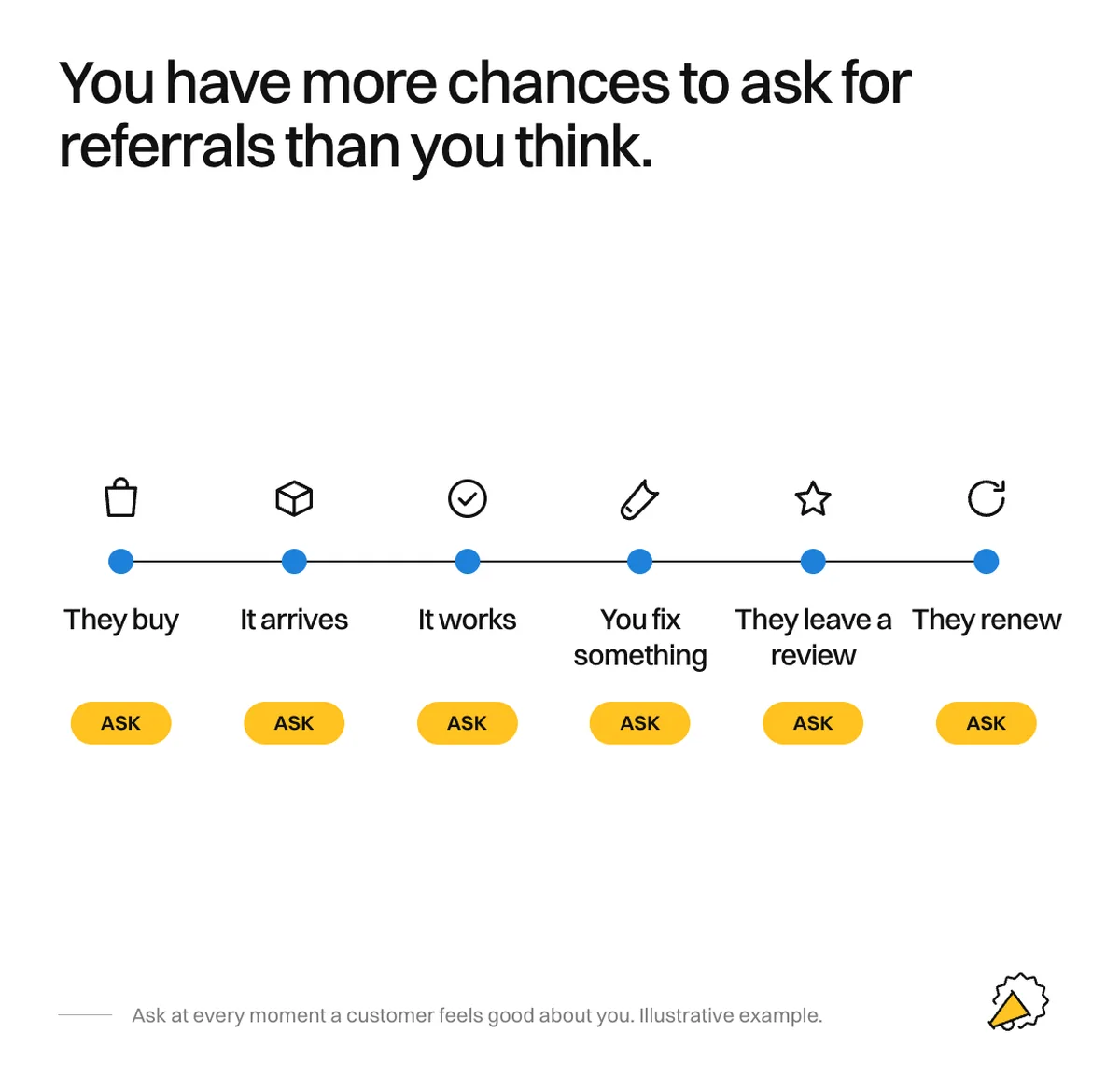
Online, that list includes the welcome email, a banner inside the account they log into, the receipt, the confirmation emails nobody thinks of as marketing, and the moment somebody leaves a five star review. Offline it includes the invoice, the QR code on a thank you card, the message after an appointment, and the engineer standing in a customer's kitchen having just fixed something. Either way, put it in your staff email signatures and get your sales team asking out loud.
One decision arrives at this size that never comes up earlier: whether people opt in to your program or you generate a link for everybody. Opt-in means they sign up before they get a link, so your list is smaller and everyone on it chose to be there. Auto-generating a link for every customer removes the step that loses most people, and it means nobody has to remember they joined. The tradeoff is consent. If you operate somewhere with strict marketing consent rules, or you sell to businesses that care how their staff got enrolled in something, opt-in is the safer build. Most consumer programs run the other way.
Two more things are worth adding here. Time some asks to your industry rather than to one happy customer: roofers should be asking the week after a big storm, accountants the week after filing season ends. And watch your participation rate, meaning how many of the people you asked actually did something. If it is climbing, the program is healthy. If it is flat, the program probably is not broken. It is invisible, and you go back to your touchpoints.
What one customer is worth changes everything
Whatever stage you are in, one number decides how large a reward you can afford and how much human attention a single referral deserves.
Say a customer is worth $25,000 and you have a few hundred of them. One referral is then worth real effort: a large reward paid once a deal is signed, tracked in your CRM, with a salesperson calling the referrer to say thank you and walking the referred friend in personally.
Now say a customer is worth $40 and you have 100,000 of them. Nobody is phoning anybody. You flip it: a small reward paid automatically, no person in the process, and all of that effort redirected into promotion and automated follow up.
What does not change is the work underneath. Somebody has to know who referred who, the friend on the other end has to be introduced properly, and the reward has to arrive. That job is identical at $40 and at $25,000. Only the size of the reward and the amount of human attention around it move.
What to expect
Numbers from three referral programs built on Referral Factory, all published as case studies.
| Business | Referred leads | Converted | Worth knowing |
|---|---|---|---|
| Solar company, Australia | 3,700 in the first year | 38% | Around $6,000 average sale, over $8 million in revenue, and referrals became the biggest source of new business inside 6 months |
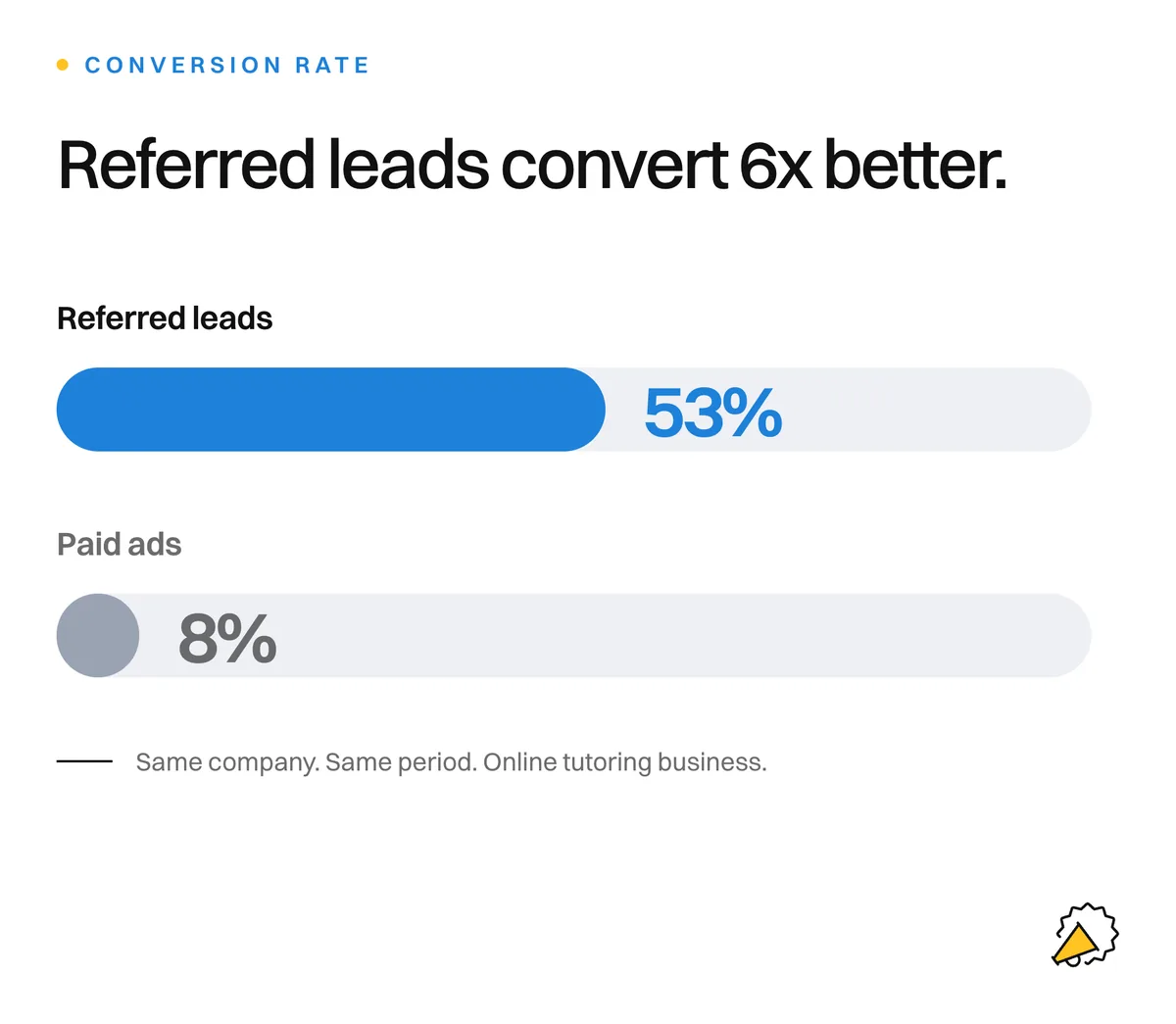
| Online tutoring company, USA | 1,700 in 10 months | 53% | Paid ads converted at 8%, and a customer through other channels cost about $375 |
| Mobile physiotherapy clinic, USA | 834 | 47% | 1,402 people took part in the program |
The tutoring comparison is the one to run for your own business. Fifty three percent of referred leads converted, against eight percent from paid ads. That gap, not the reward, is why referred leads are worth chasing.
If you want a rough number for your own business before you build anything, our referral calculator estimates annual referral volume from the size of the audience you can reach.
Two honest caveats. Participation is always a minority sport: that same tutoring company got 22% of its contact list taking part, which is a strong number and still only one in five. And referral gets more predictable the more customers you have, which is exactly why the strategy has to change as you grow.
Getting started
- Answer the three questions: who can refer you, how often can you reach them, what is one of them worth.
- Work out what a customer costs you today. That sets your reward ceiling.
- Decide what counts as a converted referral, and pay only on that.
- List every touchpoint you have, then pick the ones where a customer feels good about you.
If you want to see what your version looks like, book a demo and talk it through with our team. If you would rather read further, our CMO's guide to referral marketing covers budgeting and board-level reporting, and customer acquisition strategy for every business stage puts referral in context alongside every other channel.
FAQ
What is a referral marketing strategy?
A referral marketing strategy is the plan for who you ask to refer you, when and how often you ask them, and what you pay when a referral converts. It is not the same as picking a reward. The reward is one decision inside it, and usually not the one that decides whether the program works.
How do I choose a referral reward?
Start from what a customer already costs you to acquire. If a customer costs $300 through paid channels, a $100 reward is cheap. Spending under your acquisition cost means every referral saves money. Check what you are allowed to offer first if you work in a regulated sector, because cash is restricted in some of them and a discount is not.
When is the best time to ask for a referral?
At a moment when the customer feels good about you, and more than once. Asking a single time rarely works, because people do not have a friend in mind at the moment you ask. The point of asking repeatedly, across different touchpoints, is to be remembered later when someone they know needs what you sell.
Do referral programs work for B2B as well as consumer businesses?
Yes, but they look different. When a customer is worth tens of thousands, one referral justifies a large reward paid on a signed deal, CRM tracking and a human follow up. When a customer is worth tens of dollars and you have a hundred thousand of them, the same strategy runs on small automatic rewards and heavy promotion instead.
How many customers do I need before a referral program is worth it?
There is no threshold, but there is a shape. With very few customers a referral program will not move your numbers, so early stage businesses get more from partners and people with an audience. As your customer base grows, referral gets more predictable, which is when it starts behaving like a channel rather than a lucky month.
What is a good referral program participation rate?
Getting a fifth of your list to take part is strong. One published Referral Factory case study reached 22% of a contact database. Treat participation as the health metric: if it is climbing your promotion is working, and if it is flat the program is probably invisible rather than broken.
Referral link generator (free)
We take your website, send it to Referral Factory, and provision a real referral program for your brand. The link you get is a live referral URL your customers can share, backed by tracking and rewards in the app - not a static "generator" preview. This is the fastest way to see what a real referral program would look like for your brand! Try it below...