
Examples, templates, checklists, and practical inspiration you can adapt quickly.
The biggest customer acquisition mistake businesses make
One of the most common questions in marketing is:
“What’s the best way to get more customers?”
It’s also one of the worst questions you can ask.
Because the answer completely depends on where your business is today.
After working with hundreds of businesses of different sizes over the last decade, this is one of the patterns I’ve seen again and again: companies often use perfectly good customer acquisition channels at completely the wrong time.
Founders look at what successful businesses are doing and copy them.
They see established brands investing in SEO, creators, communities, referral programs, PR and customer advocacy, so they assume they should be doing the same.
But customer acquisition isn’t static.
It evolves as your business evolves.
The channels that can make a huge difference when you have zero customers are completely different from the channels that can transform a business with 10,000 customers.
Trying to use the wrong channel at the wrong stage isn’t just inefficient.
It can waste months or even years.
I see this a lot at Referral Factory.
I’ve seen businesses invest heavily in referral marketing before they had enough customers for referrals to create meaningful volume.
I’ve seen startups spend months obsessing over SEO or AI Search Optimization before they had enough credibility, customers, reviews or history for search engines and AI tools to take them seriously.
And I’ve seen established businesses with thousands of happy customers continue pouring money into acquisition while barely using the audience they’ve already built.
The better question isn’t:
“Which customer acquisition channel is best?”
It’s:
“Which customer acquisition channel is best for the stage my business is in right now?”
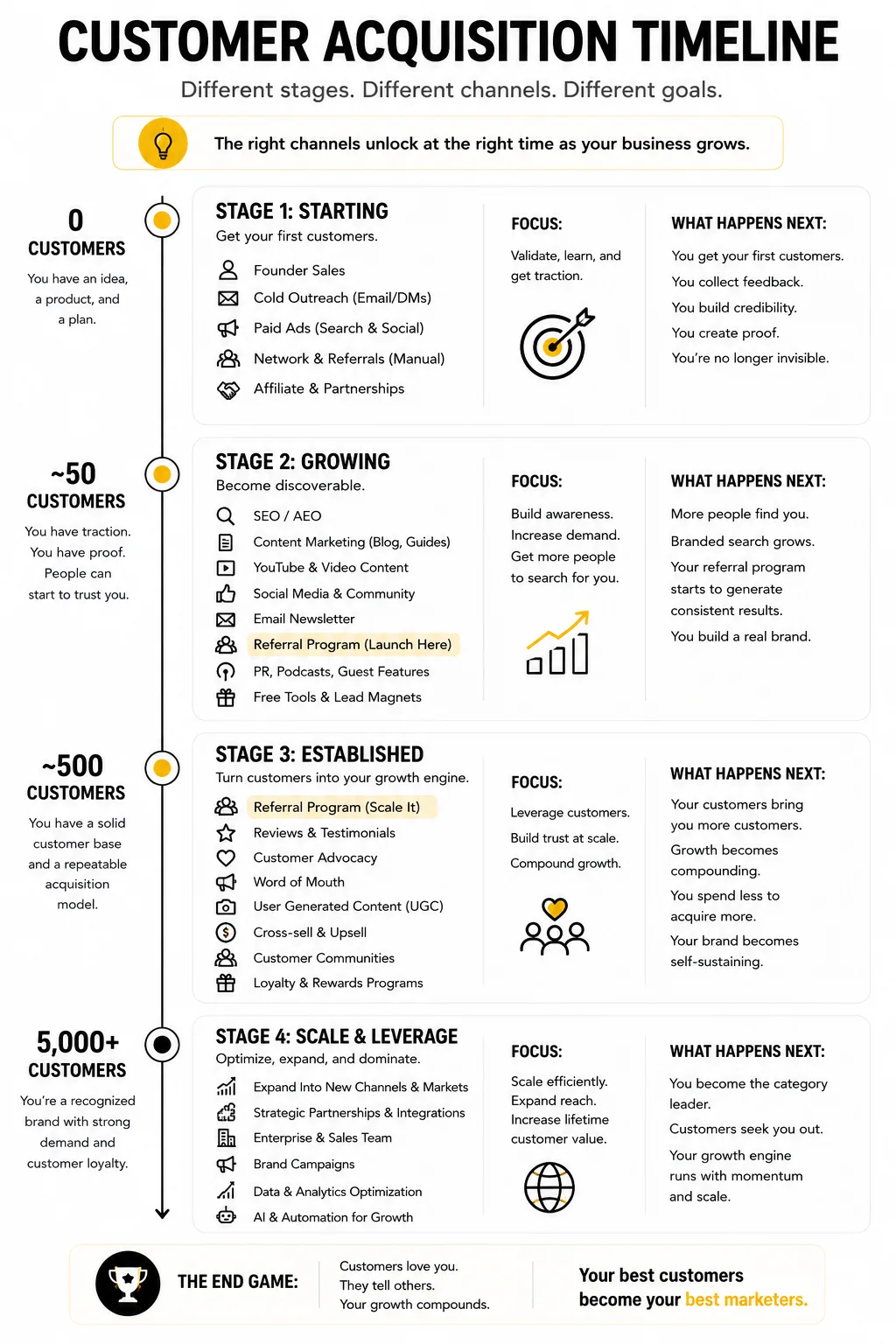
Customer acquisition evolves in three phases
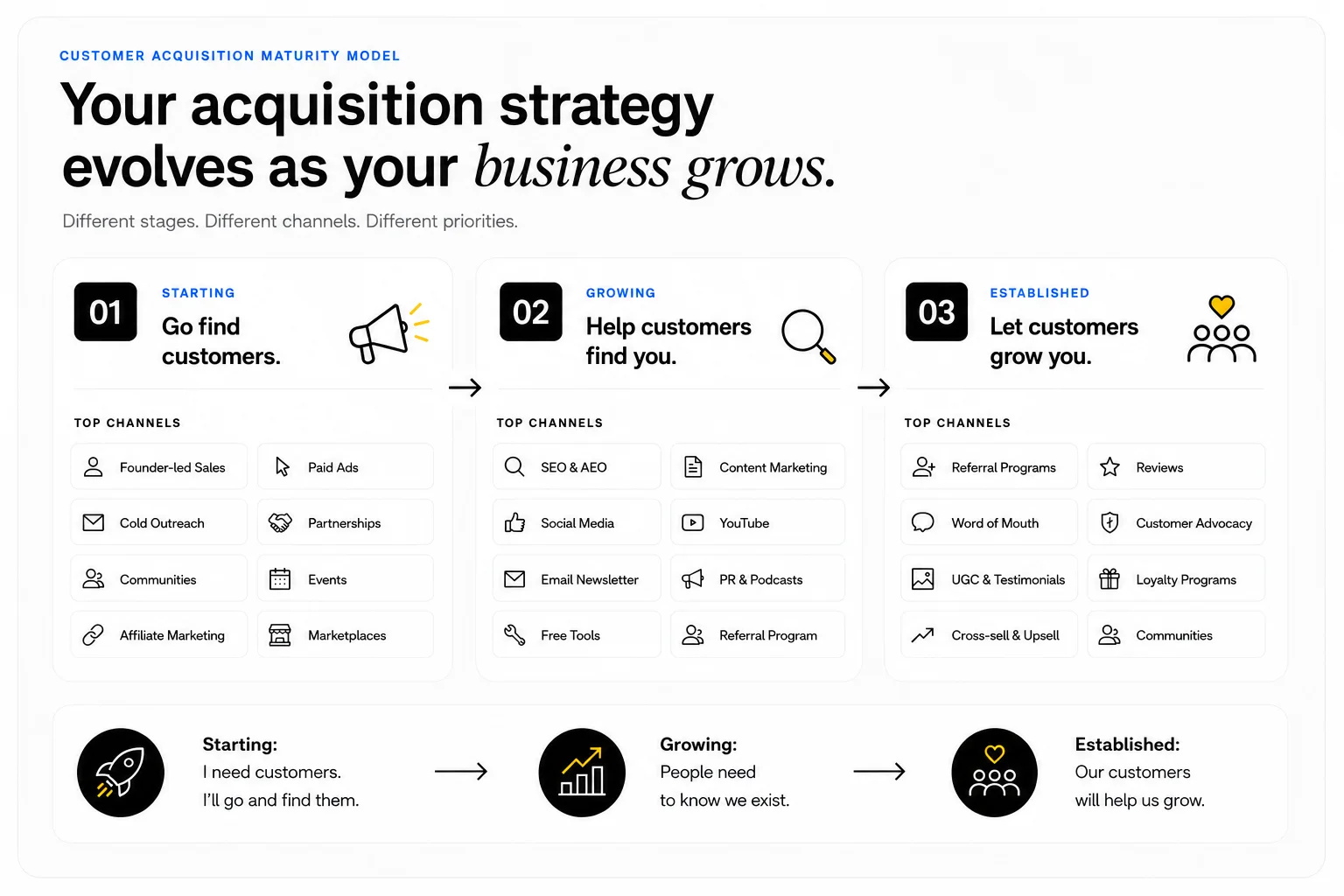
I think about customer acquisition in three broad stages:
Starting → Growing → Established
And as the business matures, the dominant acquisition strategy changes too:
Outbound → Inbound → Customer-Led Growth
This doesn’t mean you switch one channel off when you enter the next phase.
A mature company can still run Google Ads.
A growing company can still do founder-led sales.
The point is that the relative impact of each channel changes as your business grows.
Phase 1: Starting
0 → First Customers
Goal: Get your first customers
This is usually the hardest phase.
Nobody knows who you are.
You have no reviews.
No reputation.
No meaningful search demand.
No customers talking about you.
No case studies.
No brand authority.
But there’s also an advantage.
You don’t need thousands of customers to make an impact.
You just need your first few.
At this stage, I’d prioritize channels that allow you to actively go and find customers.
You can’t sit around hoping people discover a brand they don’t know exists.
You need to create demand yourself.
That means things like:
- Founder-led sales
- Personal network
- Cold email
- Cold calling
- LinkedIn outreach
- Google Search Ads
- Paid social
- Affiliate partnerships
- Marketplace listings
- Communities
- Partnerships
- Industry events
- Webinars
- Networking
At this stage, speed is often more important than efficiency.
You’re learning.
- Who buys?
- Why do they buy?
- Which message resonates?
- Which customers get the most value?
- Where do objections happen?
Every customer gives you information.
Every sale sharpens your positioning.
Every successful customer gives you something incredibly valuable for the next stage: proof.
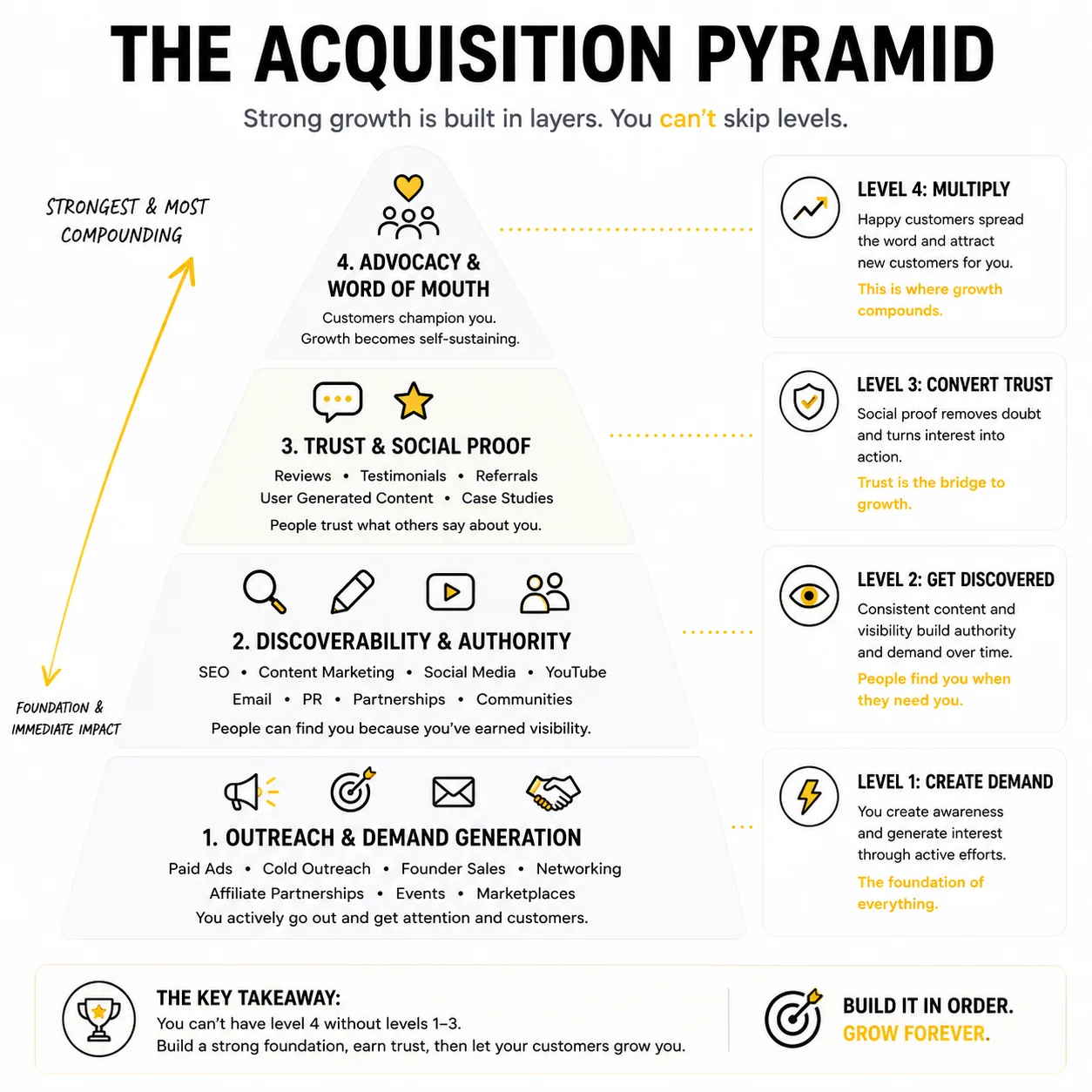
The bottom of the acquisition pyramid is active demand generation.
You go and find customers first.
Then you earn the right to build everything above it.
Phase 2: Growing
Customers → Brand
Goal: Become discoverable
Once you’ve won your first meaningful group of customers, something changes.
Now you have evidence.
You have:
- Customers
- Testimonials
- Reviews
- Case studies
- Results
- Stories
- Data
- History
Now people have a reason to trust you.
This is when inbound marketing starts becoming much more powerful.
Instead of manually finding every customer, your goal starts shifting toward getting more people to discover you.
This is where channels like these become increasingly important:
- SEO
- AI Search Optimization / AEO
- Content marketing
- Blog content
- YouTube
- Social media
- Email newsletters
- PR
- Podcast appearances
- Guest articles
- Free tools
- Lead magnets
- Comparison pages
- Industry reports
- Partnerships
One mistake I see companies make is investing too aggressively in SEO and AEO before they have much proof.
Search engines and AI tools are trying to recommend credible businesses.
If your company launched three months ago, has barely any customers, no one searches for you, nobody mentions you and there’s almost no evidence that you’re established, you’re naturally going to have a harder time earning those recommendations.
AI isn’t stupid.
It can see the wider footprint of a company.
History matters.
Mentions matter.
Reviews matter.
Authority matters.
Real customers matter.
So Phase 1 helps create the credibility that makes Phase 2 work.
This is also when I’d launch your referral program
I don’t think referral programs should only be considered once a business is huge.
But I also don’t think a company with ten customers should spend weeks building a sophisticated referral engine.
The sweet spot is usually somewhere in the Growing stage.
Once you have a meaningful base of happy customers, start asking them to refer people.
Build the infrastructure.
Test your incentives.
Learn which customers refer.
Learn which messages generate sharing.
Integrate referrals into your customer journey.
At this stage, the channel may not produce explosive volume yet.
That’s fine.
You’re building the engine before you need it at full capacity.
Every new customer you acquire from this point onward becomes another potential referrer.
That’s what makes referral marketing particularly interesting.
Its potential increases as your customer base increases.
Phase 3: Established
Brand → Customer-Led Growth
Goal: Turn customers into your growth engine
This is where the acquisition model becomes much more interesting.
You’ve already built something that early-stage businesses desperately wish they had: a large group of people who already know and trust you.
- Customers
- Fans
- Users
- Subscribers
- Partners
- Advocates
At this stage, one of the biggest missed opportunities is continuing to think about marketing entirely as:
“How do we find more strangers?”
Instead, start asking:
“How can the people who already know us help us grow?”
This is what I think of as customer marketing.
Channels include:
- Referral programs
- Review generation
- Customer advocacy
- Word of mouth
- Testimonials
- User-generated content
- Customer communities
- Ambassador programs
- Case studies
- Customer spotlights
- Loyalty programs
- Cross-selling
- Upselling
- Customer newsletters
- Customer success marketing
And this is where the referral program you launched during the Growing phase becomes significantly more valuable.
With 200 customers, asking customers to refer can work.
With 2,000 customers, it can become meaningful.
With 20,000 customers, it can become an acquisition engine.
The mechanism hasn't fundamentally changed.
The size of the audience powering it has.
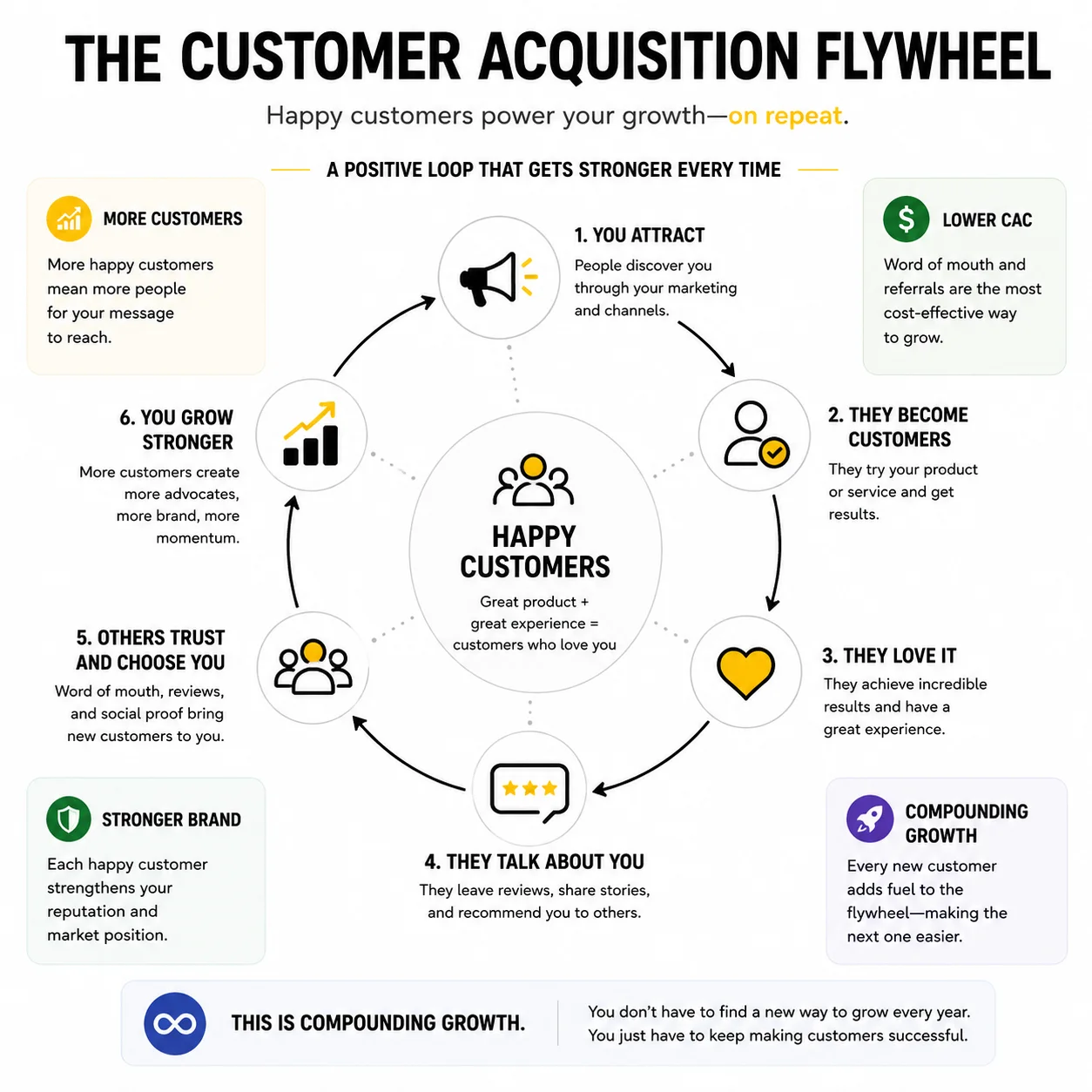
Eventually, your customers should do more talking than your brand
This is the point many marketing teams never really reach.
Brands spend years learning how to talk about themselves.
But ultimately, what you want is for other people to do the talking for you.
Because consumers are skeptical of brands.
Of course your homepage says you're amazing.
Of course your ads say your product is better.
Of course your sales team says customers love you.
You're the brand.
You're supposed to say that.
What becomes significantly more persuasive is when somebody else says it.
- A customer
- A friend
- An industry expert
- A creator
- A Reddit user
- A colleague
- A reviewer
That's why reviews, referrals, testimonials, UGC and word of mouth become so valuable.
They're not just acquisition channels.
They're trust channels.
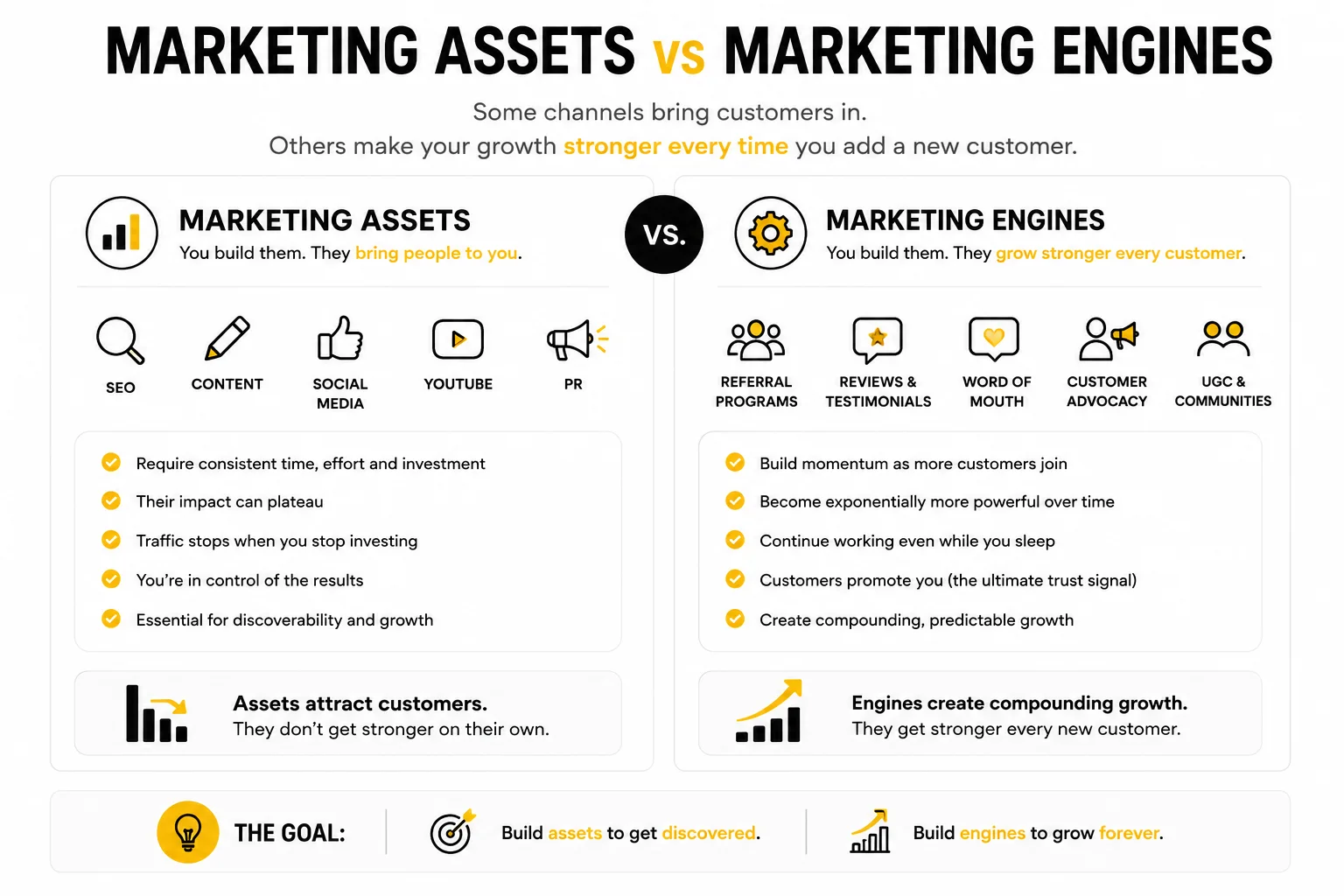
Marketing assets vs marketing engines
There’s another distinction I think is useful here.
Some marketing channels are primarily assets.
Others become engines.
Marketing assets include things like:
- SEO
- Content
- Social
- YouTube
- PR
You build them to help people discover you.
They're incredibly important.
But they generally require continued investment and optimization.
Then you have what I think of as marketing engines:
- Referral programs
- Reviews
- Word of mouth
- Customer advocacy
- UGC
These become particularly interesting because their potential increases as the business grows.
Every new happy customer adds another person who might review you.
Refer you.
Recommend you.
Create content about you.
Talk about you.
Defend you.
Bring somebody else.
Customer acquisition can compound
This is where established businesses have an advantage that startups simply don't have.
Consider paid advertising.
You put money in.
Customers come out.
Turn the spend off and, generally speaking, the flow of customers slows dramatically.
There's nothing wrong with that.
Paid acquisition can be an excellent channel.
But compare that with building a customer advocacy engine.
You acquire customers.
Some refer others.
Those customers refer others.
More customers leave reviews.
Those reviews improve conversion.
More people discover you through word of mouth.
Your reputation gets stronger.
Your branded search increases.
More websites mention you.
AI tools see more evidence of your brand.
Your acquisition channels start reinforcing one another.
That's compounding.
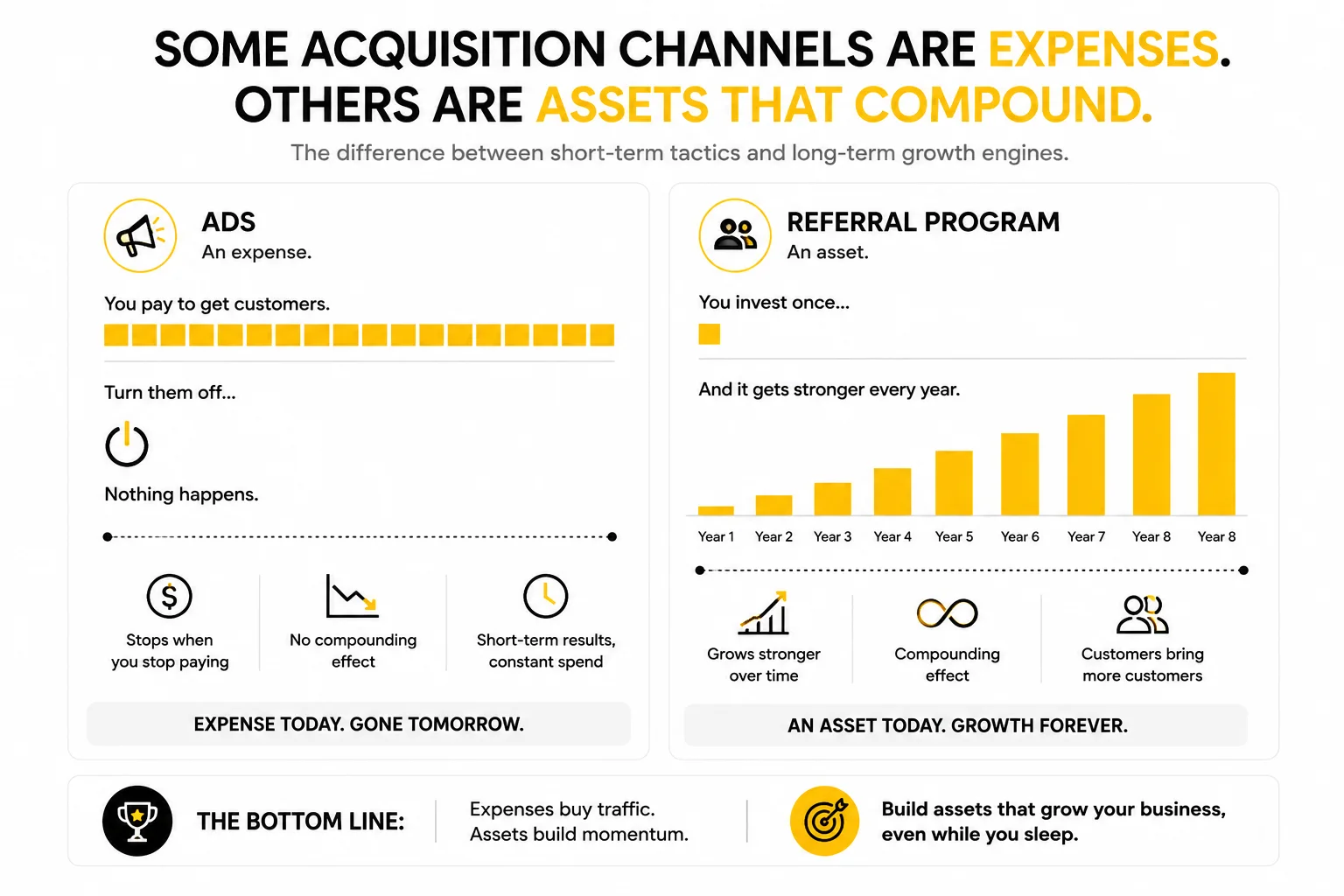
This is why I think the most mature marketing strategies stop treating customer acquisition as a collection of isolated channels.
Everything starts connecting.
The marketing engine
At some point, your marketing starts looking less like a funnel and more like a machine.
Your content brings people in.
Your SEO makes you discoverable.
Your social presence builds familiarity.
Your customers convert.
Then those customers create:
- Reviews
- Referrals
- Testimonials
- Word of mouth
- UGC
Those signals strengthen your brand.
Which makes your SEO stronger.
Which makes your conversion stronger.
Which makes your advertising more effective.
Which brings you more customers.
And the cycle starts again.
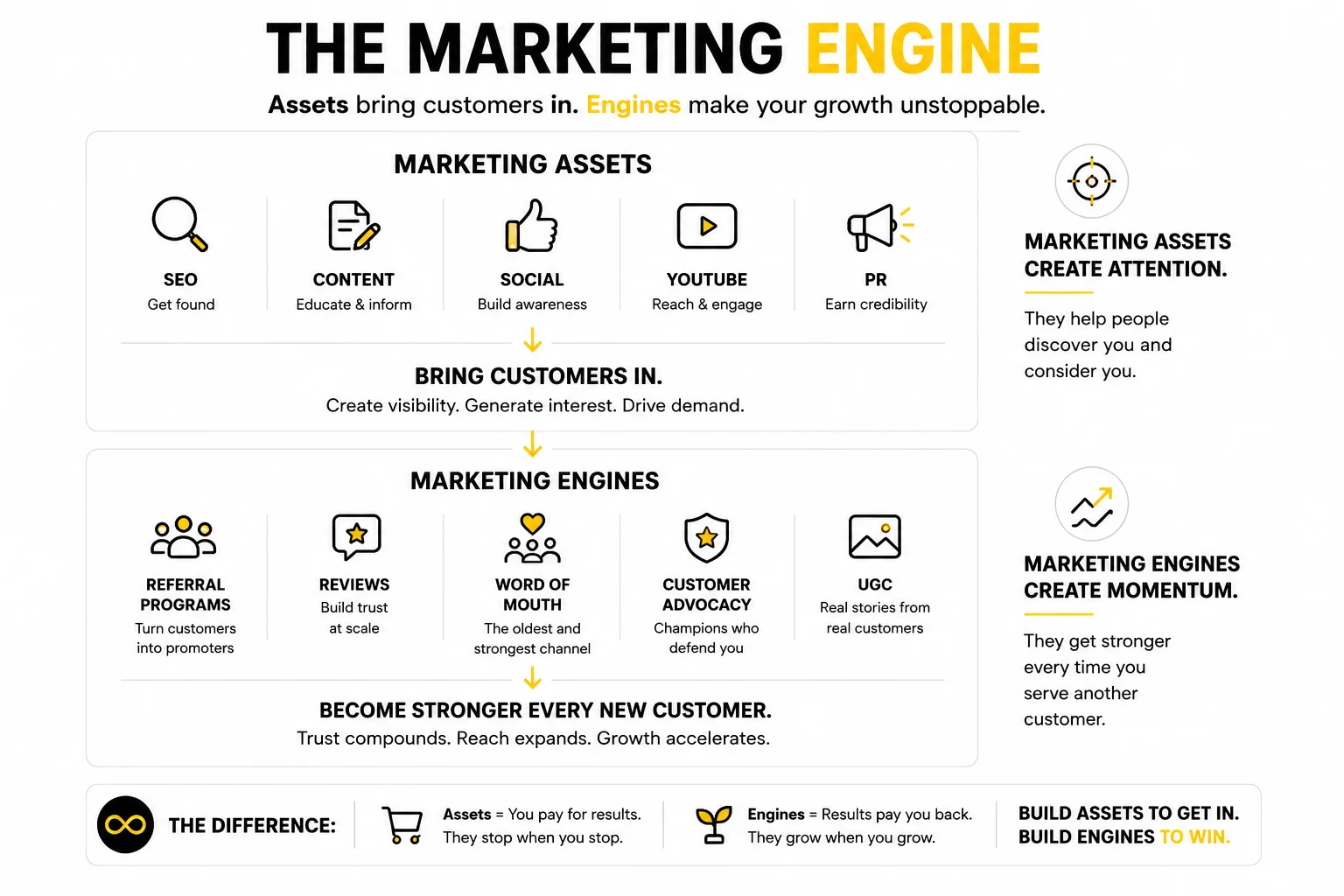
That is the goal.
Not endlessly searching for the next clever acquisition hack.
Building a system where your existing growth makes future growth easier.
So which customer acquisition channels matter most?
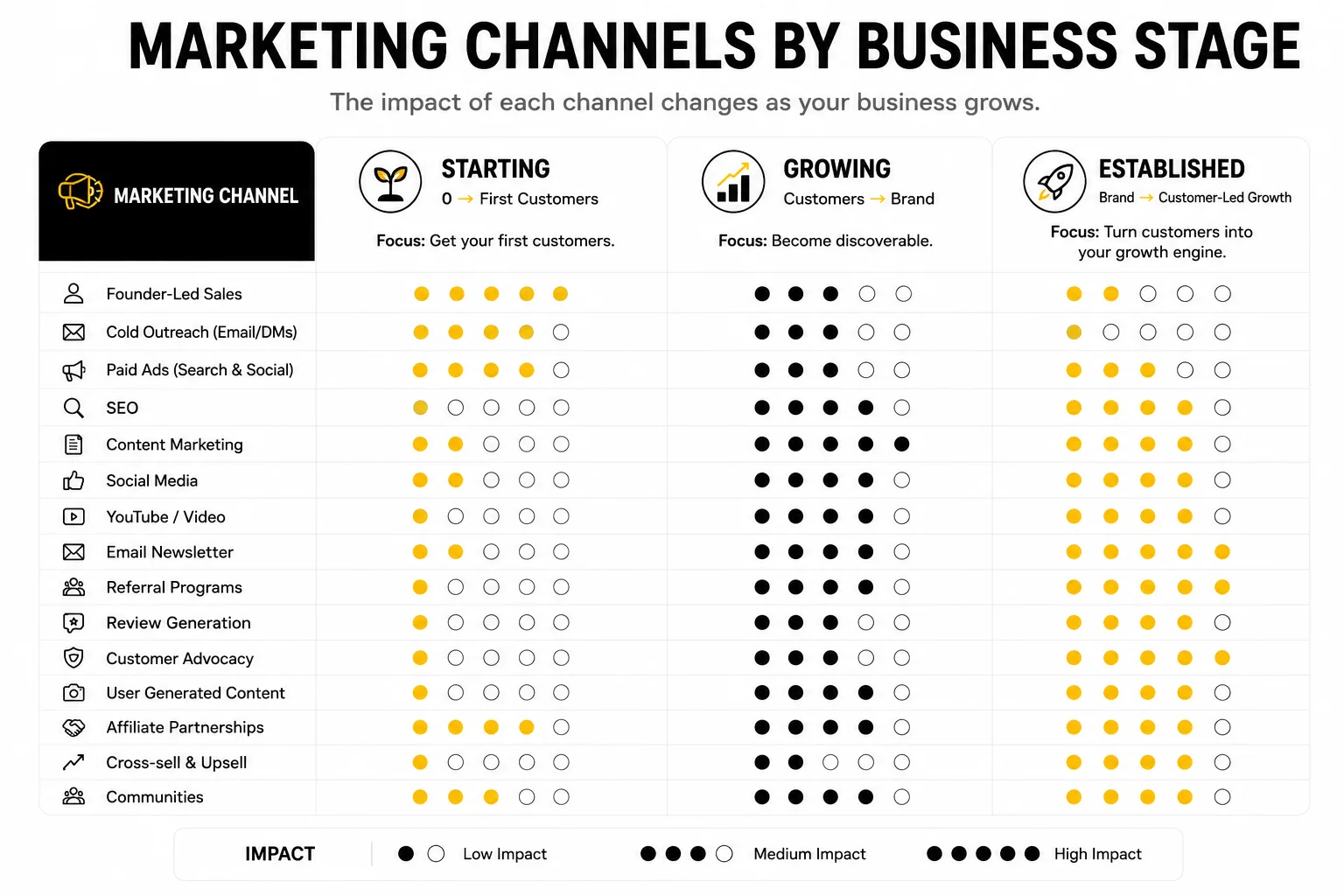
Here’s roughly how I’d think about the relative impact of different channels across the three stages.
The exact scores will obviously vary depending on your industry, price point, sales cycle and business model.
The point isn't that every company should follow this framework exactly.
The point is that the same channel can have radically different leverage depending on when you use it.
Stop asking “What’s the best acquisition channel?”
Instead, ask three questions:
- How established is our business today?
- How many people have already interacted with us?
- What marketing assets have we earned the right to leverage?
If you have no customers, go find them.
If you have customers but nobody knows you exist, become discoverable.
If you have thousands of happy customers but you're still doing all the marketing yourself, turn those customers into your growth engine.
Different stage.
Different channels.
Different priorities.
There is no universal answer to customer acquisition because there is no universal business.
Your acquisition strategy should mature at the same pace as your company.
And the best marketers don't obsess over doing everything.
They focus on doing the next right thing.
Referral link generator (free)
We take your website, send it to Referral Factory, and provision a real referral program for your brand. The link you get is a live referral URL your customers can share, backed by tracking and rewards in the app - not a static "generator" preview. This is the fastest way to see what a real referral program would look like for your brand! Try it below...