
Examples, templates, checklists, and practical inspiration you can adapt quickly.
Marketers can use AI to draft, test and analyze the messaging around a referral program, but tracking, qualifying and rewarding referrals still belong to your referral software. This guide shows where AI saves time at each stage of a program, and where it needs your judgment.
Referral marketing works because of trust. A Nielsen study, cited in Referral Factory's analysis of acquisition costs, found that 88% of consumers trust recommendations from people they know. The same article reports a Journal of Marketing study of about 10,000 customers of a German bank, where referred customers had roughly 25% higher lifetime value.
A program only earns that trust if the offer is clear, the invitation sounds like your brand, and someone reads the results and adjusts. Those are repetitive yet creative which is where AI helps most.
Where AI fits in a referral program
AI helps at most of the stages in referral program, except tracking, which belongs to your referral software.
| Program stage | Where AI helps | What you still decide |
|---|---|---|
| Identify referrers and design the offer | Brainstorm reward options and angles for each customer segment | Reward size, based on customer value and your current acquisition cost |
| Write invites and share copy | Draft many versions in your voice and adapt them per channel | Which version goes live, after a test |
| Create share assets | Generate banners, social cards and landing page visuals | Brand fit and the accuracy of any text in the image |
| Track and reward | Nothing; use referral software | Qualification rules and when rewards are paid |
| Evaluate and adjust | Summarize exports, spot patterns and draft the next test | Whether the numbers justify a change |
Step 1: Shape the offer before you write
Start by widening your options, then decide the reward budget yourself. I recommend a double-sided offer that rewards both the referrer and the new customer, and AI can propose structures for each of your segments in minutes.
Give it your product, your customer segments and the reward types you can afford. Then ask for three offer structures per segment, plus the most likely objection to each. A long-standing customer and a first-month customer rarely want the same thing.
Keep one decision for yourself: the total reward paid to both sides. It should sit below what a new customer is worth to you and below what you pay to acquire one through paid channels today. AI cannot know either number, so put them in the prompt.
Step 2: Write invite copy, then test it across models
Different models write in noticeably different voices, so generate drafts from more than one before you pick a direction. A prompt like this gives each model the same brief:
You are the lifecycle marketer for [brand], a [product] for [audience].
Write 5 versions of a referral invite email for existing customers.
Offer: give a friend [reward], get [reward] when they [qualifying action].
Voice: [three adjectives]. Length: under 90 words. One call to action.
Avoid: hype words, claims we cannot prove, urgency we do not have.
In Sparkian, switch on Multi-model chat in the model picker and send the prompt to GPT, Claude, and Gemini side by side. Then continue the conversation from the answer you prefer, with the earlier messages and files still in place.
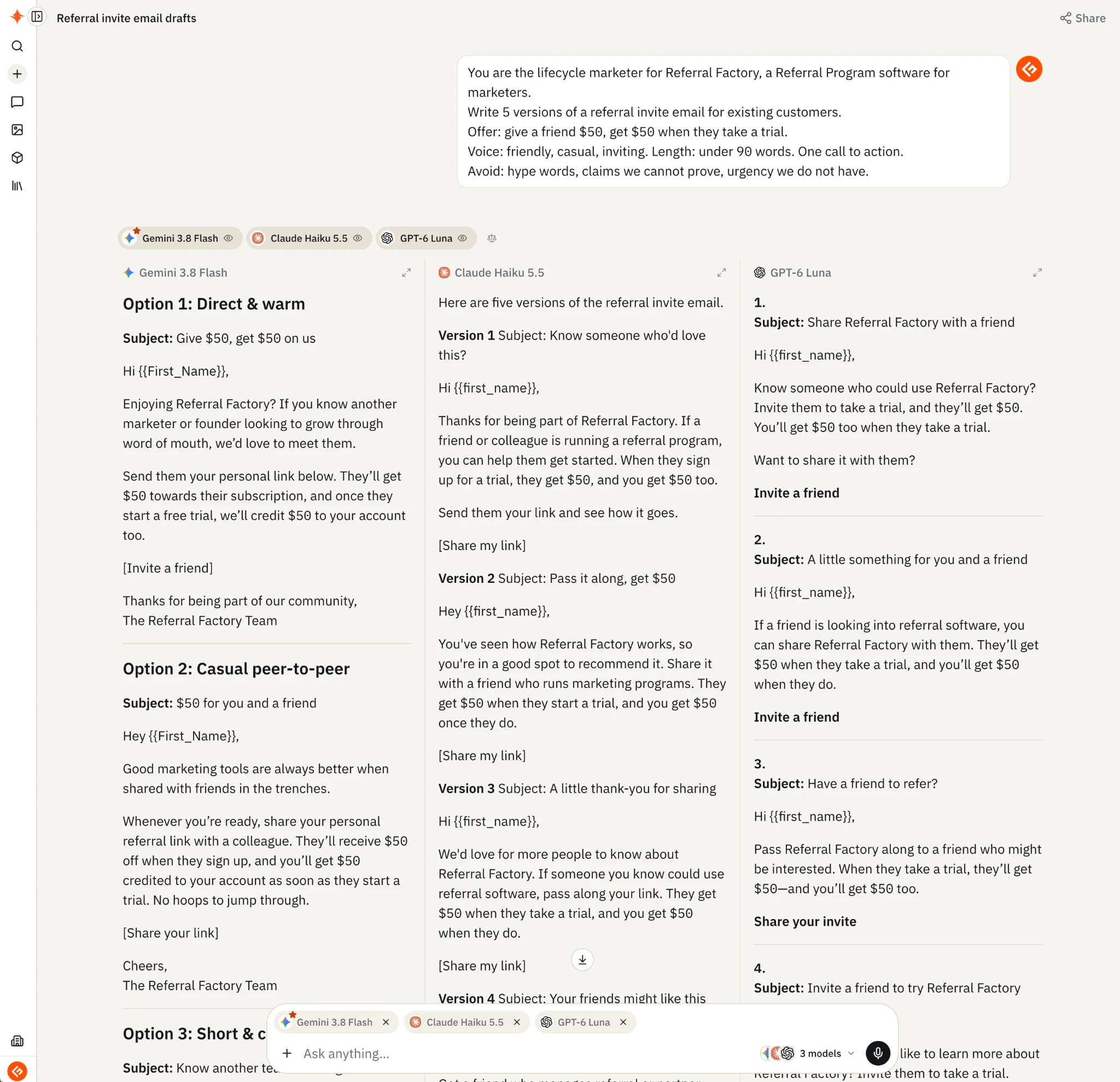
Treat the output as drafts. Pick the two strongest versions and A/B test them in your email or referral tool, because a test result is evidence and a model's preference is not.
Step 3: Create share assets without waiting on design
A referral program needs more than email: a banner for the referral page, a social card for sharing, and an in-app prompt. AI image tools can produce first versions of all three quickly.
Sparkian's image studio lets you create and compare images with Nano Banana, GPT, Seedream, Recraft and more.
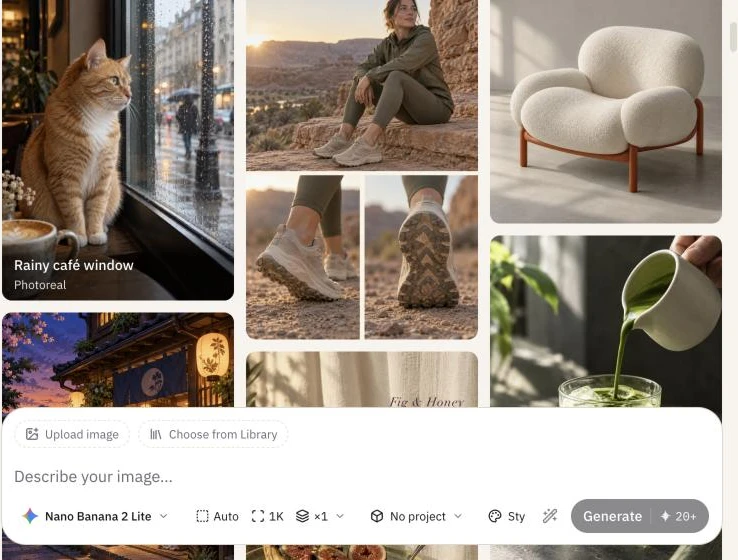
Two habits save rework. Name the exact format you need, such as a wide banner or a square social card, and keep any text in the image to a few words. Then read every word in the result, because image models sometimes misspell text.
Step 4: Keep program rules and brand voice in one shared place
Every new draft should follow the same reward terms and tone. The simplest way is to give the whole team one shared project instead of letting each person re-explain the program in a fresh chat.
In Sparkian, a project groups shared conversations, instructions and collaborators, and a Knowledge base holds sources you can chat with, with citations attached to answers. For a referral program, load it with:
- Reward terms: who qualifies, what counts as a completed referral, and when rewards are paid.
- Brand voice notes: a short style guide and two or three past emails that performed well.
- Support answers: how you reply to "where is my reward?".
- Claims to avoid: statements you cannot back up, so drafts do not invent them.
A teammate drafting a partner email next month then starts from the same rules you used today.
Step 5: Read the results faster, then verify them
Your referral software records referrals and releases rewards; AI helps you make sense of what it reports. Export a report and attach it to a chat.
Useful questions to ask:
- Which invite versions and channels produced qualified referrals, not just clicks?
- Where do people drop off between receiving an invite and completing the qualifying action?
- What is one change worth testing next, and what result would convince us it worked?
Ask the model to show its calculations, and check the headline numbers against your dashboard before you act. A fluent summary can still contain a wrong figure.
What AI should not do in a referral program
- Replace tracking. Rewards should go out only for referrals your referral software has tracked and qualified.
- Invent proof. Do not let it write testimonials, statistics or customer quotes you cannot source.
- Set the legal terms. Rules differ by country and industry; financial services, for example, have their own conditions. Have someone qualified review reward terms.
- Handle personal data carelessly. Avoid pasting customer names or emails into a chat, and check how your AI vendor uses prompts before you upload customer exports.
Choosing an AI workspace for marketing work
Any assistant can draft an email. The differences show up once a team uses it every week, so check five things:
- Model choice: can you compare models on the same prompt and switch without losing context?
- Shared context: are there projects and a knowledge base the whole team can use?
- Creation tools: is image generation in the same place, so copy and assets are not split across subscriptions?
- Predictable cost: how are seats and credits priced, and what happens when you run out?
Sparkian is one of the options that covers that list. It offers 100+ models from OpenAI, Anthropic, Google and others, projects with shared context, a Knowledge base, an image studio and one monthly balance of credits called Sparks.
FAQ
Can AI run a referral program on its own?
No. It drafts and analyzes, while tracking, qualification and reward payouts need referral software.
Which AI model writes the best referral copy?
It depends on your brand voice, which is why comparing a few models on the same prompt beats guessing. Then test the winners with real customers.
Conclusion
AI will not turn a weak offer into a strong one, but it shortens the loop between idea, draft, test and result. Use it for drafting and reading, keep the reward economics and tracking in your own hands, and test everything with real customers.
Referral link generator (free)
We take your website, send it to Referral Factory, and provision a real referral program for your brand. The link you get is a live referral URL your customers can share, backed by tracking and rewards in the app - not a static "generator" preview. This is the fastest way to see what a real referral program would look like for your brand! Try it below...