
Industry-specific guidance showing how referral marketing works in real operating contexts.
SaaS growth is fundamentally different from traditional business growth.
In a subscription model, revenue doesn’t happen once. It happens every month or every year. That means growth isn’t just about how many users you acquire, but also how many you activate, retain, and renew. This is why referral programs for SaaS growth work perfectly within the subscription model. They reinforce engagement and introduce new customers who already trust your product before they even sign up.
In this article, we’ll explore how referral programs influence every stage of the SaaS lifecycle and how to design them as a long-term growth engine rather than a short-term marketing tactic.
Why SaaS Growth Depends on Engagement and Retention
A successful SaaS referral program cannot exist in isolation. It only performs well when engagement and retention are already strong.
This reflects a wider customer acquisition journey: different channels become more valuable at different stages of growth.
Two core growth pressures in SaaS make engagement and retention non-negotiable:
1. Rising Customer Acquisition Costs (CAC)
Paid advertising has become increasingly expensive. As more SaaS companies compete for attention, customer acquisition costs continue to rise. Relying solely on paid channels creates a fragile growth model: one where scaling requires constantly increasing spend.
When acquisition costs climb, but retention remains weak, profitability suffers.
2. Churn Erodes Growth
Churn is the silent killer of SaaS growth. You can acquire thousands of users, but if they fail to experience value quickly or disengage over time, your growth stalls. Retention is what compounds revenue. The longer users stay, the more they contribute to:
- Monthly Recurring Revenue (MRR)
- Annual Recurring Revenue (ARR)
- Lifetime Value (LTV)
- Expansion revenue from upgrades
This is why engagement is so critical. Active users renew. Engaged users upgrade. Satisfied users advocate.
Advocacy, in the form of referrals, becomes one of the most powerful retention signals a SaaS company can have. When customers are willing to recommend your product, it’s usually because:
- They’ve experienced meaningful value
- They trust the product
- They feel confident associating their name with it
That makes referrals more than an acquisition tactic. They’re a measurable sign of product-market alignment and customer satisfaction.
For SaaS businesses focused on long-term growth, engagement and retention must come first. Referral programs work best when built on top of that foundation, not when used to compensate for weak activation or high churn.
What a SaaS Referral Program Actually Is
At its core, a SaaS referral program is a structured system that encourages existing users to recommend your software to others in exchange for a reward. It formalizes word-of-mouth and turns it into a measurable, repeatable growth channel.
Unlike casual recommendations, referral marketing for SaaS is intentional. It gives customers an easy way to share your product and ensures their referrals are tracked, rewarded, and attributed correctly.
How a SaaS Referral Program Works
While the structure can vary, most SaaS referral programs follow a similar framework:
1. Unique referral links or codes
Each user receives a personalized referral link or code they can share with colleagues, friends, or their network. This link tracks who referred whom.
2. Defined reward structure
When the referred user completes a specific action, such as signing up, subscribing, or making their first payment, rewards are triggered. Rewards can be one-sided (only the referrer benefits) or two-sided (both the referrer and the referred user receive a reward).
3. Automated tracking and validation
Referral software tracks clicks, signups, and qualifying actions. It verifies that the referral meets the program’s requirements before issuing rewards. This prevents fraud and ensures incentives are tied to meaningful actions, not just free trials or low-quality signups.
The key is that everything is measurable. SaaS companies can see exactly how many referrals convert, how much revenue they generate, and how they impact customer acquisition cost (CAC) and lifetime value (LTV).
Referral Programs vs. Affiliate Programs
Referral programs are often confused with affiliate programs, but they serve different purposes.
Referral programs focus on existing customers. They are built around trust and authentic recommendations. The referrer typically already uses and values the product because they want to share something useful.
Affiliate programs, on the other hand, are typically designed for marketers, influencers, or publishers who promote a product to earn a commission. Affiliates may not use the product themselves. Their relationship is transactional and performance-based.
In short:
- Referral programs = customer advocacy
- Affiliate programs = partner-driven promotion
For SaaS companies focused on long-term growth, referral marketing works best when it strengthens relationships with satisfied users rather than treating promotion as purely commission-driven.
When built correctly, a SaaS referral program becomes more than a marketing tool. It becomes an extension of the product experience itself.
Referral Programs as a Growth Lever, Not Just a Marketing Tactic
Too often, companies launch a referral initiative as a short-term campaign: a banner in the dashboard, a few emails, and a reward offer. But referral programs for SaaS growth work best when embedded into the broader growth strategy.
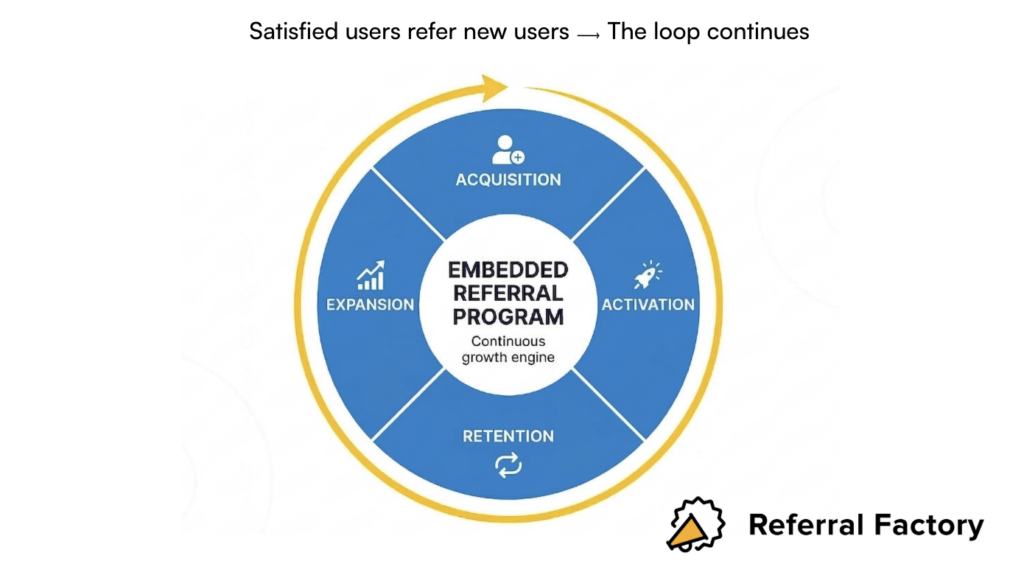
Referrals influence multiple stages of the SaaS lifecycle:
Acquisition
At the top of the funnel, referrals bring in high-intent users. Unlike paid traffic, referred prospects arrive with built-in trust. They have already heard about the product from someone they know, which reduces skepticism and shortens the decision-making process.
This typically results in:
- Higher conversion rates
- Lower customer acquisition cost
- Better lead quality
Activation
Referred users often activate faster because expectations are clearer. They already understand the core value proposition from the person who referred them. That clarity reduces friction during onboarding and increases the likelihood of meaningful product usage.
Retention
When customers participate in a customer referral program, they reinforce their commitment to the product. Recommending a tool to others creates a form of social accountability. Users are more likely to continue using a product they have publicly endorsed.
Expansion
Referred customers frequently upgrade sooner and choose higher-value plans. Because trust is established early, upsell conversations feel less risky and more natural.
When referrals are integrated into the product experience, they stop being a one-time marketing push and become a continuous growth loop. Satisfied users bring in new users, who then become advocates themselves.
The Importance of Timing in Referral Asks
One of the most common mistakes SaaS companies make is asking for referrals too early.
Requesting a referral at signup, or before a user has experienced real value, almost always fails. At that stage, the user has not formed an opinion yet. They do not know if the product solves their problem, and they certainly do not feel confident recommending it.
Referral requests should only happen after a user reaches a “success moment.”
A success moment is a clear point at which value has been delivered. It is when the user thinks, “This is working.”
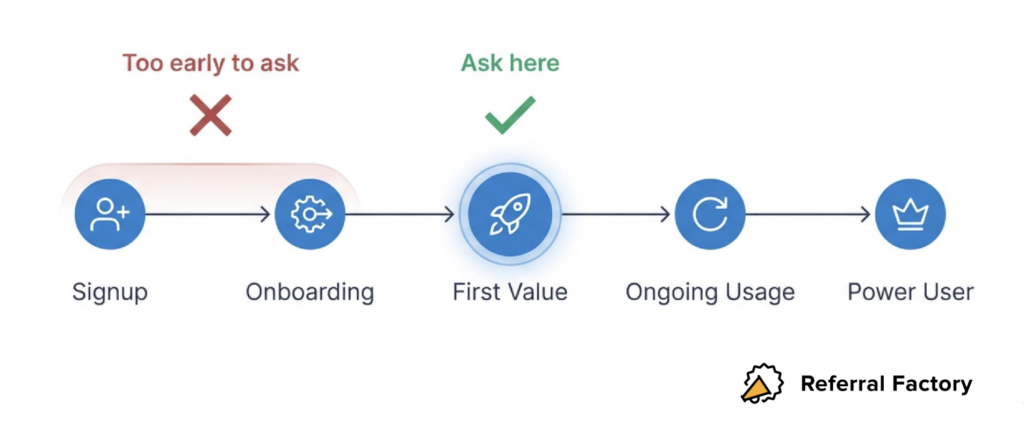
In SaaS, that might look like:
- Completing their first transaction
- Sending their first invoice
- Publishing their first project
- Integrating the software with their existing tools
- Seeing measurable results in analytics or reports
These are moments of confidence and satisfaction. They signal readiness.
By aligning referral requests with success moments, companies ensure that advocacy is authentic. The request feels natural because it follows demonstrated value, not just the promise of value.
The more precisely a company identifies these milestones, the more effective its referral strategy becomes.
Referral Programs and Post-Onboarding Engagement
The highest-impact window for referrals is post-onboarding, once users are comfortable, confident, and actively using the product.
During onboarding, users are focused on learning. They are absorbing information, setting up integrations, and trying to understand workflows. Asking for referrals at this stage shifts attention away from activation.
Post-onboarding, however, engagement signals start to appear. These signals differ depending on the SaaS product:
- For a finance platform, consistent transactions or invoice creation
- For a project management tool, multiple completed projects
- For a marketing platform, launched campaigns with measurable results
- For a CRM, active pipeline usage over time
These behaviors indicate not just usage, but meaningful adoption.
This is where automating customer referral programs becomes powerful. Instead of manually deciding when to ask, companies can trigger referral invitations based on behavioral milestones. When a user reaches a predefined engagement threshold, the system prompts them at exactly the right time.
This approach ensures that referral programs for SaaS growth feel integrated into the product experience rather than bolted on as an afterthought. When referral prompts align with moments of satisfaction and proven value, participation rates increase, and the generated referrals are of significantly higher quality.
How Referral Programs Support User Activation
Acquisition alone does not drive SaaS growth. What matters is activation, the point at which a user experiences real value and begins using the product consistently. A well-designed referral program can directly support stronger activation, but only if rewards are tied to meaningful actions.
One of the most important best practices for a SaaS referral program is to avoid rewarding shallow behaviors, such as simple signups or free-trial registrations. Instead, incentives should be triggered by actions that indicate genuine engagement, for example:
- Completing a first payment
- Reaching a usage milestone
- Publishing a live project
- Subscribing to a paid plan
When rewards are tied to value-driven behaviors, referral programs attract higher-quality users. These users are more likely to convert, activate properly, and remain long-term customers.
This approach also protects the customer acquisition cost. If rewards are paid out only after meaningful actions, the company avoids overspending on low-intent users who never convert. Instead of inflating top-of-funnel numbers, the program drives revenue-generating growth.
How Referrals Improve Retention
Referrals influence retention in two powerful ways.
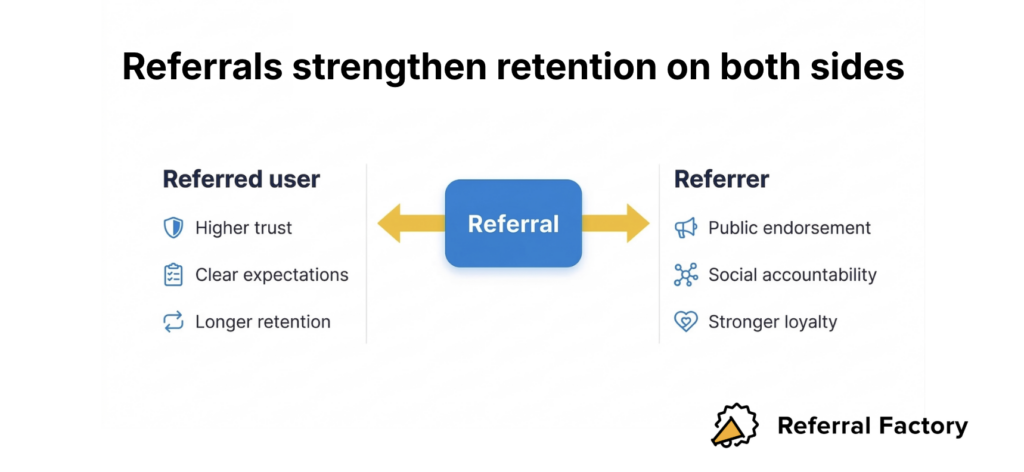
First, referred users tend to stay longer. Because they join through personal recommendations, their expectations are clearer, and trust is established early. They are not discovering the product through a cold advertisement. They are entering with context and validation.
Second, referrals reinforce retention for the person doing the referring.
When customers recommend a product, they associate their reputation with it. This creates a subtle but meaningful form of social accountability. People are more likely to continue using and supporting a product they have publicly endorsed.
Referrals are also closely connected to reviews and testimonials. Customers who are willing to refer are often the same ones who leave positive reviews, participate in case studies, or advocate in communities. This broader advocacy ecosystem strengthens long-term retention because it builds emotional investment alongside functional value.
Retention, therefore, is not just about product usage. It is about trust, confidence, and identity. Referral-driven growth strengthens all three.
The Impact on Subscription Renewals and Upgrades
In SaaS, long-term revenue depends on renewals and expansion. Referral-driven customers often outperform other acquisition channels in both areas.
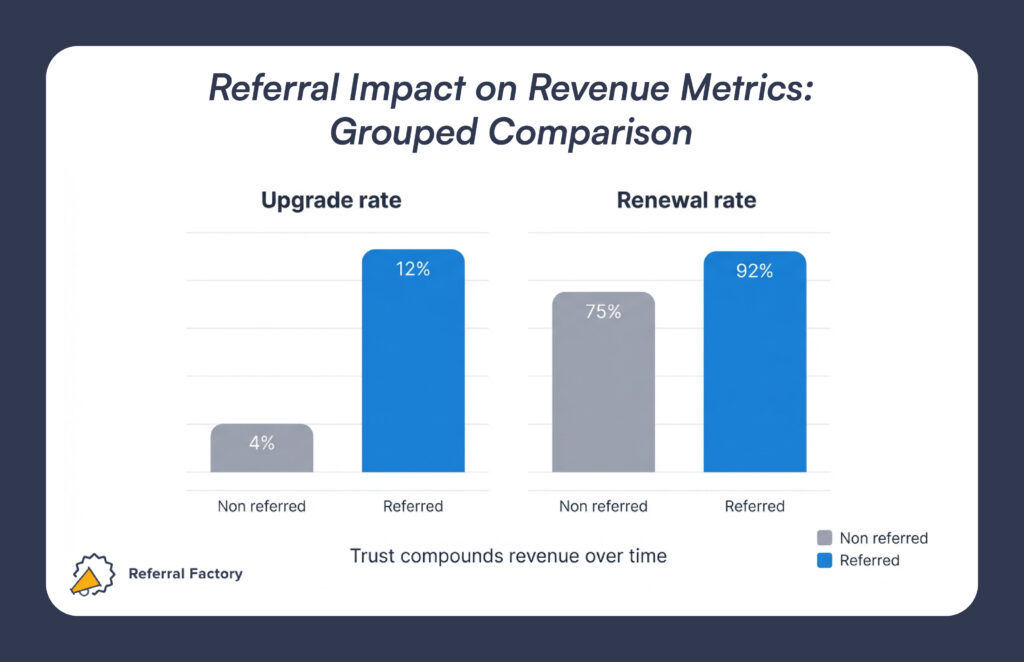
Referred users come with built-in trust. Before they ever sign up, they have heard about the product from someone they know. This reduces friction during the buying decision and increases commitment from the start.
Because of this early trust, referred users are more likely to:
- Choose paid plans sooner
- Opt for annual subscriptions
- Upgrade as their needs grow
- Require less persuasion from sales teams
This directly impacts Annual Recurring Revenue, as stronger retention and earlier upgrades compound over time.
Companies that strategically design and manage their referral systems, using platforms such as Referral Factory, can track not only signups but the long-term revenue impact. This visibility allows SaaS teams to measure how referrals influence renewals, plan selection, and expansion behavior.
When viewed through this lens, referral programs are not just acquisition tools. They are revenue multipliers embedded within the subscription lifecycle.
Designing Incentives That Work for SaaS
The right incentive structure can determine whether your referral program scales or stalls. In SaaS, rewards should reinforce subscription value, not distract from it.
Here are the incentive models that consistently perform well.
- Account Credits: Reward users with credits applied to their subscription. This keeps value inside your ecosystem, reduces the risk of churn, and encourages continued product usage.
- Billing Discounts: Offer a percentage or fixed discount on future invoices. Simple, immediate savings are easy to understand and highly motivating for paying users.
- Feature Unlocks: Provide access to premium features or expanded limits. This deepens engagement while reinforcing the product’s value, often at a lower cost than cash rewards.
- Cash Rewards: Offer direct monetary incentives once a referral converts to a paid customer. Cash works well for higher-ticket SaaS plans but should be tied to meaningful milestones to protect CAC.
- Two-Sided Incentives: Reward both the referrer and the referred user. This reduces friction for the new customer and makes sharing feel generous rather than self-serving.
- Simple Qualification Rules: Keep the criteria and payout structure clear and transparent. Overcomplicated reward systems reduce participation and create confusion that hurts trust.
Promoting Referral Programs Inside the Product
A referral program should never feel like a hidden feature. If users have to dig through settings or scroll through emails to find it, participation will always be limited. Referral programs must be actively promoted inside the product experience, not treated as a one-time announcement.
Visibility Drives Participation
The first rule is simple: If users cannot see the referral program, they will not use it. The referral option should live somewhere intuitive, such as the main navigation, account area, or dashboard. It should feel like a natural extension of the product, not a temporary marketing banner.
Trigger Prompts at the Right Moments
Referral invitations work best when they are tied to positive user experiences. In-app prompts should appear after meaningful milestones, such as completing a project, sending an invoice, closing a deal, or hitting a usage goal. These moments carry emotional momentum, and that momentum increases the likelihood of sharing.
Use Lifecycle Emails Strategically
Not every user will respond to in-app messaging. That is why lifecycle emails play a key role. Post-onboarding emails, milestone celebration emails, and performance summary emails are ideal places to introduce referral opportunities. The message feels contextual rather than promotional.
Empower Customer-Facing Teams
Support agents and account managers often interact with customers during moments of satisfaction, such as after resolving a ticket or during a successful renewal conversation. These interactions are powerful referral opportunities. When customers express appreciation, that is the natural time to invite them to share the product.
The key principle is consistency. Referral programs should be reinforced repeatedly across product, email, and human touchpoints. Advocacy grows when visibility becomes part of the customer journey.
Measuring the Impact of Referral Programs
A referral program is a measurable growth channel, and it should be evaluated with the same discipline as paid acquisition or sales performance.
Look Beyond Signups
The first metric many companies track is referral signups. But signups alone do not indicate success. What matters is conversions. How many referred users become paying customers? A strong referral conversion rate signals high-quality traffic and genuine trust transfer.
Compare Acquisition Costs
Referral programs often reduce customer acquisition cost, especially when rewards are tied to meaningful milestones such as paid subscriptions. Comparing referral CAC to paid advertising CAC reveals the program’s financial efficiency.
Measure Lifetime Value
Referred users frequently stay longer and spend more. Tracking lifetime value allows you to see whether referrals are contributing to sustainable revenue, not just short-term growth.
Monitor Retention and Churn
Do referred customers churn less often than other users? If they do, that is a powerful indicator that referrals bring in better-aligned customers. Retention differences can justify further investment in the program.
Track Renewal and Expansion Behavior
Look at annual plan adoption, upgrade rates, and renewal percentages among referred users. If referral-driven customers are more likely to renew and upgrade, the program is directly impacting ARR growth.
Evaluate Trends Over Time
Referral programs compound gradually. Instead of focusing on one campaign spike, analyze month-over-month performance and long-term trends. Sustainable referral growth reflects strong product value and consistent advocacy.
Common Mistakes SaaS Companies Make
Even well-designed referral programs can underperform if execution is flawed. Most failures are not about the idea of referrals, but about timing, structure, and visibility.
Here are the most common mistakes SaaS companies make and what to do instead.
- Asking Too Early: Requesting referrals at signup or before users experience value leads to low participation and weak results. Instead, trigger referral asks after clear success moments when users feel confident recommending the product.
- Overcomplicated Rewards: Tiered points systems, unclear rules, or confusing payout criteria discourage users from participating. Keep incentives simple, transparent, and tied to meaningful actions like paid subscriptions or active usage.
- Poor Visibility: Hiding the referral program in account settings or mentioning it only once limits engagement. Make it consistently visible inside the product, in lifecycle emails, and during positive customer interactions.
- Manual Tracking: Managing referrals through spreadsheets or manual processes increases errors and delays rewards. Use automated systems to track referrals accurately, validate milestones, and issue rewards on time to maintain trust.
Turning Happy Users into a Growth Engine
SaaS growth is no longer about who can spend the most on ads. It is about who can build the strongest growth loops.
The most resilient SaaS companies do not treat referrals as a side campaign. They embed referral programs into activation milestones, retention strategies, and expansion conversations. When advocacy becomes part of the product experience, growth compounds.
Platforms like Referral Factory make this process measurable and scalable. By automating referral tracking, validating meaningful milestones, and connecting data to your CRM, SaaS teams can see exactly how referrals influence CAC, retention, renewals, and lifetime value.
When structured correctly, referral programs for SaaS growth stop being a marketing tactic. They become a revenue engine built on satisfied users.
FAQs
When should SaaS companies ask for referrals?
SaaS companies should ask for referrals after users experience clear value, not at signup. The ideal moment is after a success milestone, such as completing a first transaction, launching a project, or seeing measurable results. Timing referral requests around these moments increases participation and lead quality.
Do referral programs improve SaaS retention?
Yes, when implemented correctly. Referred users often stay longer because they join with built-in trust and clearer expectations. At the same time, customers who refer others reinforce their own commitment to the product, which strengthens overall retention.
How do referrals impact subscription renewals?
Referrals influence renewals by bringing in customers who are already confident in the product. This early trust reduces friction, increases satisfaction, and often leads to stronger renewal rates and higher annual plan adoption, directly supporting recurring revenue growth.
Are referral programs part of product-led growth?
Yes. Referral programs align naturally with product-led growth because they rely on users experiencing value before promoting the product. When integrated properly, platforms like Referral Factory can trigger referral prompts based on behavioral milestones inside the product. This makes advocacy feel like a natural extension of the user journey, not a disconnected marketing push.
Why should SaaS businesses use referral programs to improve lead quality?
Referral-driven leads are typically higher intent and better aligned with the product. Because they come through trusted recommendations, they convert faster, require less persuasion, and often demonstrate stronger long-term engagement compared to cold traffic.
Which referral program platforms are best for tracking and evaluating results?
The best platforms provide automated tracking, milestone-based reward triggers, fraud prevention, and clear revenue attribution. SaaS teams need visibility beyond clicks and signups. Tools like Referral Factory allow you to track referrals from first share through paid conversion, renewals, and expansion, integrating directly with your CRM so you can measure real impact on CAC and LTV.
How can referral program platforms benefit subscription-based SaaS companies?
Referral platforms reduce manual work and ensure rewards are tied to meaningful subscription milestones, not just free trials. For example, Referral Factory allows SaaS companies to trigger incentives only after paid conversion or renewal events. This protects margins, improves acquisition efficiency, and keeps referral marketing aligned with long-term revenue growth rather than vanity metrics.
Referral link generator (free)
We take your website, send it to Referral Factory, and provision a real referral program for your brand. The link you get is a live referral URL your customers can share, backed by tracking and rewards in the app - not a static "generator" preview. This is the fastest way to see what a real referral program would look like for your brand! Try it below...