
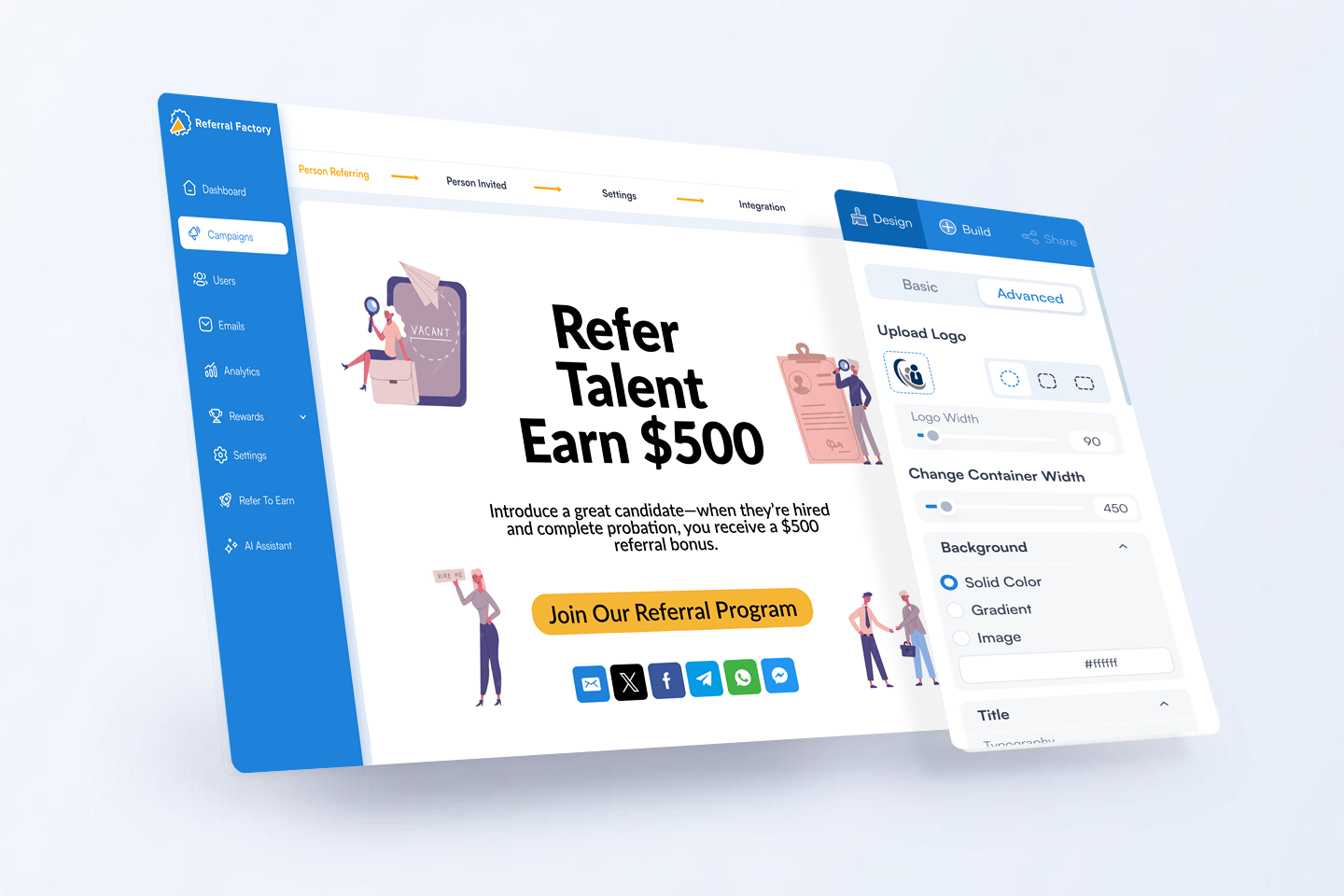
Typical placement reward
$300-$1,000
Higher-value roles can support stronger referral rewards once the placement becomes real.
Recruitment & HR
Recruitment already runs on introductions, reputation, and timing. This page shows how agencies and talent teams can structure those natural referrals into a reliable source of better candidates and new client opportunities.
Typical placement reward
$300-$1,000
Higher-value roles can support stronger referral rewards once the placement becomes real.
Case-study placements
450+
Structured referral follow-up can create a substantial placement pipeline without the same ad dependence.
Best time to ask
Referral timing matters
Best time to ask: after placement, probation success, or another clear trust win.
Referral-ready criteria
Do not launch a referral program just because the industry has word of mouth. Launch when customers are happy, the referral moment is obvious, the reward makes economic sense, and conversion can be tracked.
Why this works
Recruitment is already a relationship-driven market. The people you help today often know the next candidate, hiring manager, or client who needs the same support.

Candidates and employers both want to work with people who understand the market and can be trusted with high-stakes career decisions.

Past candidates and past clients each create a referral surface, which means the program can grow from both sides of the market.

A trusted introduction can improve responsiveness, shorten screening time, and lead to better-fit placements.
Warm introductions reduce sourcing friction and improve initial response rates.
You can pay only after placement or probation, which keeps the program commercially disciplined.
Satisfied candidates often know peers in similar roles and salary bands.

London Recruitment Agency
450+ new placements
Case study
This case-study view shows what happens when a recruitment team stops relying on ad hoc referrals and starts systematically asking at the right moments in the hiring journey.
How many candidates or clients will you ask to refer?
Estimated annual referral leads
The estimate helps you see the lead volume available when referrals become part of candidate and client follow-up.
About 25% of customers asked will actively refer
Each referring customer generates roughly 2 leads per year
Program design
A recruitment referral program works best when the reward is tied to a real placement milestone and the referred person gets a useful next step, not just a vague promise.
Reward design
Cash usually performs best because it is simple and works across both candidate and client referral programs.
Friend-facing offer
The referred person still needs a reason to respond, such as a role match call, salary benchmark, or hiring consultation.
You do not want them saying:
"Use my link so I can get paid."
You want them saying:
"Use my link and get a priority intro call about roles that match your experience."
That positions the referral as useful career help, not a hard sell. The reward drives participation while the offer makes the introduction easier to make.
Timing
Recruitment has clear moments where gratitude, trust, and market relevance all peak. Those are the moments to build your referral ask around.
Right after a role offer lands and the candidate feels the result.
Once onboarding or probation is going well and confidence is confirmed.
After a client fills a difficult role and feels the commercial impact.
When you help negotiate salary or solve a difficult hiring problem.
During follow-up check-ins so the program stays active beyond the first win.
Timing rules
The best referral program still fails if the ask happens at the wrong moment. Build the timing into your process so the prompt shows up when the customer is most likely to share.
Ask after a result, not before value is visible.
Keep the referral ask short enough for recruiters to use naturally in conversation.
Track both candidate-side and client-side referrals clearly to avoid disputes.
Referral flow
The process should feel simple for the referrer and operationally clean for the team managing candidates and placements.
Give each referrer a simple link or form they can share in seconds.
Offer a role-match conversation, hiring brief, or career consultation.

Track progress from introduction to offer to probation milestone.
Once the placement milestone is reached, issue the reward quickly.
Launch requirements
You need one system that keeps referral links, pipeline progress, placement milestones, and payouts organized across both sides of the market.
Use one system to manage the program and keep customer, referral, and payout data tied together.
Give people a simple way to share that does not require a long explanation from your team.
Make the qualifying milestone explicit so everyone knows when the reward is earned.
Follow up at the moments that matter so participation does not depend on memory.
Your team should know exactly how to introduce the program when the customer is most likely to share.
Measure participation, lead quality, and revenue so you can improve the program over time.
Exclusive offer
The next step is a live demo. We will walk you through the setup, reward timing, and operating model for your category, and if you decide to build with Referral Factory afterwards, you can get 50% off your first six months.
See how Referral Factory would fit your team, referral flow, and qualification milestones before you commit.
After the demo, if you decide to launch with Referral Factory, you can unlock 50% off your first six months.
Use proven reward, milestone, and follow-up patterns that fit long hiring cycles instead of managing referrals ad hoc.

FAQ