
Industry-specific guidance showing how referral marketing works in real operating contexts.

Building a strong student community starts with attracting people who truly belong at your institution. One of the most effective ways to do that today is through referral programs, where your students, alumni, staff, and partners actively recommend you to prospective learners.
These referrals work because they’re built on real experiences. When someone shares their personal story about your university, it carries a level of trust and authenticity that traditional marketing simply cannot match.
Instead of hearing from an advertisement, prospects hear from someone who has actually been in their shoes.
With a structured referral program, you are not just encouraging word of mouth, you can also measure its impact. Platforms like Referral Factory help you launch and manage these campaigns, turning genuine advocacy into a scalable, trackable channel that helps you increase student enrollment while strengthening trust and community.
In this article, we’ll show you how universities increase student enrollment through referral programs and how you can use these programs for your institution.
How Universities Attract Students Today
Today’s student recruitment landscape is really competitive, and the data makes one thing clear: the old ways alone aren’t enough. Digital channels dominate recruitment strategies, but they also come with rising costs and uncertain returns.
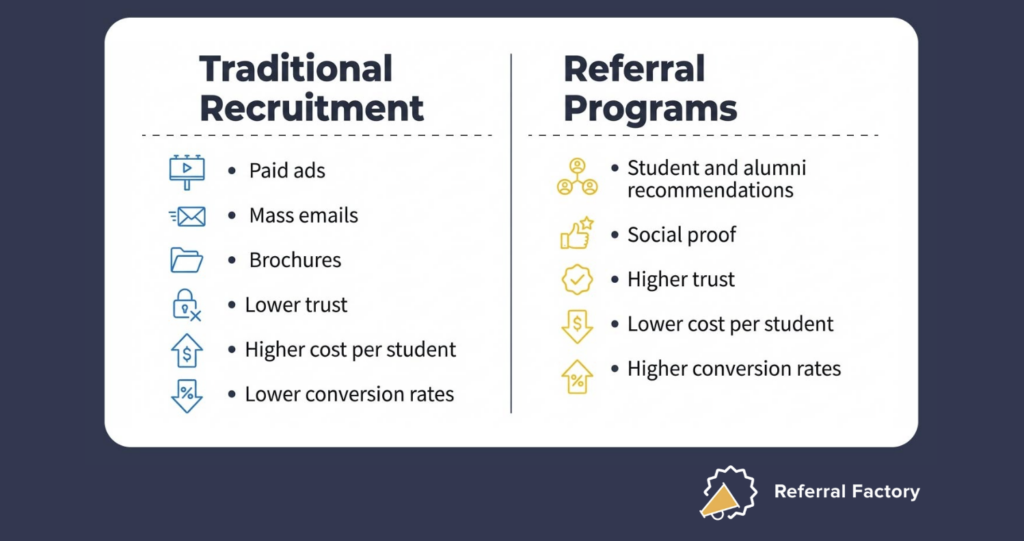
Digital marketing leads the field, but with challenges.
Over 75% of higher education institutions now rely primarily on digital recruitment channels, from paid search and social media to SEO and email campaigns. Online ads and organic search generate visibility and inquiries, and more than 50% of prospective students first discover universities through online search and digital touchpoints.
Rising spend, mixed outcomes.
Institutions continue to pour resources into digital advertising, but the real measure of success, cost per enrolled student, remains hard to track. Research shows universities spend an average of around $2,800 to enroll a single student, and more than half can’t confidently pinpoint which channels drive actual enrollments.
Conversion rates vary widely by channel.
Referral-based interactions consistently outperform traditional digital tactics. In some markets, referral programs generate 20-30% conversion rates, compared with 10-15% for paid search advertising, and 5-10% for social media or email marketing. That means referral-generated prospects are far more likely to move from inquiry to enrollment than leads from broad campaigns.
Traditional tactics are losing credibility.
Methods like generic brochures, mass emails, and broad ad campaigns can raise awareness, but they often fail to build the confidence students seek. Today’s learners are making major life decisions; they want outcomes, reassurance, and trust, not just value statements. This is where referral-based recruitment becomes more effective. A student referral program introduces trust into the process by relying on real experiences shared by current students, alumni, or partners.
What Referral Programs Look Like in Higher Education
A college student referral program set up in higher education is practical, structured, and designed to fit naturally into existing recruitment workflows. At its core, it formalizes recommendations that already happen informally and gives universities a way to track and scale them through an education referral program.
Who Can Participate?
Referral programs work best when participation is broad and inclusive.
- Current students share their real, day-to-day experience with friends, classmates, and online communities.
- Alumni refer prospects from their professional and personal networks, often adding credibility by linking education to career outcomes.
- Faculty and staff recommend programs to students they meet through outreach, academic events, or advisory roles.
- Partners and organizations such as pathway providers, corporate partners, or training institutions refer qualified candidates they already trust.
How the Referral Process Works
The process itself is intentionally simple to remove friction.
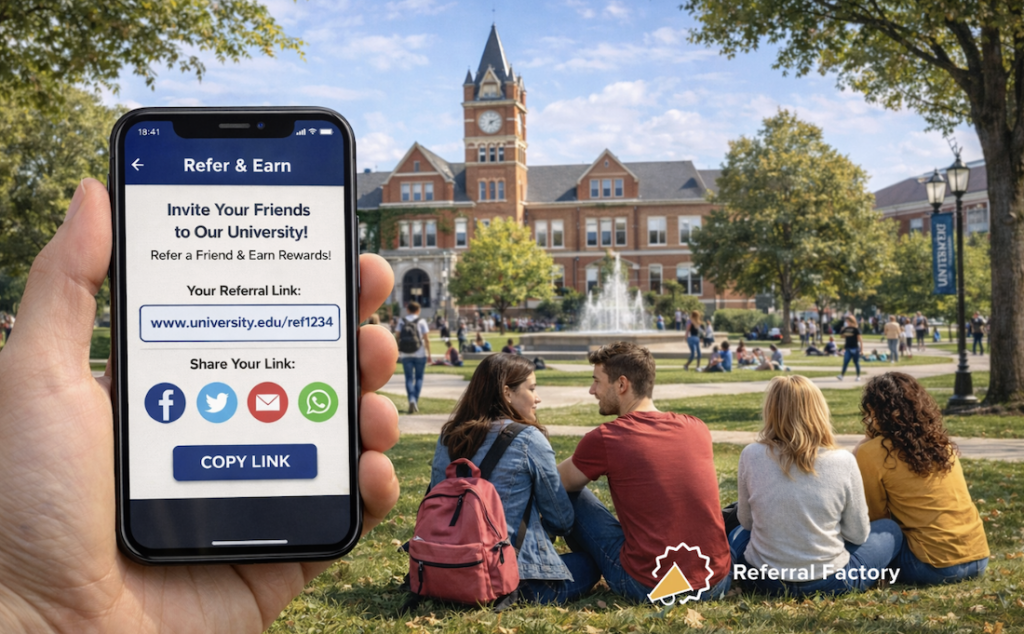
- Each referrer receives a unique referral link or submission form.
- Prospective students enter the funnel through that link by requesting information or starting an application.
- The referral is automatically tracked and attributed as the student progresses.
- Rewards or recognition are issued only after predefined milestones such as enrollment are completed.
How Referral Programs Fit Daily Operations
Referral programs are not separate from admissions operations. They plug directly into existing systems and workflows.
- Referral data feeds into admissions and marketing tools.
- Performance is tracked alongside other recruitment channels.
- Rules and eligibility criteria are clearly defined to avoid confusion or misuse.
Why Student Referrals Matter in Enrollment Decisions
Student referrals tend to work better than traditional advertising because they’re built on trust, not persuasion. When prospective students hear about a university from someone who’s actually studied there or graduated from the program, it feels real and credible, like advice from a friend, not a marketing pitch.
That kind of firsthand perspective often plays a big role in shaping enrollment decisions, especially at those key moments when students are deciding where to apply or enroll.
- Trust Comes From People, Not Campaigns
Paid ads, emails, and brochures all come from the institution itself. Student and alumni referrals come from peers who have nothing to sell. A recommendation from a current student or graduate answers unspoken concerns about academic quality, campus culture, career outcomes, and day-to-day life. This is why attracting new students increasingly depends on authentic voices rather than louder messaging.
- Social Proof Reduces Decision Risk
Enrollment is a high-stakes choice, financially and emotionally. Seeing others succeed at an institution reduces perceived risk. Referrals act as social proof by showing that real people have chosen the university and benefited from it. A structured student recruitment referral program turns this natural validation into a repeatable acquisition channel instead of leaving it to chance.
- Alumni Add Long-Term Credibility
Alumni referrals carry a different kind of influence. Graduates can connect education to real career outcomes, making the value of a degree tangible. This is especially powerful when universities activate corporate alumni referral programs, where professionals recommend programs within their companies or industries. These referrals often attract more qualified and motivated applicants.
- Measurable Impact Compared to Ads
Unlike traditional awareness campaigns, referral programs can be tracked end to end. Universities can see which referrals convert into applications and enrollments and how they compare to other channels. When connected through CRM and API integrations, referral data sits alongside admissions and marketing data, making referrals as measurable as any customer referral program in the commercial world.
New Student Referral Programs and Early-Stage Recruitment
New student referral programs are most effective at the very top of the recruitment funnel, before applications begin. At this stage, the goal is not enrollment yet, but awareness, interest, and lead quality. Referrals support all three without adding friction.
At the early stage, referral programs help universities:
- Enter trusted personal networks before students actively apply
- Spark interest without relying on promotional messaging
- Attract better-fit prospects through natural self-selection
Because students and alumni tend to refer people they believe belong at the institution, referral leads are often more informed and motivated from the start. This early warming reduces effort later in the funnel and increases the likelihood that prospects convert once applications open.
The Role of Alumni and Corporate Networks
Alumni and corporate networks play a powerful role in referral-driven enrollment because they extend a university’s reach far beyond campus. These groups connect education to real-world outcomes, which makes their recommendations especially influential for prospective students evaluating long-term value.
- Alumni as credible advocates
Alumni bring lived proof of what a degree can lead to. When graduates recommend a program, they reinforce the connection between education and career progression. This makes referrals more persuasive, especially for prospects focused on employability and return on investment.
- Corporate networks expand reach and relevance
Corporate partners and employers interact with potential students daily, whether through training programs, hiring pipelines, or professional development initiatives. When these organizations participate in referrals, universities gain access to highly relevant audiences already thinking about skills and career advancement.
- Network effects increase over time
Each successful referral strengthens the overall network. As more alumni and partners participate, referral activity compounds, creating a self-reinforcing system where trust and visibility grow together. This long-term effect is difficult to replicate with short-term marketing campaigns.
- Sustainable value beyond enrollment cycles
Unlike one-off advertising spend, alumni and corporate referrals continue to deliver value year after year. Relationships deepen, advocacy increases, and the referral channel becomes more efficient as networks mature.
Referral Incentives Universities Commonly Use
Referral incentives work best when they encourage sharing without turning recommendations into transactions. In higher education, the goal is to reward advocacy while preserving authenticity and trust within a university referral program.
- Tuition-related benefits: Universities often offer tuition credits, partial scholarships, or fee reductions tied to successful enrollments. These incentives align closely with the academic mission and feel meaningful rather than promotional.
- Gift cards and financial rewards: Modest cash equivalents or gift cards are commonly used, especially for students and staff. When amounts are kept reasonable and tied to clear milestones, they motivate participation without undermining credibility.
- Campus and experience-based rewards: Priority registration, access to exclusive events, merchandise, or recognition within the university community can be just as effective as financial incentives. These rewards reinforce belonging and pride rather than simple compensation.
- Alumni and partner recognition: For alumni and corporate partners, incentives often focus on recognition instead of money. Public acknowledgment, networking opportunities, or contributions made in their name to scholarships or programs help maintain long-term engagement.
The most successful incentive structures balance motivation with integrity. By keeping rewards transparent, proportional, and aligned with institutional values, universities encourage genuine referrals that strengthen trust rather than dilute it.
How Referral Programs Fit into the Enrollment Funnel
Referral programs are most effective when they’re intentionally mapped to every stage of the enrollment funnel, turning advocacy into measurable recruitment outcomes. They provide a structured way for universities to leverage personal networks while maintaining trust and authenticity.
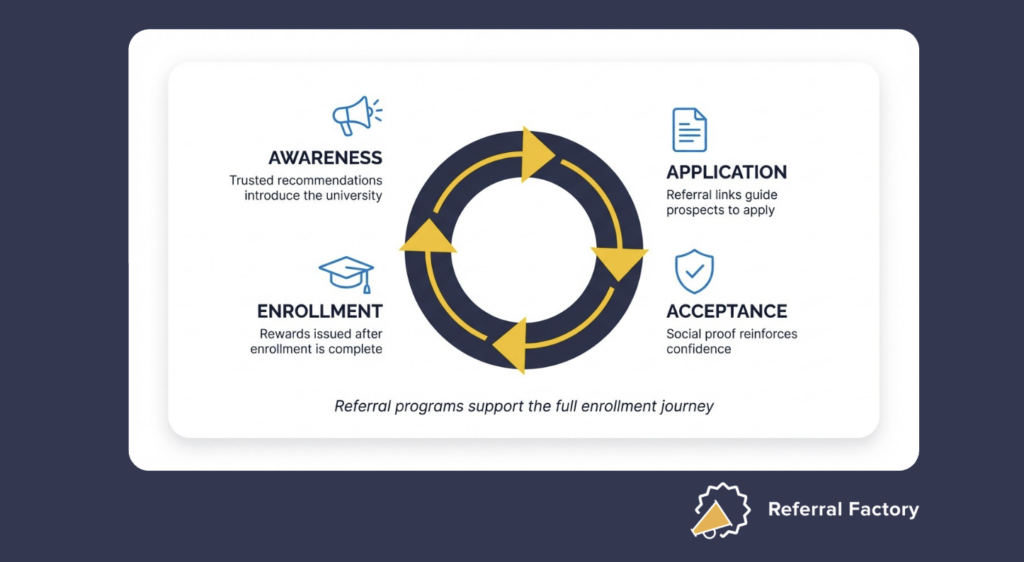
Awareness
At the top of the funnel, referrals help prospective students discover programs through trusted voices. Recommendations from current students, alumni, or corporate partners introduce the university in a way that feels credible and personal. Compared to traditional ads, this approach increases attention and relevance for early-stage prospects, showing exactly how universities attract students in a meaningful way.
Application
Once interest is sparked, referral programs guide prospects toward completing applications. Unique referral links or forms simplify the process, ensuring the referrer’s influence is captured and tracked. Incentives tied to submitted applications encourage timely engagement, producing higher-quality leads than untargeted outreach alone.
Acceptance
As students compare offers, referrals serve as social proof, reinforcing confidence in their choice. Peer and alumni recommendations validate the program’s value and help prospects feel assured about long-term outcomes, from academics to career readiness.
Enrollment
At the final stage, referral programs reward successful conversions, whether through tuition credits, recognition, or other incentives. This ensures accountability and encourages continued advocacy. Programs can even integrate with financial solutions, such as student loan refinancing referral programs, offering additional value for referred students and extending benefits beyond enrollment.
Measuring the Success of University Referral Programs
Measuring the performance of a university referral program is essential to ensure it delivers real impact and justifies the investment. Universities track several key metrics to understand how well referrals convert into applications, enrollments, and long-term engagement.
Applications Generated
The first measurable outcome is the number of applications originating from referrals. By using unique referral links or codes, universities can see exactly which students applied because of a referrer’s influence. This helps quantify the program’s reach and highlights the most active referrers, whether students, alumni, or corporate partners.
Enrollment Conversions
Applications are valuable, but the true indicator of success is enrollment. Universities track how many referred applicants ultimately accept offers and complete registration. This stage measures the program’s effectiveness in attracting qualified and committed students, offering insights into both the quality of referrals and the student experience.
Cost per Student
Referral programs are often more cost-efficient than traditional recruitment channels. By calculating the total program cost against the number of enrollments generated, universities can determine cost per student. Lower costs per enrollment indicate that referrals are a highly efficient acquisition channel, often outperforming paid advertising or event-based outreach.
Attribution and Analytics
Understanding which referrers, channels, or campaigns drive results is critical. By integrating referral tracking with admissions systems, universities can attribute applications and enrollments to specific sources. This enables continuous optimization, such as refining incentives, adjusting messaging, or identifying underperforming networks.
Continuous Improvement
Regular reporting and analysis help institutions fine-tune their programs. Insights from metrics allow universities to identify trends, recognize top referrers, and make informed decisions about scaling the program, adding incentives, or expanding participation to alumni and corporate networks.
Common Challenges and How Universities Solve Them
Referral programs in higher education are highly effective but come with several challenges that can affect participation, fairness, and results. Addressing these issues carefully helps universities maximize the impact of referrals.
Low Participation and Awareness
A frequent challenge is encouraging students, alumni, and partners to actively participate. Without clear communication or visible incentives, referral programs may remain underused. Universities address this by promoting programs across multiple channels, making the process simple, and highlighting meaningful rewards.
Tracking and Attribution
Accurately tracking which referrals lead to applications and enrollments can be difficult. Without clear attribution, it is hard to measure success or identify top referrers. Using CRM allows universities to monitor each referral throughout the enrollment funnel, providing data for analysis and improvement.
Incentive Management
Improperly designed incentives can create confusion or encourage low-quality referrals. Universities address this by defining eligibility, milestone requirements, and reward limits. Automation helps manage rewards efficiently, keeping the program fair and motivating participants effectively.
Program Complexity
Programs that involve multiple participant groups, incentives, or referral channels can become complex. Simplifying workflows, providing step-by-step instructions, and using digital tools reduces friction and makes participation straightforward for all stakeholders.
Maintaining Trust
The credibility of referrals is essential. Universities maintain trust by validating referred students, monitoring referral activity, and setting clear guidelines for participation. This keeps referrals authentic and persuasive, preserving the social proof that makes them more effective than traditional advertising.
Turn Student Advocacy Into a Scalable Enrollment Channel
Referral programs can transform trust and personal connections into measurable enrollment results. Students, alumni, staff, and partners become advocates, sharing authentic experiences that carry far more weight than traditional marketing. When structured properly, referral programs help universities:
- Qualified leads from better academic and cultural fit
- Long term engagement with students, alumni, and partners
- Compounding awareness, applications, and enrollments through peer networks
- Lower acquisition costs through repeatable, structured referral processes
Referral Factory makes it easy to launch and manage these programs with built-in tracking, automation, and analytics. Universities can grow their network of advocates while seeing measurable results at every stage of the enrollment funnel, turning student advocacy into a scalable and strategic enrollment channel.
FAQs
How do universities attract students using student referral programs?
Universities encourage students, alumni, and partners to recommend the institution to prospective students. Referrals are tracked through links or forms and often convert better because they come from trusted voices.
Why do referral programs work for student enrollment?
Referral programs work because they’re informed by trust and social proof. Prospective students respond more to recommendations from peers or alumni than to promotional messaging. Referrals surface real experiences, academic quality, and outcomes while allowing universities to track performance, reward advocacy, and improve results more efficiently than traditional recruitment channels.
How do student referrals influence enrollment decisions?
Student referrals influence enrollment decisions by providing first-hand, credible insights into university life. Prospective students value the opinions of peers and alumni because they feel authentic and relatable. Referrals offer reassurance about academics, campus culture, and career outcomes, helping students evaluate options with confidence. When incorporated into structured programs, these recommendations reach the right audience at the right stage, increasing the likelihood that referred students will apply, accept offers, and enroll.
Are referral programs only useful for undergraduate enrollment?
No. Referral programs also work well for graduate, professional, and certificate programs. Alumni and partner referrals are especially effective for working professionals and continuing education.
Do referral programs replace traditional student recruitment methods?
Referral programs do not replace traditional recruitment methods. Ads, events, and outreach still play a role in awareness, but referrals add trust that these channels lack. They improve lead quality, lower acquisition costs, and support ongoing advocacy when used alongside existing recruitment efforts.
Why are referral programs becoming more important for universities?
Referral programs are gaining importance as traditional marketing becomes more expensive and less trusted. Students and parents increasingly rely on peer and alumni input when making enrollment decisions. Referrals produce higher-quality leads, improve conversion rates, and extend reach through alumni and partner networks while remaining measurable and scalable.
Referral link generator (free)
We take your website, send it to Referral Factory, and provision a real referral program for your brand. The link you get is a live referral URL your customers can share, backed by tracking and rewards in the app - not a static "generator" preview. This is the fastest way to see what a real referral program would look like for your brand! Try it below...