
Tracking referrals, attribution logic, ROI, qualification, and conversion visibility.

Solar companies rely on referrals from customers, partners, and installers to drive growth, but managing these leads manually is error-prone and time-consuming.
Solar referral program automation replaces spreadsheets, notes, and guesswork with a centralized system that captures every lead, assigns credit accurately, and provides clear reporting.
In this article, we’ll take a look at what referral programs mean for solar companies and how you can use one to scale referrals without adding manual work.
Why Referral Tracking Matters for Solar Companies
Referrals are one of the strongest growth drivers in solar. Homeowners trust neighbors, businesses trust peers, and local reputation plays a major role in buying decisions. But when referrals are not tracked properly, valuable opportunities slip through the cracks.
Here’s why referral tracking has a direct impact on revenue, commissions, and installer growth:
- Revenue visibility: Referral tracking shows which leads come from trusted sources and which ones actually close. Without this visibility, referrals are treated as one-off wins instead of a reliable source of future revenue.
- Fair commissions and partner trust: Clear tracking prevents disputes over who referred a deal and when it entered the pipeline. Sales reps, installers, and partners stay motivated when referrals are attributed correctly and rewards are paid on time.
- Stronger local reputation: Referrals reflect how customers talk about your business in their community. Tracking them helps you understand which neighborhoods, installers, or partners drive the most trust and momentum.
- Lower acquisition cost: Referred leads convert more often and require less persuasion. Knowing the best way to track referrals for solar installers allows you to focus on relationships that consistently produce high-value deals.
How Solar Referrals Usually Happen
Solar referrals rarely come from one single channel. They grow out of everyday conversations, local trust, and on-the-ground relationships. Let’s talk about how they typically happen in real life.
Neighbors and Community Conversations
Most solar referrals start close to home. A homeowner installs panels and suddenly becomes a walking case study. Neighbors notice lower bills, ask questions, and want to know who handled the installation. These referrals often happen informally at the mailbox, in a WhatsApp group, or during a weekend chat. The intent is high because the recommendation comes from someone nearby who already took the leap.
Existing Customers
Happy customers are one of the strongest referral sources. They refer friends, relatives, or coworkers after a smooth install or when savings become obvious. Many customers do not actively think of themselves as referrers. They simply answer questions when asked or share their experience when the topic of energy costs comes up.
Sales Representatives
Sales reps frequently refer deals internally or across territories. A rep may pass along a lead that falls outside their region or specialty. These referrals tend to be fast-moving because the lead already trusts the brand and expects a follow-up.
Installers and Field Teams
Installers are deeply embedded in local communities. While working on rooftops, they talk to neighbors, answer quick questions, and often hear who else is considering solar. These referrals are highly contextual and time sensitive, but are often poorly documented.
Partners and Local Businesses
Roofers, electricians, real estate agents, and contractors regularly encounter homeowners thinking about solar. Referrals from these partners come through casual recommendations or informal agreements, not structured systems.

The Challenges of Manual Referral Tracking
Manual referral tracking creates hidden problems that compound over time. What starts as small gaps and inconsistencies quickly turns into lost referrals, strained partner relationships, and reporting blind spots as volume grows.
Lost and Untracked Referrals
Manual referral tracking relies heavily on human consistency. Referrals are often shared through emails, Slack messages, introductions over LinkedIn, or informal conversations, then logged later (if at all). The problem is that “later” frequently turns into “never.”
When referral data lives across inboxes, spreadsheets, and CRM notes, there’s no single source of truth. A sales rep forgets to tag a referral. A spreadsheet isn’t updated. An intro email gets buried. Over time, legitimate referrals go unrecorded, making it impossible to accurately credit partners or measure the true impact of your referral program.
Attribution Disputes and Trust Breakdown
If you are tracking referrals manually, attribution quickly becomes a gray area. It’s often unclear who introduced an account first, whether the referral met the agreed criteria, or how much influence the partner had on the deal.
That lack of clarity leads to disputes. Partners may feel confident they earned credit, while internal teams may see the opportunity as already in motion. Without a clear audit trail, these conversations become subjective and relationship-driven instead of grounded in data. Over time, this creates frustration on both sides and can weaken partner trust, making future referrals less likely.
Delayed and Error-Prone Payouts
Manual tracking also slows down payouts. Since commissions cannot be calculated automatically, finance and operations teams are left piecing together information from the CRM, email threads, deal stages, and contract details before approving payments. Each step adds time and increases the chance of mistakes.
From a partner’s perspective, late or inaccurate payouts send the wrong message. Even strong partnerships can suffer when compensation feels inconsistent or unpredictable, especially when partners are referring high-value opportunities and expecting a smooth, professional process in return.
Incomplete and Unreliable Reporting
When referral data is tracked manually, answering basic performance questions becomes surprisingly difficult. Which partners are sending the best leads? How do referred deals perform compared to inbound or outbound opportunities? Where are referrals getting stuck in the funnel?
Because data is entered inconsistently and stored in multiple places, reporting is often incomplete or outdated. Teams end up relying on assumptions or anecdotal feedback instead of clear trends. That makes it harder to optimize your partner strategy, forecast revenue accurately, or make a strong case for continued investment in referrals.
Limited Scalability as Programs Grow
Manual tracking might feel manageable when you are working with a small number of partners and a limited flow of referrals, but as the program grows, the cracks start to show. Each new partner adds more coordination, more manual work, and more room for error.
What once felt workable quickly turns into a bottleneck. Teams are forced to choose between spending more time on administrative tasks or limiting the growth of the program altogether, neither of which supports long-term scale.
What Does an Automated Referral Tracking System Actually Do?
An automated referral setup takes the guesswork out of how referrals move through your solar business. Instead of relying on memory, spreadsheets, or follow-up messages, everything’s captured and organized in one place.
Here’s what a modern solar referral tracking system typically handles behind the scenes:
- Creates unique referral links for every source: Customers, installers, sales reps, and partners each receive their own referral link or form. When a prospect clicks or submits details, the system automatically records who sent them without manual input.
- Handles attribution across long sales cycles: Solar deals rarely close fast. Automated systems remember the original referrer even if weeks or months pass between the first click, site visit, and signed contract. This prevents disputes and missed credit.
- Tracks referral activity in real time: You can see when a referral is submitted, contacted, qualified, and closed. This visibility helps sales teams prioritize warmer leads and keeps referrers confident that their leads are being handled.
- Generates clear reporting: Automated dashboards show which sources drive the most referrals, the highest close rates, and the strongest deal values. This data makes it easier to double down on high-performing partners and campaigns.
- Manages rewards and commissions: Once a referral converts, the system calculates payouts based on your rules. This reduces delays, errors, and awkward conversations about who is owed what.
- Centralizes everything in one workflow: Instead of juggling emails, notes, and CRM fields, referral data lives in a single system, like in this case, making it easier to scale referral efforts without adding admin work.
These systems are not limited to solar. The same automation used to track solar referrals can also be used in professional services as a consulting referral program or in sales, where long sales cycles and relationship-based deals require accurate attribution, similar to a consulting referral program.
Common Methods Solar Companies Use to Track Referrals
What are the methods of solar referral tracking? Most solar companies start tracking referrals with tools they already have. These methods can work at a small scale, but each comes with tradeoffs that become obvious as referral volume grows.
Below are the most common approaches and where they tend to fall short.
- Spreadsheets: Your team logs referrers, lead details, and deal status manually. This method is simple to set up but easy to break. Data gets outdated quickly, entries are inconsistent, and it becomes hard to see which referrals actually turn into revenue.
- CRM notes and custom fields: Some companies track referrals inside their CRM by adding notes or tagging leads. While this keeps data in one system, attribution often depends on sales reps remembering to log the referral correctly, which leads to gaps and disputes.
- Promo codes or referral codes: Codes are shared with customers or partners to pass along. This works for basic attribution but fails when prospects forget to use the code or contact the company through a different channel.
- Manual follow-ups: Sales teams ask new leads who referred them during calls or site visits. This approach relies on memory and timing and often misses referrals that come through online forms or delayed conversations.
These methods do the job, but none are built for scale. As installers grow, manual systems struggle to keep up with longer sales cycles, multiple referral sources, and accurate payout tracking.
How Automation Improves Accuracy and Attribution
Explain how automation improves referral accuracy and attribution across sales cycles. Focus on visibility and trust.
The Best Way to Track Referrals for Growing Solar Installers
As solar installers expand, keeping track of every referral across customers, partners, and sales reps becomes increasingly complex.
Relying on spreadsheets, CRM notes, or manual follow-ups quickly leads to missed opportunities, disputes over credit, and delayed payouts. The most efficient solution is to use dedicated referral software, which centralizes all referral data and automates tracking throughout the sales cycle.
Using the best way to track referrals for solar installers, software platforms capture referral sources instantly, assign credit accurately, and provide real-time dashboards to monitor performance. This visibility helps sales teams prioritize warm leads, partners feel confident their referrals are recognized, and installers can scale without adding administrative overhead.
Key advantages include:
- Automatic attribution across long and multi-step sales cycles
- Instant reporting on referral volume, conversion rates, and payouts
- Integration with existing tools to reduce errors and streamline workflows
- Transparent communication with customers, partners, and installers
How to Measure Whether Your Referral Tracking Is Working
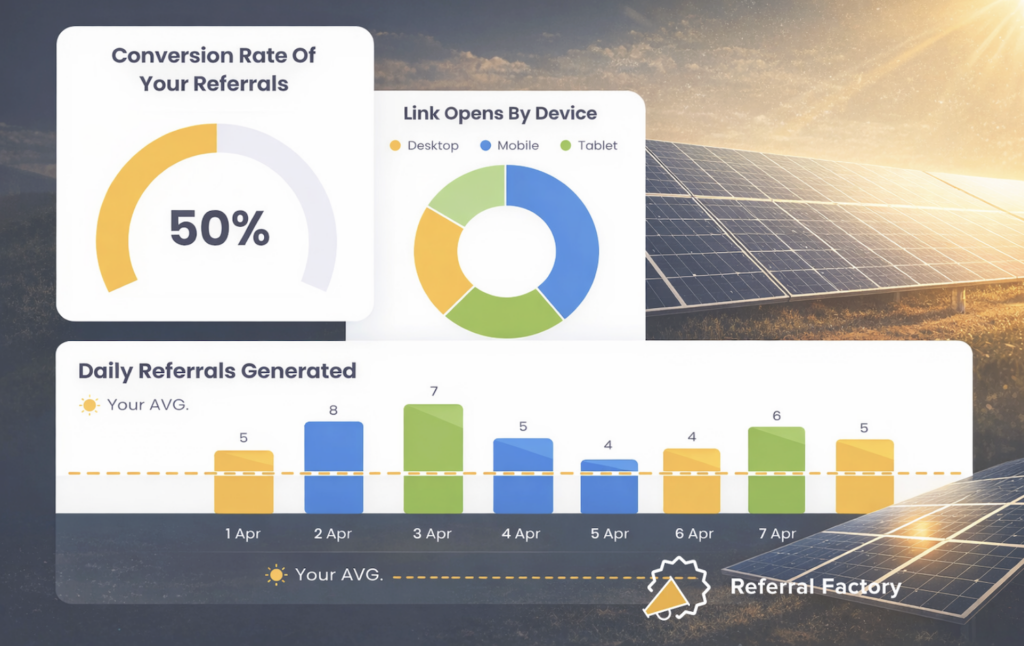
Tracking referrals is only valuable if you can measure their impact accurately. For solar companies, monitoring the right metrics ensures that your referral program is driving growth, rewarding partners fairly, and generating revenue. Key metrics to monitor include:
- Referral volume: Measure the total number of referrals coming from customers, partners, and installers. Tracking this shows which sources are the most active and helps identify areas to focus marketing and outreach efforts.
- Close rate: It’s not enough to generate leads. Understanding how many referrals convert into signed contracts highlights the quality of each referral source and indicates where improvements or follow-ups are needed.
- Cost per deal: Calculate the cost of acquiring a customer through referrals compared to other channels. Automated tracking helps assign accurate values to rewards, incentives, and operational costs, giving a clear picture of return on investment.
- Payout accuracy: Make sure that all referrers are credited and compensated correctly. Inaccurate payouts can damage trust with partners and installers, reducing future participation in the program.
Your company can see which referral sources generate the most revenue, identify trends over time, and optimize the program without manual reconciliation.
Common Mistakes to Avoid When Automating Referral Tracking
Automating referral tracking can transform how solar companies manage leads, but several common mistakes can limit its effectiveness. Understanding these pitfalls helps teams set up programs that scale smoothly and generate consistent results.
Poor Setup
A referral program that’s not configured correctly from the start will create frustration for referrers and internal teams. Incorrect tracking links, incomplete attribution rules, or missing integrations can cause leads to be lost or misassigned. Taking the time to define program rules and workflows upfront prevents these issues.
Unclear Rules
Referrers need to know exactly how the program works. Confusing eligibility, reward criteria, or payout timing reduces participation and leads to disputes. Clear communication about what qualifies as a referral and how rewards are earned builds confidence and encourages consistent engagement.
Lack of Adoption
Even the best system fails if your team and partners do not use it consistently. Without training and incentives, sales reps, installers, and partners may default to old habits, like spreadsheets or informal notes, undermining the program’s accuracy and trustworthiness.
Disconnected Systems
Many solar companies attempt referral tracking in isolation from other tools. When the referral platform does not integrate with CRM, sales, or reporting systems, data silos appear, manual work increases, and performance insights are incomplete.
A Smarter Way to Track and Scale Solar Referrals
Automation is essential if you want referrals to scale without friction. Manual tracking leads to missed leads, unclear attribution, and delayed payouts. With automation, you get full visibility into every referral, accurate credit across long sales cycles, and a reliable way to reward partners.
Platforms like Referral Factory make this easy, helping you turn referrals into a scalable, trusted growth channel.
FAQs
Why is referral tracking important in the solar industry?
Referral tracking helps solar companies understand which leads come from customers, partners, and installers, while ensuring every referral is credited correctly. Because solar sales cycles are long and relationship driven, accurate tracking prevents lost leads, supports fair rewards, and turns referrals into a predictable, scalable growth channel.
What problems does automation solve in referral tracking?
Automation eliminates missed referrals, manual errors, and attribution disputes. It captures referral sources instantly, preserves credit across long sales cycles, and automates reporting and rewards. For solar companies, this reduces admin work, improves partner trust, and allows referral programs to scale without adding operational complexity.
How does automated referral tracking support sales teams?
Automated referral tracking shows sales teams where each lead came from, preserves referral credit automatically, and highlights higher intent opportunities. This reduces manual follow ups and attribution questions, allowing teams to focus on closing deals instead of tracking referrals.
What is the best way for solar installers to track referrals as they grow?
The most effective approach is using dedicated referral software built for tracking referrals across long sales cycles. These tools automatically capture sources, assign credit, and provide real time reporting, replacing spreadsheets and manual notes while giving installers a scalable system that keeps referrals organized and transparent.
Can automated referral tracking work with a CRM?
Yes. Automated referral tracking can integrate directly with CRM systems, allowing referral data to flow from first touch to closed deal. This ensures consistent attribution, reduces duplicate data entry, and gives solar teams a complete view of referral performance alongside their existing sales pipeline.
Referral link generator (free)
We take your website, send it to Referral Factory, and provision a real referral program for your brand. The link you get is a live referral URL your customers can share, backed by tracking and rewards in the app - not a static "generator" preview. This is the fastest way to see what a real referral program would look like for your brand! Try it below...