
Software selection, platform evaluation, tools, and buyer-side comparison content.

A high-impact storytelling guide for insurance brokers, advisors, carriers, insurtech platforms, and agencies that want higher-quality clients without burning money on low-quality channels.
The Crossroads: Advertising Highway vs. The Quiet Trust-Built Lane
Imagine you’re standing at a busy crossroads. On one path, the highway there are noisy billboards, flashy ads, cold-calling, outbound campaigns, online ads competing for clicks… hundreds of firms shouting “Choose me for your insurance!” Over there sits the majority of insurance companies, spending big to get seen.
But on the other path a quiet, more trustworthy lane, sits something more subtle, more powerful: a satisfied customer walking into a room and saying to a friend: “Hey, I use this broker. They sorted out my car / home / life insurance, it was smooth, and they were helpful. Give them a call.”
That second path: referrals, is often overlooked or under-leveraged. Yet, for insurance businesses, it’s arguably the most powerful growth channel.
Because in insurance, trust matters more than anything else. You don’t choose an insurance provider based on a catchy ad or a fancy banner, you choose them because you trust them. They’re safeguarding your life, health, home, business.
And people trust people they know. Trust built into referrals.
A friend recommending their broker.
A business owner telling another business owner.
A family member saying, “Call my guy, he handled everything for me.”
The world’s most valuable insurance leads don’t cost you anything, except the trust you’ve already earned.
This is the story of how insurance businesses are turning that quiet trickle of referrals into a predictable, automated, high-converting growth engine, and why the fastest-growing insurance businesses today are doubling down on referral marketing.
1. The Harsh Reality: Insurance Lead Costs Are Out of Control
Let’s be blunt:
Paid ads for insurance?
A bloodbath. Insurance is one of the most competitive verticals on earth.
CPCs can range from $20 to $60+, depending on the product and region.
CPLs often hit $150–$400+, especially for long-tail products like life insurance or commercial insurance.
Every insurer, every broker, every aggregator is fighting over the same keywords.
Meanwhile…
SEO?
Powerful, but painfully slow, dominated by giants and comparison sites.
Affiliates?
Useful, but costly and unpredictable.
Social?
Good for visibility, rarely great for conversion.
Comparison sites?
You’ll pay through the nose for leads that are shopping 14 other providers at the same time.
And the biggest problem of all?
Insurance buyers don’t trust marketing.
Not one bit. Insurance is a category built on skepticism:
🛑 People think insurers avoid paying claims.
🛑 They fear the fine print.
🛑 They assume the lowest price hides the biggest surprises.
🛑 They don’t understand the jargon.
🛑 They feel overwhelmed and intimidated by policy choices.
So even when your marketing works… it barely works.
But there’s one channel insurance buyers do trust:
👉 Referrals. Recommendations. Word of mouth.
Because nobody chooses insurance lightly.
You’re protecting:
- their family
- their health
- their home
- their car
- their business
- their livelihood
- their entire future
People will scroll past a Facebook ad.
But they’ll pause instantly when a friend says:
“Here’s who I use – you can trust them.”
Trust is everything in insurance. And trust spreads through people.
2. Why Referral Programs Are So Effective in the Insurance Industry
Insurance is one of the most referral-friendly industries in the world, and almost nobody is capitalizing on it properly.
2.1 Insurance Doesn’t Sell Policies — It Sells Trust
If a billboard said:
“Trust us with your life insurance!”
…you’d laugh.
But if your best friend says:
“My broker sorted everything out and made it easy.”
…you believe them.
Insurance decisions are deeply emotional and deeply personal.
A referral instantly removes:
- the trust barrier
- the complexity barrier
- the risk barrier
- the procrastination barrier
A referred insurance lead is pre-warmed, pre-validated, and pre-trusting — something no paid ad can replicate.
2.2 Referred Insurance Clients Convert Faster and Stay Longer
A referred policyholder:
- trusts you more
- closes faster
- buys more cover
- renews more consistently
- submits fewer complaints
- churns far less
Referrals are not just cheaper.
They are better.
In fact:
One US disability-insurance brokerage running a referral program on our platform converts three in four referred leads into booked reviews, gated on the friend requesting a quote and booking time with an advisor rather than buying a policy.
And unlike paid channels, referred clients create second-order referrals, which multiply your growth without multiplying your costs.
2.3 Insurance Has Natural Built-In Referral Moments
Insurance businesses typically offer a wide variety of products: life, health, home, auto, business liability, income protection, etc. That variety means:
- Every time a client’s life changes, new car, new home, new job, growing family, there’s a natural “trigger moment” to discuss a new or changed policy.
- Each of those trigger-moments is also a perfect “referral moment.” Your client might know someone else going through the same life event, a friend buying a house, a colleague getting a new car, a sibling starting a family.
If you’re organised and intentional, you can tap into these built-in referral triggers instead of waiting for random referrals to happen.
2.4 Insurance Decisions Are Cognitively Hard — Referrals Make Them Easy
Most products are simple to buy.
Insurance is not.
It requires people to:
- interpret risks
- compare complicated policies
- decode legal language
- predict future scenarios
- compare ambiguous pricing
- trust a company they barely know
This complexity often creates hesitation and procrastination. Referral leads, introduced by someone they trust, dramatically reduce friction. The heavy lifting (explaining risk, building trust) is already done by the referrer.
In short: referrals reduce the cognitive burden of buying insurance, making it easier for prospects to say “yes.”
They give people confidence to choose quickly without second-guessing themselves.
2.5 Referrals Improve Retention — Not Just Acquisition
Insurance depends on renewals.
Referral clients:
- churn less
- require fewer service interactions
- feel more committed
- are less price-sensitive
- bundle more products
- refer others
Insurance referral program growth compounds faster because churn decreases while LTV increases.
A single referral can generate value for years, even decades.

3. How to Launch an Effective Referral Program in Your Insurance Business
You know referrals are powerful, now let’s get practical. What does it take to build a referral program that really works?
Good news: Launching a referral program is not complicated.
Most insurance teams can set it up in 2–5 days when using a no-code referral platform like Referral Factory. Here’s the typical setup:
✔ Create unique referral links
One for each client, advisor, or broker.
✔ Build a referral landing page
Simple, clean, benefit-driven.
✔ Track leads through your CRM or AMS
Referral → lead → policyholder → reward.
✔ Automate reward payouts
Cash, gift cards, premium credits, etc.
✔ Integrate referral prompts into every client touchpoint
More on this soon.
✔ Launch communication sequences
Email, SMS, online portal, advisor scripts.
Your risk?
Almost nothing.
Your investment?
Mostly time + referral software.
Your cost?
Referral rewards only after a policy is sold and paid.
Your upside?
Many insurance companies see 30–40% more leads annually after rolling out referrals, with lower CPL and higher conversion rates.
4. How to Structure the Perfect Referral Offer in Insurance
This is where 90% of insurance businesses fail.
They misunderstand the psychology of referrals.
Let’s fix that.
4.1 The Offer Matters More Than the Reward
When the referrer feels like they’re doing their friend a favor, participation skyrockets.
Incentives should feel like a gift or benefit, not a bribe. People are more motivated when they feel they are genuinely helping someone (a friend) get value, not just sending a lead for money.
When the reward is embedded in the context of the value you provide (e.g. “help your friend save on premiums”), referring feels altruistic, friendly, rather than opportunistic.
The reward motivates the referrer.
But the offer motivates the new client.
Example of a bad ask:
“Use my link so I get $100.”
Example of a great ask:
“Use my link — it gives you a discount on your first premium.”
One feels selfish.
The other feels helpful.
Also go for the option that makes people feel helpful.
4.2 What Rewards Work Best for Insurance?
Insurance has extremely high LTV.
Meaning: You can afford to be generous.
Best-performing rewards:
- Cash bonuses ($50–$500 depending on product)
- Premium credits
- Gift cards (if cash is restricted)
- Account credits
- Charitable donations in the referrer’s name
- Upgrades to better coverage
Cash is usually kingm but premium credits are often just as strong.
4.3 Regulatory Considerations (Simplified)
Different regions limit what you can offer.
But here’s the truth: Regulation doesn’t stop referral marketing.
It simply shapes it.
If cash is restricted, offer:
- gift cards under the allowed threshold
- charitable donations
- value-added services
- discount vouchers
- free policy reviews
Creativity beats compliance constraints.
In the US specifically, this is governed by state anti-rebating laws, rules that stop an insurer sweetening a policy sale with cash or gifts to the buyer. That is why most insurance referral programs reward only the existing customer and make the friend's incentive the service itself, a free quote or a review, rather than a cash split. The full legal picture, state by state, is in are referral programs legal in financial services. What to offer instead of a cash split is in what should you offer as a referral reward in financial services.
4.4 When Should You Pay The Reward?
Insurance is vulnerable to low-quality or fraudulent referrals.
So: Only pay rewards when the new client becomes valuable.
That means:
- Signed contract
- First premium paid
- Policy active
- (Optional) 30-day retention check
This protects your program and ensures rewards only go toward real revenue.
5. When, Where, and How Insurance Businesses Should Ask for Referrals
Most insurance companies ask once, then pray. Referrals don’t work that way.
You need to ask consistently, at the right emotional moments. Here are the strongest referral triggers in the industry.
5.1 Ask Right After a Positive Claims Experience
A smooth claim is rare in the insurance world.
When it happens, clients feel grateful, and vocal.
Perfect moment to trigger an automated referral request.
5.2 Ask After a New Policy Is Issued
The client feels:
✔ relief
✔ progress
✔ security
✔ trust
Great time to say:
“If you know anyone needing coverage, here’s your referral link.”
5.3 Ask When a Client Saves Money or Qualifies for a Bonus
- No-claims bonus
- Premium discount
- Renewal savings
- Bundling discount
People want friends to benefit too.
5.4 Ask During Customer Service Wins
After a helpful support call or successful advisory session:
“If you ever want to refer anyone, I can send your referral link.”
Not pushy.
Not scripted.
Just natural.
5.5 Promote Referrals Inside Client Portals
Anywhere clients log in to:
- make claims
- check policies
- update details
- view premiums
- submit documents
…is perfect real estate for referral banners.
5.6 Use Everyday Communication Touchpoints
- onboarding emails
- monthly newsletters
- renewal notices
- claims updates
- policy documents
- agent email signatures
- WhatsApp communication
- SMS reminders
- mobile app notifications
Remember:
A referral program only works if people are reminded that it exists.
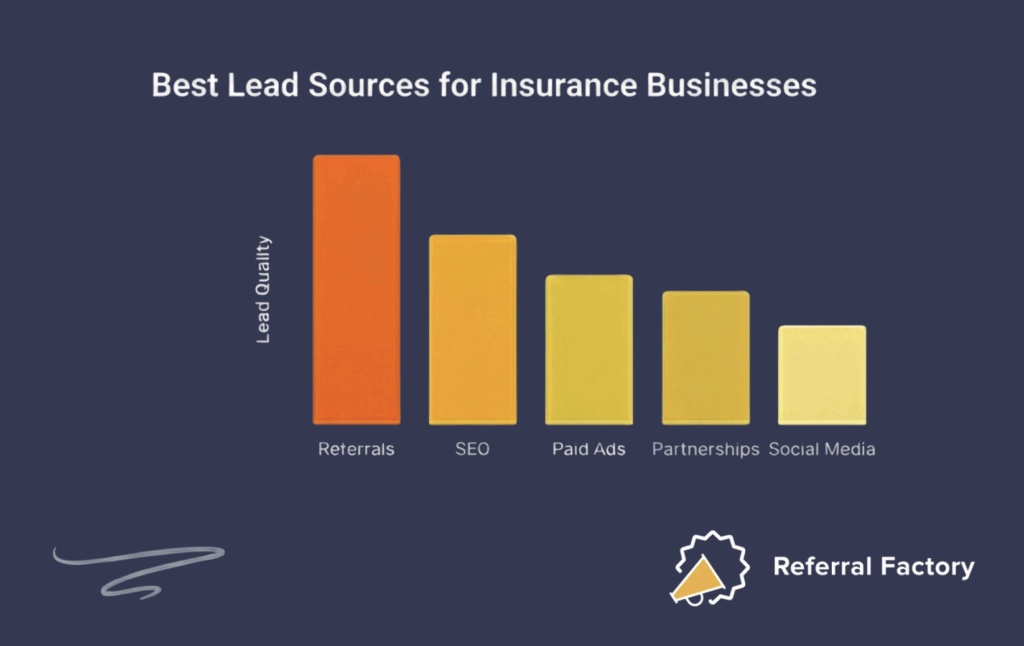
6. The Most Profitable Lead Sources for Insurance (Ranked)
After analyzing hundreds of insurance businesses, here’s how the channels actually perform:
1. Referrals — #1 most profitable
- highest trust
- highest intent
- lowest cost
- longest retention
- best quality
2. Organic Search (SEO)
- strong inbound demand
- great for comparison shoppers
- slow but compounding
3. Paid Ads
- expensive
- competitive
- hit-or-miss quality
- still useful for scale if profitable
4. Partners & Affiliates
- solid, but require management
5. Social Media
- good visibility
- weak direct conversion
- great support channel for your referral strategy
7. How Insurance Companies Can Stand Out in a Crowded Market
Insurance is boring, until people need it.
Your job is to make your brand impossible to forget.
7.1 Be Seen Everywhere
When someone is shopping for insurance, they do their homework.
They:
- compare quotes
- Google everything
- look at reviews
- ask friends
- read Reddit threads
- check LinkedIn
- plug queries into ChatGPT or Perplexity
The more they see your brand, the more they trust your brand.
7.2 Collect Reviews Nonstop
Reviews = credibility. Use testimonials everywhere:
- landing pages
- insurance product pages
- email campaigns
- comparison tables
- agent bios
- claim success stories
Reviews strongly influence AI-generated responses too.
7.3 Nurture Your Leads
Insurance research cycles are long.
Use:
- SMS
- educational emails
- short explainer videos
- renewal reminders
- check-in calls
- policy upgrade prompts
The more you help before selling, the more they trust you.
8. A Simple, Highly Profitable Insurance Funnel
This funnel works for personal lines, commercial lines, life insurance, health, income protection, contractors, and more:
Landing Page → Needs Assessment / Intro Call → Quote → Policy Issued → Onboarding → Refer
This turns every policyholder into fuel for your next policyholder.
Compounding growth at its finest.
9. Insurance Referral Program Template (Copy & Paste)
Program name:
💼 Protect & Earn — Insurance Referral Rewards
Who can refer:
Any active policyholder.
What the referrer gets:
$50–$300 cash bonus
OR
premium credit
OR
gift card
What the new client gets:
A premium discount, bonus credit, or value-added service.
ualification requirement:
Reward paid after:
- policy activation
- first premium paid
- (optional) after 30 days
Rules:
Unlimited referrals.
Rewards paid within 14 days of qualification.
Both parties must be in good standing.
How it works:
- Client shares unique referral link
- Friend completes the quote request
- Friend becomes a policyholder
- Both parties receive rewards
Perfect for:
- home insurance
- car insurance
- life insurance
- income protection
- business insurance
- liability + workers comp
- pet insurance
- phone/device insurance

10. Email Scripts Insurance Companies Can Use to Request Referrals
Email 1 — After a Policy Is Issued
Subject: Your policy is active! Want to help a friend save too?
Hi {{Name}},
Your new {{PolicyType}} policy is officially active — welcome aboard!
If you know someone who could benefit from better coverage or better pricing, here’s your personal referral link:
👉 {{ReferralLink}}
They’ll receive a special discount, and you’ll earn {{Reward}} when they join.
Thanks for trusting us.
{{Company}}
Email 2 — After a Smooth Claims Experience
Subject: We’ve got your back — and your friends’, too
Hi {{Name}},
We’re glad we could help you with your recent claim.
If you know anyone who’d appreciate the same level of service, feel free to share your referral link:
👉 {{ReferralLink}}
Whenever someone you refer takes out a policy, you’ll earn {{Reward}} as a thank-you.
We appreciate you.
{{Company}}
Email 3 — Renewal Reminder + Referral Push
Subject: Renewing soon? Here’s a way to reduce your costs
Hi {{Name}},
Your renewal date is approaching, and we’re thrilled to continue protecting you.
Quick tip: If you want to reduce your premium, remember that you earn rewards for every friend you refer.
👉 {{ReferralLink}}
Thanks for being part of our community,
{{Company}}
11. Pitch Template: How to Sell a Referral Program to Leadership
Use this structure to get internal buy-in:
1. The Problem
- Lead costs rising
- Paid ads attracting low-quality traffic
- Competition intensifying
- Buyers skeptical
- Conversions unpredictable
2. The Solution: A Referral Program
Referrals deliver:
- higher-quality leads
- lower acquisition cost
- faster sales cycles
- stronger retention
- compounding growth
3. The Economics
- Rewards only paid after revenue
- Setup takes 2–5 days
- Minimal overhead
- High-LTV clients
- Insurance averages 30–40% more leads annually from referrals
4. The Plan
- Set up referral software
- Create referral links
- Build landing page
- Add tracking
- Automate payouts
- Promote at all touchpoints
- Launch internal + external campaigns
5. Expected Outcomes
- +25–40% more leads
- Lower CPL
- Lower churn
- Higher retention
- Higher lifetime value
- Stronger brand trust
6. Why Now
- Rising ad costs
- Declining ad profitability
- Industry-wide distrust
- Existing clients are the most powerful trust engine
12. Final Thoughts: The Future of Insurance Growth Is Trust-Powered
Insurance companies spend millions trying to buy trust.
In the world of insurance, where trust is fragile, sales cycles are long, and customer lifetime value is high — referral marketing is not just another tactic. It’s a strategic advantage.
Referrals bring you high-quality leads with built-in trust, at a fraction of the cost of traditional marketing. They convert faster, stay longer, and often refer others — building a compounding network of advocates.
The most powerful trust engine you will ever have is already inside your client base:
Your policyholders.
Your families.
Your business owners.
Your retirees.
Your self-employed clients.
Your new homeowners.
Your car buyers.
They’re satisfied.
They’re connected.
They’re trusted in their communities.
And they want to help the people they care about make the right decisions.
With the right referral system, the right offer, the right timing, the right reminders, you can turn your entire client base into a self-sustaining growth engine.
Referral link generator (free)
We take your website, send it to Referral Factory, and provision a real referral program for your brand. The link you get is a live referral URL your customers can share, backed by tracking and rewards in the app - not a static "generator" preview. This is the fastest way to see what a real referral program would look like for your brand! Try it below...