
Tracking referrals, attribution logic, ROI, qualification, and conversion visibility.

Most businesses say referrals are one of their best growth channels. Fewer can explain exactly where those referrals come from, who deserves credit for them, or whether the program is actually working.
That gap almost always comes down to tracking.
If you cannot reliably track referrals, you cannot reward people fairly, measure ROI, or scale your referral program with confidence. You might still get referrals, but eventually the cracks start to show.
In this guide, we’ll walk through how referral tracking works in the real world, including:
- why most teams start with manual tracking and where it breaks down
- the most common referral tracking tactics, from basic to fully automated
- how to decide which method makes sense for your business today
- what to look for if you want referrals to scale without adding complexity
Then we’ll look at how referral tracking software fits into the picture, and why many teams eventually choose it once referrals become a serious growth channel.
What Is Referral Tracking?
Referral tracking is the process of identifying when a new customer, lead, or signup was referred by someone else and correctly attributing that action back to the referrer. In practical terms, good referral tracking answers a few simple questions. Who made the referral? How the referral happened. What action did the referred person complete? And whether a reward should be issued.
If any of those questions cannot be answered with confidence, the referral program becomes unreliable very quickly.
Manual vs Automated Referral Tracking
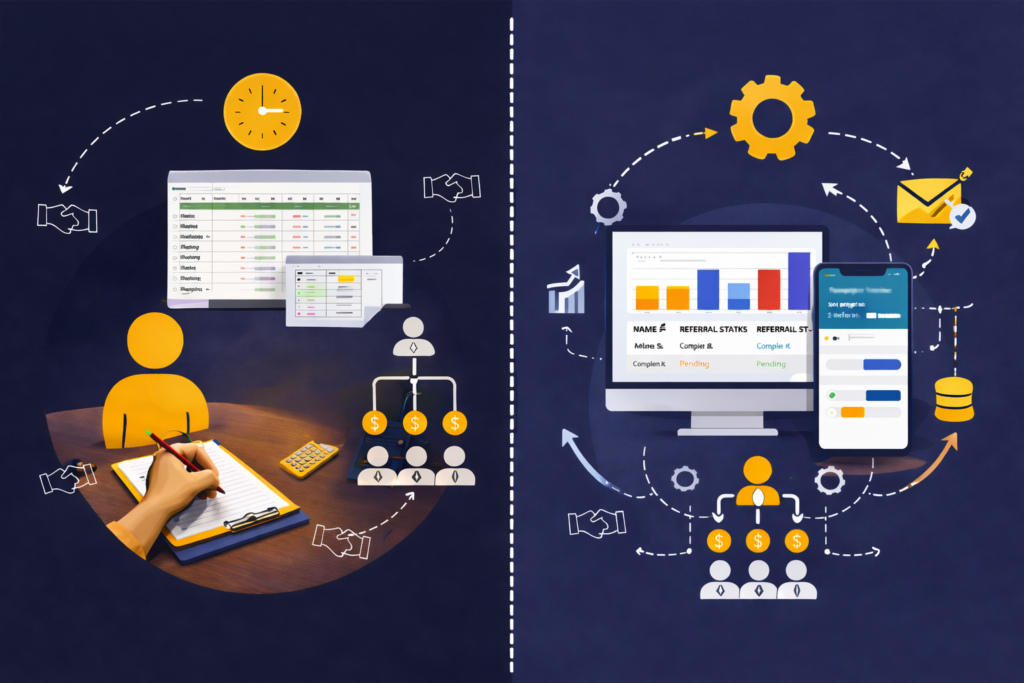
Most referral programs follow the same journey, whether teams realize it or not. They start with manual tracking because it feels quick and lightweight. As referrals increase, manual processes become messy. Eventually, automation becomes less of a nice-to-have and more of a necessity.
Manual referral tracking relies on people. Automated referral tracking relies on systems. The difference matters more than most teams expect.
Manual methods can work at very low volume, but they struggle with consistency, accuracy, and fraud. Automated methods remove guesswork, apply rules consistently, and make referrals something you can actually trust as a growth channel.
Understanding this progression helps you choose the right tactic for where your business is today, not where you hope it will be.
Why Tracking Referrals Matters
Referral tracking is not just an operational detail. It directly affects growth, trust, and decision-making across your business.
It allows you to prove the ROI of referrals
Without tracking, referrals feel anecdotal. With tracking, you can see exactly how many customers referrals bring in, how much they are worth, and how they compare to other acquisition channels. This is often the moment referrals start being taken seriously internally.
It ensures referrers are rewarded fairly
Referral programs run on trust. When rewards are missed, delayed, or assigned incorrectly, participation drops fast. Accurate tracking removes ambiguity and makes rewards predictable, which keeps people engaged.
It helps prevent referral fraud
Any incentive system can be abused if there are no guardrails. Proper tracking makes it far harder for people to refer themselves, create fake accounts, or exploit loopholes that quietly drain your budget.
It shows you who your strongest advocates are
Not all referrers contribute equally. Tracking reveals who refers often, who brings in high-quality customers, and who drives long-term value. That insight is impossible to get from manual guesswork.
It reveals which referral channels actually work
Whether referrals come from email, social sharing, direct links, or word of mouth, tracking shows which channels convert and which ones just create noise.
It gives you the data needed to improve the program
When referrals slow down or stop converting, tracking data points to where the problem is. Without that visibility, teams are left making changes based on intuition instead of evidence.
It builds confidence in the referral program
Clear tracking builds trust internally and externally. Teams trust the numbers, and customers trust that the program is fair and reliable.
What You Need Before You Start Tracking Referrals
Before choosing any tracking method, a few fundamentals need to be in place.
- A clearly defined referral action, such as a signup, purchase, or demo booking.
- A way to uniquely identify referrers, whether that is a unique referral link or account ID.
- A clear attribution rules so the system knows who gets credit.
- A defined reward trigger so everyone understands when a reward is earned.
Skipping these steps is one of the fastest ways to end up with tracking that looks fine on the surface but breaks under real usage.
9 Ways To Track Referrals, From Manual to Fully Automated
There is no single best way to track referrals for every business. The right method depends on volume, resources, and how important referrals are to your growth. Most businesses start with manual methods and gradually move toward automation as referrals become more important.
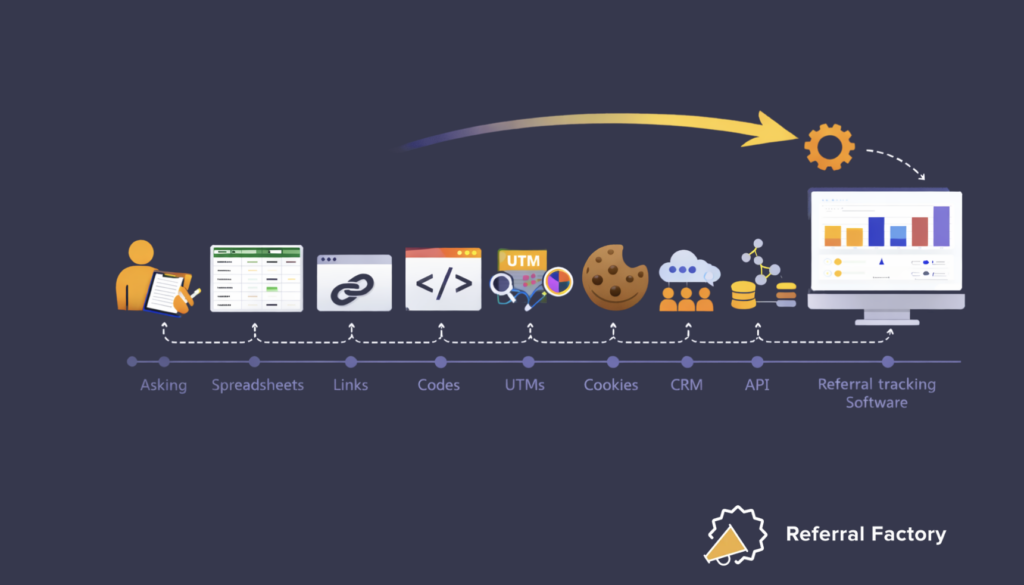
Below are the most common referral tracking tactics, ordered from manual to fully automated, with an honest look at where each one works and where it breaks down.
1. Asking “How did you hear about us?”(Manual)
This is the most common starting point. You ask new users to tell you who referred them, usually during signup or onboarding. It feels simple, but it quickly becomes unreliable. People forget names, spell them differently, or skip the question altogether. It also leaves you with no reliable way to reward referrers or prevent abuse. This approach is fine for early validation, but it does not scale.
Why teams use it: it’s easy and free
Why it fails: it’s subjective and impossible to scale
2. Spreadsheet-based referral tracking(Manual)
Some teams manually log referrals in spreadsheets and try to match referrers to conversions. This can work briefly at very low volume, but it quickly becomes time-consuming and error-prone. It also puts a heavy burden on whoever is responsible for keeping the spreadsheet up to date. Spreadsheets tend to collapse under the weight of real growth.
Why teams use it: early experimentation
Why it fails: manual effort, mistakes, no fraud protection
3. Referral links (Automated)
Creating a unique referral links give each referrer a unique URL. When someone clicks that link, the system automatically knows who made the referral. This is one of the most common and reliable tracking methods, especially for online businesses. It scales well and removes manual effort.
Why it works well: accurate attribution and easy sharing
Limitations: depends on attribution rules but is offset by easy of use and accuracy
4. Referral codes or coupons (Automated)
Referral codes allow referrers to share a simple code instead of a link. This works well when links are impractical, such as offline referrals, podcasts, or influencer campaigns. Codes are flexible and easy to remember, but they can spread publicly if not controlled. Without proper rules, this can lead to misuse.
Why it works well: flexible and easy to customize
Limitations: codes can spread publicly if not controlled
5. UTM parameters and analytics tools (Semi-automated)
UTMs pass referral data into analytics platforms like Google Analytics. This is useful for understanding traffic sources and campaign performance. The limitation is that analytics tools are not designed to manage referral rewards, long-term attribution, or fraud prevention. They show you what happened, but they do not manage the referral program itself. UTMs pass referral data into analytics platforms like Google Analytics. While useful for understanding traffic sources, they weren’t designed to handle rewards or long-term attribution.
Why teams use it: marketing attribution
Why it falls short: no reward logic or fraud protection
6. Cookie-based referral tracking (Automated)
Cookies store referral information in a user’s browser so the referrer can still be credited if the conversion happens later. This improves accuracy but introduces time and privacy limitations.
Why it works well: seamless user experience
Limitations: cookies expire and can be blocked
7. CRM-based referral tracking (Semi-automated)
Some teams track referrals directly in their CRM, particularly in B2B environments. This centralizes data, but it often requires custom workflows and manual steps. CRMs are powerful tools, but they are rarely built with referral logic in mind.
Why it works: good for sales visibility
Limitations: complex setup and not referral-specific
8. API or webhook-based referral tracking (Fully automated, developer-heavy)
At the fully automated end of the spectrum, some companies build custom referral tracking using APIs or webhooks. This approach offers complete flexibility and control, but it comes with a cost. It requires ongoing developer resources, careful maintenance, and slower iteration when rules need to change. For teams without dedicated engineering capacity, this approach is usually more expensive than it looks.
Why it works: full control and automation
Why it’s not ideal for most teams: high development cost and slower iteration
9. Referral tracking software(Fully automated, most practical)
Dedicated referral tracking software is built specifically to handle attribution, fraud prevention, rewards, and reporting without custom development. For most businesses, this is the most practical option. It combines the reliability of automation with the flexibility to adapt as your program evolves.
Why most businesses choose it: fast setup, fewer errors, and scalability
Trade-off: software cost, offset by saved time and accuracy
How Referral Tracking Software Works in Practice
Referral software exists to take the guesswork out of attribution and rewards, and to make referrals something you can actually rely on.
In practice, it usually works like this:
- A customer or user joins your referral program and is given a unique referral link or code
- When someone uses that link or code, the software automatically identifies the referrer
- Attribution rules determine what qualifies as a successful referral, such as a signup or purchase
- The system waits for those conditions to be met before taking any action
- Rewards are triggered automatically once the referral is verified
- All referral activity is recorded in a central dashboard for reporting and analysis
This keeps referral tracking consistent, fair, and scalable without adding manual work for your team.
How Referral Factory Tracks Referrals
Referral Factory brings multiple tracking methods together in one platform, making it the most effective referral tracking software on the market. It uses referral links which is the most reliable way to track referrals but it also integrates directly with tools like Stripe and HubSpot, Salesforce, and other CRMs, through Zapier, APIs, and webhooks.
The goal is to give teams flexible and reliable referral tracking without requiring ongoing developer involvement. For most businesses, that balance is what makes referral programs sustainable.
Referral Tracking Metrics Worth Paying Attention To
Tracking referrals is only useful if you know what to measure. The most important metrics usually include:
- number of referrals
- number of converted referrals
- referral conversion rate
- rewards issued
- which channels referral links are being shared on
Together, these metrics show whether your referral program is growing in a healthy and scalable way.
Common Referral Tracking Mistakes
Many referral programs struggle for the same reasons.
- they rely on manual tracking for too long.
- they try to use too many tools that don’t fully connect.
- they reward referrals before validating them.
- they don’t issue rewards a s soon as they are due
Most of these mistakes are easy to avoid once you understand how referral tracking actually works. And if you use plug and play referral software, this will all be taken care of for you.
Final Thoughts
Manual referral tracking can work briefly. Automated tracking works when referrals start to matter.
If referrals are an important part of your growth strategy, investing in proper tracking is not optional. It is the difference between a program that feels unreliable and one that becomes a repeatable, scalable channel.
Frequently Asked Questions About Referral Tracking
1. Can you track referrals without using referral software?
Yes, but only up to a point. Manual methods like asking “how did you hear about us” or tracking referrals in spreadsheets can work when volume is very low. As soon as referrals increase, these methods become unreliable, time-consuming, and difficult to audit. That’s usually when teams move to automated tracking.
2. What’s the difference between referral tracking and affiliate tracking?
Referral tracking usually focuses on customers or users referring people they know, often with simpler rewards and shorter attribution windows. Affiliate tracking is typically designed for professional marketers, larger payouts, and more complex commission structures. While the mechanics can overlap, the intent and use cases are different.
3. Can Google Analytics be used to track referrals?
Google Analytics can show where referral traffic comes from, but it isn’t designed to manage referral programs. It does not handle reward logic, attribution across devices, or fraud prevention. Many teams use analytics for visibility, but rely on dedicated tools to actually run referral programs.
4. How long should you track a referral for?
That depends on your sales cycle. For fast decisions, a shorter tracking window may be enough. For longer buying journeys, you need a longer attribution period so referrers don’t lose credit unfairly. The key is choosing a window that matches how your customers actually decide.
5. What’s the most reliable way to track referrals at scale?
For most growing businesses, dedicated referral tracking software is the most reliable option. It combines automated attribution, fraud prevention, and reward management in one system. This reduces manual effort and makes referral programs easier to trust as they grow.
Referral link generator (free)
We take your website, send it to Referral Factory, and provision a real referral program for your brand. The link you get is a live referral URL your customers can share, backed by tracking and rewards in the app - not a static "generator" preview. This is the fastest way to see what a real referral program would look like for your brand! Try it below...